
/2021/09/Marvin-Gaye.jpg)
/2018/11/Denise-Gordy.jpg)
/2009/12/Berry-Gordy.jpg)
/2009/12/Smokey-Robinson.jpg)
/2015/12/Teena-Marie.jpg)
/2009/11/Stevie-Wonder.jpg)
/2009/09/Jennifer-Aniston.jpg)
:strip_exif()/2015/09/GettyImages-476575299.jpg)
/2019/10/denzel-washington-1.jpg)
/2009/11/George-Clooney.jpg)
/2020/01/lopez3.jpg)
:strip_exif()/2009/09/P-Diddy.jpg)
/2019/04/rr.jpg)
/2018/03/GettyImages-821622848.jpg)
/2009/09/Cristiano-Ronaldo.jpg)
/2009/09/Brad-Pitt.jpg)
/2020/06/taylor.png)
What Was Marvin Gaye's Net Worth?
Marvin Gaye was an American singer-songwriter, musician, and record producer who had a net worth of -$9 million at the time of his death in 1984.
When he was killed, his estate was burdened with roughly $9 million in debt, much of it owed to the IRS for unpaid taxes. He died without a will, leaving his finances in disarray.
In the years leading up to his death, Gaye had been cash-strapped and sold the majority of his music royalty rights to Motown in order to address mounting obligations, though he retained his publishing rights. For several years after his death, the IRS seized virtually all income generated by his estate, which was earning approximately $1 million annually in royalties.
Despite his troubled finances, Gaye's artistic legacy is immeasurable. One of the most important figures in the history of soul and R&B, he helped transform Motown from a hit factory into a platform for personal expression and social commentary. Blessed with a silky tenor and a three-octave vocal range, he evolved from polished hitmaker to boundary-pushing auteur. Over the course of his career, he released 25 studio albums and placed 67 singles on the Billboard charts. He was posthumously inducted into the Rock and Roll Hall of Fame in 1987.
Early Life
Marvin Pentz Gay Jr. was born on April 2, 1939, in Washington, D.C. He later added the "e" to his last name professionally. His father, Marvin Gay Sr., was a strict minister in the Pentecostal House of God church, and his mother, Alberta, was a domestic worker.
Gaye began singing in church at age four and learned to play piano and drums at an early age. His upbringing was deeply religious but also marked by violence. He later spoke openly about the severe physical abuse he suffered at the hands of his father, an experience that would cast a long psychological shadow over his life.
He attended several Washington schools, including Spingarn High School and Cardozo High School, where he sang in doo-wop groups. At 17, he dropped out and enlisted in the U.S. Air Force. Disillusioned with military life, he feigned mental illness and was discharged shortly thereafter.
Early Career and Motown Breakthrough
After leaving the Air Force, Gaye joined a vocal group called the Marquees. Through connections with Harvey Fuqua, the group evolved into the New Moonglows and eventually caught the attention of Berry Gordy Jr., founder of Motown Records.
Although Gordy was not interested in signing the group, he recognized Gaye's potential as a solo artist. In 1961, Gaye signed with Motown's Tamla label. Ironically, his earliest success at the label came not as a singer but as a session drummer, playing on early hits by artists like Smokey Robinson.
His early singles struggled commercially, but 1962's "Stubborn Kind of Fellow" gave him his first taste of success. By the mid-1960s, he was a consistent chart presence with hits such as "Hitch Hike," "Can I Get a Witness," "Ain't That Peculiar," and "How Sweet It Is (To Be Loved by You)."
In 1968, "I Heard It Through the Grapevine" became his biggest hit to date, reaching #1 and cementing his status as one of Motown's premier stars.
Duets and Mainstream Stardom
Gaye also recorded a series of successful duet albums, most memorably with Tammi Terrell. Together they produced enduring classics including "Ain't No Mountain High Enough," "Your Precious Love," and "Ain't Nothing Like the Real Thing." The chemistry between Gaye and Terrell was undeniable, and her death from a brain tumor in 1970 devastated him emotionally.
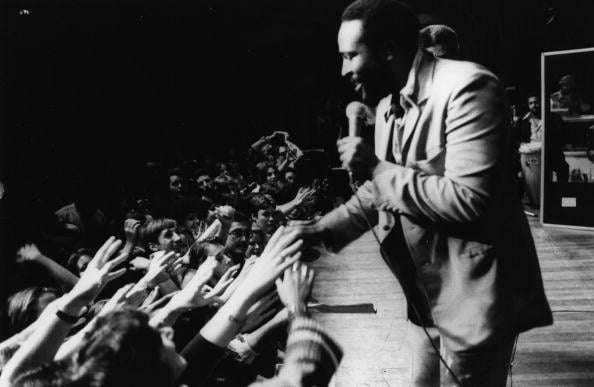
By the end of the 1960s, Gaye had established himself as both a romantic balladeer and a charismatic stage presence. His sensual style and tailored suits earned him the nicknames "Prince of Motown" and "Prince of Soul."
Getty Images
"What's Going On" and Artistic Independence
In 1971, Gaye fundamentally changed the trajectory of soul music with the release of "What's Going On." Frustrated with Motown's assembly-line approach, he insisted on producing and arranging the album himself.
The result was groundbreaking. Addressing themes such as the Vietnam War, police brutality, environmental destruction, and urban poverty, "What's Going On" became the first major album by a Black pop artist to directly confront contemporary social issues. It was both a commercial success and a critical milestone, influencing artists such as Stevie Wonder and Curtis Mayfield.
The album redefined Gaye as an artist of conscience and creative autonomy.
Sensual Reinvention and 1970s Success
Gaye followed his socially conscious phase with a pivot back toward intimacy and romance. In 1973, he released "Let's Get It On," whose title track became one of the most overtly sensual hits in pop music history.
Subsequent albums, including "I Want You" and the ambitious divorce-inspired double album "Here, My Dear," showcased his growing sophistication as a writer and producer. "Here, My Dear," inspired by his divorce from Anna Gordy, was a deeply personal and musically adventurous project that initially underperformed but later gained critical acclaim.
By the late 1970s, Gaye was blending soul, jazz, funk, African rhythms, and Caribbean influences into a uniquely textured sound.
Comeback with "Midnight Love"
After years of personal turmoil, drug dependency, and tax troubles, Gaye left Motown and signed with Columbia Records. In 1982, he released "Midnight Love," which became one of the biggest commercial successes of his career.
The single "Sexual Healing" earned him two Grammy Awards and restored him to mainstream prominence. The album went multi-platinum and reintroduced him to a new generation of listeners.
In 1983, he returned to the stage with triumphant shows at Radio City Music Hall, signaling what appeared to be a full career revival.
Personal Life
Marvin married Anna Gordy, the sister of Berry Gordy, on January 8, 1964. Anna was 17 years his senior. In 1965, Anna's niece Denise Gordy gave birth to a son. It would later be revealed that Marvin was the biological father of the boy, who was named Marvin III. Denise had turned 16 just six days after she gave birth to Marvin III. Marvin II was 26. Anna was 43. Marvin and Anna adopted the boy. They divorced 1977.
Marvin married Janis Hunter on October 10, 1977. They welcomed daughter Nona on September 4, 1974, and son Frankie on November 16, 1975. Marvin and Janis divorced in 1981.
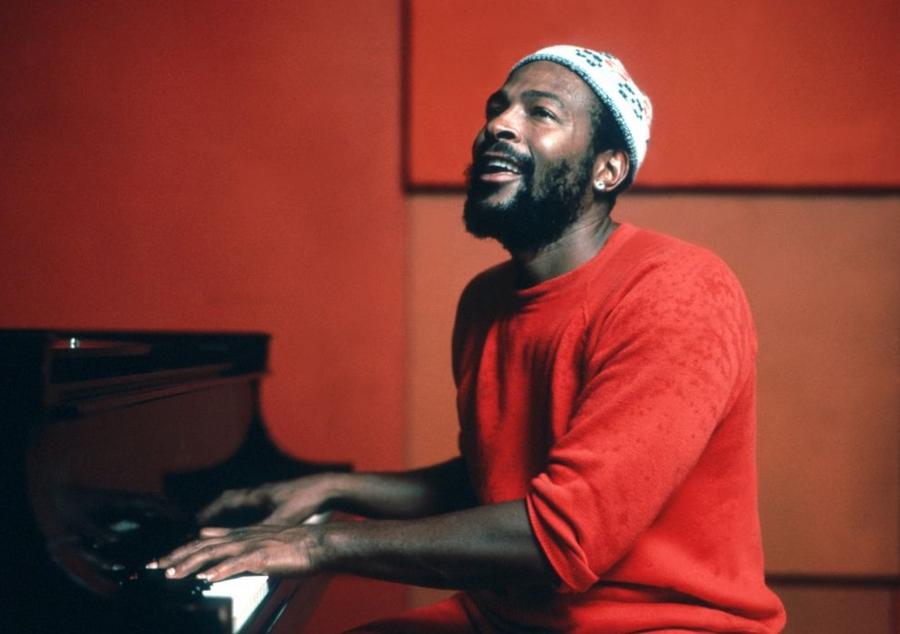
Gaye used marijuana throughout his life, and he began using cocaine in the early '60s. He also used PCP, and his drug use reportedly caused him to become depressed and paranoid. Marvin attempted suicide in 1969, but Berry Gordy's father stopped Gaye from shooting himself. Ten years later, Marvin attempted suicide again by ingesting an ounce of cocaine. According to his sister, Gaye attempted suicide again four days before his death by jumping out of a moving car.
(Photo by Jim Britt/Michael Ochs Archives/Getty Images)
Death
On April 1, 1984, Marvin intervened when his parents were fighting at the family home in Los Angeles. The situation escalated, and Gaye and his father got into a physical altercation. Marvin Sr. shot his son in the chest and shoulder with a gun that Gaye had given him as a gift. Marvin was pronounced dead at California Hospital Medical Center at 1:01 p.m., less than 30 minutes after the shooting took place. Gaye's brother Frankie revealed that as Marvin was dying, he said, "I got what I wanted… I couldn't do it myself, so I had him do it… it's good, I ran my race, there's no more left in me."
On April 5th, more than 10,000 mourners attended Gaye's funeral at Forest Lawn Memorial Park, and Marvin's body was cremated; Gaye's ex-wife Anna and his three children spread half of his ashes near the Pacific Ocean. Marvin died without a will, so 17-year-old Marvin III became co-administrator of the estate. Gaye was in debt at the time of his death, but the debts were eventually paid off by royalties from his music. Marvin's father was charged with first degree murder, but after it was discovered that he had a brain tumor, the charges were reduced to voluntary manslaughter. He received a suspended sentence of six years plus five years of probation.
Awards and Nominations
Gaye posthumously received a Grammy Lifetime Achievement Award in 1996, and he won two Grammys in 1983, Best R&B Vocal Performance, Male for "Sexual Healing" and Best R&B Instrumental Performance for "Sexual Healing (Instrumental Version)." He earned ten other Grammy nominations: Best Rhythm & Blues Group Performance, Vocal or Instrumental for "Ain't No Mountain High Enough" (1968), Best Rhythm & Blues Vocal Performance, Male for "I Heard It Through The Grapevine" (1969), Best R&B Instrumental Performance for "After The Dance" (1977), Best Rhythm & Blues Song for "Sexual Healing" (1983), and Best R&B Vocal Performance, Male for "Inner City Blues (Make You Wanna Holler)" (1972), "Let's Get It On" (1974), "Marvin Gaye – Live" (1975), "I Want You" (1977), "Got To Give It Up (Part I)" (1978), and "Midnight Love" (1984). Jack Black's performance of "Let's Get It On" in the film "High Fidelity" earned Marvin a posthumous Online Film & Television Association Award nomination for Best Music, Adapted Song in 2001.
Gaye was inducted into the NAACP Image Awards Hall of Fame in 1988, and he received a star on the Hollywood Walk of Fame in 1990. Marvin was also posthumously inducted into the Michigan Rock and Roll Legends Hall of Fame (2005), Rhythm and Blues Music Hall of Fame (2014), and Songwriters Hall of Fame (2016). In 2006, Washington, D.C.'s Watts Branch Park was renamed Marvin Gaye Park, and in 2009, the 5200 block of Foote Street NE (which is an entrance to the park) officially became known as Marvin Gaye Way. In 2019, the United States Postal Service released a stamp featuring Marvin's image as part of their Music Icons series.
/2021/09/Marvin-Gaye.jpg)
/2009/11/Stevie-Wonder.jpg)
/2018/06/GettyImages-800829628.jpg)
/2023/04/GettyImages-1485761642.jpg)
/2014/03/GettyImages-459136534.jpg)
/2009/12/Smokey-Robinson.jpg)
/2022/02/nina-simone.png)
/2017/02/GettyImages-528215436.jpg)
/2020/02/Angelina-Jolie.png)