
/2010/06/Pete-Carroll.jpg)
/2026/02/Mike-Macdonald.jpg)
/2015/01/Josh-McDaniels.jpg)
/2013/09/jr.jpg)
/2016/01/GettyImages-84075994.jpg)
/2010/11/Bill-Belichick.jpg)
/2009/09/Cristiano-Ronaldo.jpg)
/2017/02/GettyImages-528215436.jpg)
/2009/09/Brad-Pitt.jpg)
/2018/03/GettyImages-821622848.jpg)
/2019/10/denzel-washington-1.jpg)
:strip_exif()/2009/09/P-Diddy.jpg)
/2019/04/rr.jpg)
:strip_exif()/2015/09/GettyImages-476575299.jpg)
/2020/06/taylor.png)
/2020/01/lopez3.jpg)
/2009/09/Jennifer-Aniston.jpg)
What is Pete Carroll's Net Worth and Salary?
Pete Carroll is an American football coach who has a net worth of $70 million and an annual salary of $15 million. Pete Carroll is best known for his long and successful tenure with the Seattle Seahawks and his earlier dominance at the University of Southern California (USC). Known for his energetic personality and upbeat coaching style, Carroll built a reputation as one of the most accomplished and resilient figures in modern football, achieving rare success at both the college and professional levels.
After early assistant coaching roles in college and the NFL, Carroll became head coach of the New York Jets in 1994 and later the New England Patriots from 1997 to 1999. His first two head coaching stints were short-lived, but they laid the groundwork for his eventual resurgence. In 2001, Carroll took over the USC football program, transforming it into a powerhouse. Under his leadership, USC won two national championships (one later vacated) and produced multiple Heisman Trophy winners, including Carson Palmer, Matt Leinart, and Reggie Bush. Carroll's "Win Forever" philosophy emphasized competition, positivity, and relentless preparation, becoming a cornerstone of his coaching identity.
In 2010, Carroll returned to the NFL as head coach and executive vice president of the Seattle Seahawks. There, he built one of the league's most dominant defenses—the "Legion of Boom"—and guided the team to its first-ever Super Bowl victory in 2014 with a decisive win over the Denver Broncos. The following year, Seattle returned to the Super Bowl but lost in dramatic fashion to the New England Patriots. Carroll's Seahawks teams were consistent playoff contenders for over a decade, known for physical play and strong locker-room culture. In 2025, Pete was hired to be the head coach of the Las Vegas Raiders. He was fired after one season.
Pete Carroll, Jimmy Johnson, and Barry Switzer are the only three coaches to have won a Super Bowl and a college football national championship.
Salary
As the head coach and executive vice president of the Seattle Seahawks, Pete Carroll's salary was $15 million per year. He had been earning $8 million per year up until signing a five-year extension in 2020. In April 2025, Pete signed a three-year, $45 million contract to coach the Las Vegas Raiders. He was fired after one season but will earn roughly $30 million to do nothing. He's certainly come a long way from the $182 per week he earned when he first took an assistant coaching job at the University of Arkansas under coaching legend Lou Holtz!
Early Life
Pete Clay Carroll was born on September 15, 1951, in San Francisco, California, and raised in the nearby community of Greenbrae. From a young age, Carroll was known for his boundless energy and competitiveness, traits that would later define his coaching philosophy. At Redwood High School, he emerged as a multi-sport standout despite his relatively slight build. He played quarterback, defensive back, and wide receiver on the football team, while also excelling in basketball and baseball. His athletic versatility earned him the school's Athlete of the Year award as a senior.
After graduation, Carroll attended the College of Marin, where he continued to play football, before transferring to the University of the Pacific in Stockton, California. There, he played free safety for two seasons and earned All-Pacific Coast honors. He graduated in 1973 with a Bachelor of Science in Business Administration. Carroll briefly pursued a professional playing career and tried out for the World Football League, but his size and recurring shoulder problems ended those aspirations. He worked for a time selling roofing materials, but soon realized his passion was on the sidelines. Encouraged by his former college coach, Chester Caddas, Carroll returned to the University of the Pacific as a graduate assistant, launching what would become a decades-long coaching career.
Early Coaching Apprenticeship
Carroll's coaching path began at his alma mater, the University of the Pacific, where he joined the staff as a graduate assistant in the mid-1970s while also earning a master's degree in physical education in 1976. Those early years helped define the tone that would follow him throughout his career: high energy, relentlessly positive, and intensely detail-oriented, especially on the defensive side of the ball. After Pacific, he caught a major break when Lou Holtz hired him as a graduate assistant at the University of Arkansas, a job that widened his network and exposed him to elite programs and big-stage pressure.
From there, Carroll climbed quickly through college football, taking roles at Iowa State and Ohio State before becoming defensive coordinator at North Carolina State. Even in those early stops, he was building a reputation as a secondary specialist and a coach who could teach technique while keeping practices upbeat and competitive. He briefly returned to Pacific in a senior assistant role before making the leap that would begin his long relationship with professional football.
NFL Assistant and Early Head Coaching Lessons
Carroll entered the NFL in 1984 as defensive backs coach of the Buffalo Bills, then spent several seasons with the Minnesota Vikings, where his units were regularly viewed as well-prepared and aggressive. In 1990 he joined the New York Jets as defensive coordinator, and in 1994 he was promoted to head coach. His Jets season started with promise, but it ended in disappointment and a quick exit. One defining moment came in a loss to the Miami Dolphins when Dan Marino pulled off the famous fake-spike "clock play," a dramatic late-game touchdown that helped spark a late-season collapse. The Jets finished 6–10, and Carroll was fired after one season.
He landed on his feet as defensive coordinator of the San Francisco 49ers in 1995 and 1996, then returned to the head coach chair in 1997 with the New England Patriots, replacing Bill Parcells. Carroll's first Patriots team won the AFC East, and he reached the playoffs twice in three seasons, but the tenure never fully stabilized and he was dismissed after the 1999 season. After two NFL head coaching stops that ended quickly, Carroll spent 2000 largely outside the traditional coaching pipeline, doing consulting work, charitable efforts connected to the league, and media analysis, a reset that set the stage for the most important pivot of his career.
USC: A College Dynasty and a Complicated Ending
Carroll took over at USC in late 2000 after a messy coaching search in which several primary targets turned the job down. The hire was criticized at the time, partly because Carroll had been away from college coaching for years and partly because of his uneven NFL head coaching record. Within a short window, those doubts vanished. USC quickly became a national power, driven by elite recruiting, a dominant defense-first identity, and a culture that made top prospects want to be part of the program. Carroll's teams won seven straight Pac-10 titles, produced three Heisman Trophy winners, and spent extended stretches near the top of the national polls.
The program also authored one of the defining runs of the era, including a massive winning streak that made USC the sport's measuring stick. USC's on-field accomplishments during this period were later clouded by NCAA sanctions tied largely to improper benefits involving Reggie Bush. Some wins and a championship from that era were vacated after the fact, but Carroll remained widely credited with rebuilding USC into a powerhouse and reshaping the expectations for West Coast college football.
Seattle Seahawks: "Win Forever," Legion of Boom, and a Super Bowl
Carroll returned to the NFL in 2010 as head coach of the Seattle Seahawks and, crucially, as the executive in charge of football operations. Early results were uneven, but the foundation was clear: compete every day, draft and develop aggressively, and build around a defense that could dictate games. In 2010, Seattle won the NFC West at 7–9 and delivered a signature playoff moment when Marshawn Lynch's "Beast Quake" run sealed a postseason win that became part of NFL lore.
As the roster matured, Carroll's Seahawks became one of the league's defining teams of the decade, powered by the "Legion of Boom" defense and, later, Russell Wilson at quarterback. Seattle won Super Bowl XLVIII in dominant fashion and reached the Super Bowl again the following season, losing a heartbreaker to the Patriots after a late interception at the goal line. Over 14 seasons as head coach, Carroll made the Seahawks perennial contenders, with repeated playoff trips and division titles, and he finished as the winningest head coach in franchise history.
After the 2023 season, Carroll stepped down as head coach and moved into an advisory role with the organization, effectively closing one of the most successful coaching runs of the modern NFL.
Las Vegas Raiders Return and One-Season Tenure
Carroll returned to the sideline in 2025 as head coach of the Las Vegas Raiders. The reunion with quarterback Geno Smith, along with a new offensive direction that included hiring Chip Kelly as offensive coordinator and bringing his son Brennan onto the staff, signaled an attempt to jump-start the franchise quickly. The results did not follow. The Raiders finished with the league's worst record, and Carroll was fired on January 5, 2026, ending a brief final chapter that contrasted sharply with the sustained success he enjoyed at USC and in Seattle.
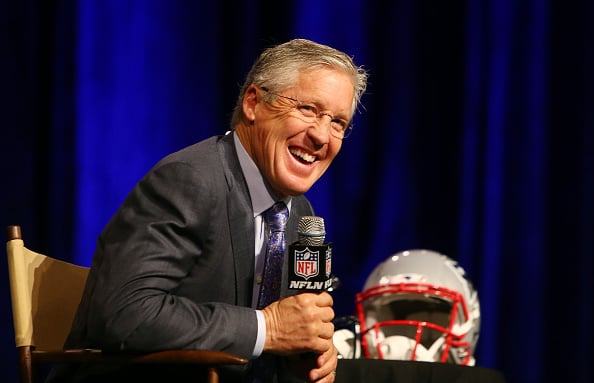
Mike Lawrie/Getty Images
Coaching Style
Pete Carroll is known for his aggressive, "all or nothing" coaching style, which has earned him the nickname "Big Balls Pete." He frequently chooses to "go for it" on fourth down instead of punting. After taking control of the Seahawks, Carroll earned significant praise for transforming the team's defensive strategy. The defense became known as the "Legion of Boom," which led the NFL in scoring defense for four years in a row.
From a more psychological standpoint, Carroll advocates clear thinking and "removing the clutter" from the sport. He is influenced by figures such as Carl Jung, Zen masters, and Buddhist meditation masters. Pete gained a reputation for being lighthearted during his time at USC, and he regularly staged pranks and special events to lighten the mood of his players. That said, he can also be incredibly strict. A good example of this is the fact that he closely controlled the diets of his players at USC.
Real Estate
In 2015, Pete Carroll sold his home in Hunts Point, a small town in the greater Seattle metropolitan area, for $6.1 million. He and his wife, Glena, purchased the property less than a year prior for $5.9 million. It was unclear why the Carrolls chose to move on so quickly, as they clearly didn't earn much of a return. The residence features three bedrooms and spans 3,860 square feet. Additional highlights include a detached guest suite, a moorage dock, and a private beach.
In 2016, Pete sold another home in Manhattan Beach, California. The beach cottage sold for $2.05 million, which was $50,000 more than the asking price. Spanning 1,200 square feet, the cottage offers exceptional ocean views, two bedrooms, and a brick patio. Carroll had been holding onto this residence for many years, as he originally purchased it back in 1999 for just $540,000. For some time, Pete was renting it out for $4,500 per month.
In 2017, Carroll sold yet another home in Rolling Hills, Washington. The $3.05-million off-market deal concluded three years of notable real estate transactions for Pete, and it seems as though he was in the mood to cash in on these investments. Set in a corner lot on a private street, the 1950s home features just one story. That being said, it is quite spacious, with 4,000 square feet of living space and four bedrooms. Highlights include cathedral-style vaulted ceilings, French doors, four fireplaces, and skylights. Outside, the home features a patio, a swimming pool, a putting green, a spa, and exceptional views of the surrounding greenbelt and park areas.
/2010/06/Pete-Carroll.jpg)
/2010/11/Bill-Belichick.jpg)
/2015/01/Josh-McDaniels.jpg)
/2010/11/GettyImages-116615276.jpg)
/2013/09/jr.jpg)
/2015/07/Lane-Kiffin.jpg)
/2016/01/GettyImages-84075994.jpg)
/2014/12/GettyImages-852640274.jpg)
/2019/11/GettyImages-1094653148.jpg)
/2020/02/Angelina-Jolie.png)
/2009/11/George-Clooney.jpg)