
/2010/05/Shigeru-Miyamoto.png)
/2026/03/Will-Wright.png)
/2014/06/GettyImages-135478301.jpg)
/2016/01/Vince-Zampella.jpg)
/2017/01/Josef-Fares-1.jpg)
/2018/04/Satoru-Iwata.jpg)
/2009/09/Brad-Pitt.jpg)
/2017/02/GettyImages-528215436.jpg)
/2009/09/Cristiano-Ronaldo.jpg)
/2018/03/GettyImages-821622848.jpg)
/2020/04/Megan-Fox.jpg)
/2019/11/GettyImages-1094653148.jpg)
/2019/10/denzel-washington-1.jpg)
:strip_exif()/2015/09/GettyImages-476575299.jpg)
/2019/04/rr.jpg)
/2009/09/Jennifer-Aniston.jpg)
/2009/11/George-Clooney.jpg)
What is Shigeru Miyamoto's Net Worth and Salary?
Shigeru Miyamoto is a Japanese producer and video game designer who has a net worth of $50 million. Shigeru Miyamoto is widely regarded as one of the most influential creative forces in modern entertainment. Over a career spanning more than four decades, he shaped the video game industry through a combination of imaginative world-building, intuitive gameplay philosophy, and a deep belief that games should spark joy for players of all ages.
Miyamoto joined Nintendo when it was still a modest toy company and became the architect behind many of the most enduring franchises in gaming history, including "Super Mario Bros.," "The Legend of Zelda," "Donkey Kong," "Star Fox," and "Pikmin." His work not only propelled Nintendo into a global powerhouse but also redefined what interactive entertainment could be. From the early arcade era to modern consoles and theme-park integrations, Miyamoto's design approach has remained rooted in accessibility, emotional resonance, and a childlike sense of wonder.
He has long been described as the "Walt Disney of video games," a comparison earned through his rare ability to create characters and stories that transcend generations, genres, and platforms. Today, his creative legacy continues to influence every corner of the medium, as Nintendo's biggest franchises remain built on foundations he established decades earlier.
Early Life
Shigeru Miyamoto was born on November 16, 1952, in Sonobe, a rural town outside Kyoto. His father was a schoolteacher, and his family lived a modest lifestyle surrounded by nature, mountains, and wooded paths. Those landscapes would later inspire the sense of exploration that defines many of his games. As a child, Miyamoto spent hours wandering through local caves, forests, and hidden nooks around his village. He often cited these adventures as the direct inspiration for the structure and atmosphere of "The Legend of Zelda."
Miyamoto developed an early interest in drawing, painting, and storytelling, and he created comic strips throughout his youth. After high school, he studied industrial design at the Kanazawa Municipal College of Industrial Arts, where he refined his artistic and mechanical thinking. Although he didn't initially plan for a career in games, his technical and artistic skills positioned him perfectly for the medium that was about to emerge as a global cultural force.
Career Beginnings at Nintendo
In 1977, Miyamoto's father helped arrange a meeting with Nintendo president Hiroshi Yamauchi. The company was still focused on toys and playing cards, but it was beginning to explore electronic entertainment. Yamauchi hired Miyamoto as an apprentice designer, initially assigning him to create artwork and packaging for toys and arcade products.
His breakthrough came in 1981, when Nintendo needed a new arcade game to replace a failing machine. Miyamoto was given the opportunity to design an entirely new concept, resulting in "Donkey Kong." The game introduced the characters who would later become Mario and Donkey Kong, brought personality into arcade gameplay, and demonstrated Miyamoto's instincts for character-driven design. It was a massive hit and marked the beginning of a new era for Nintendo.
The Rise of Mario
After the success of "Donkey Kong," Miyamoto developed "Mario Bros." in 1983, and then "Super Mario Bros." in 1985 for the Nintendo Entertainment System. "Super Mario Bros." became one of the most influential and best-selling video games of all time. Its level design, dynamic platforming, and hidden secrets set standards the industry still follows today.
Mario quickly became Nintendo's flagship character and one of the most recognizable icons in global pop culture. Miyamoto's design philosophy centered on intuitive gameplay that players could understand instantly, even without instructions. This approach helped establish Nintendo as a leader in home gaming and positioned Mario as a household name.
Creating "The Legend of Zelda"
In 1986, Miyamoto co-created "The Legend of Zelda," a groundbreaking action-adventure game inspired directly by his childhood explorations. Unlike the linear progression of "Super Mario Bros.," "Zelda" encouraged open-ended discovery, puzzle-solving, and a deeper narrative experience. Its non-linear structure and save-feature mechanics pushed gaming into more ambitious storytelling territory.
The franchise went on to become one of the most critically acclaimed in gaming history. Generations of players have experienced Miyamoto's core idea that exploration should feel personal, inspiring, and unpredictable.
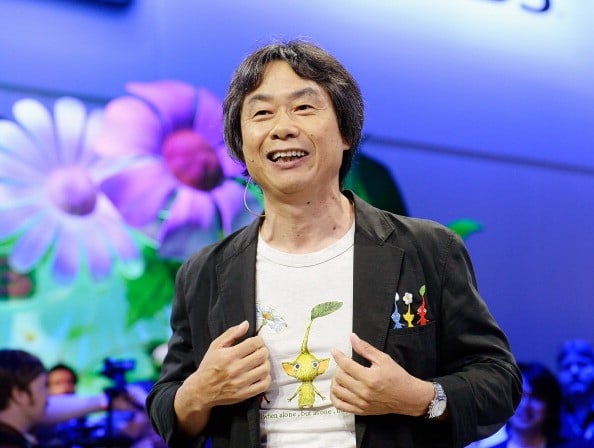
Kevork Djansezian / Getty Images
Innovation and Expanding Nintendo's Universe
Throughout the 1990s and early 2000s, Miyamoto played pivotal creative roles as Nintendo launched new hardware and expanded its character library. He worked on "Star Fox," one of the first console games to incorporate real-time 3D graphics, and oversaw the transition of major franchises into three-dimensional gameplay with titles such as "Super Mario 64" and "The Legend of Zelda: Ocarina of Time." Both are widely considered among the greatest games ever made.
Miyamoto also championed more experimental concepts. In 2001, he created "Pikmin," a strategy and puzzle series inspired by observing ants and gardening in his backyard. Years later, he played a key role in the design philosophy behind the Wii console, emphasizing movement, accessibility, and family-oriented gameplay. The Wii became one of the best-selling systems in history.
Leadership and Later Career
As Miyamoto's reputation grew, he moved into more senior creative and supervisory roles at Nintendo while continuing to shape the direction of major projects. He became one of the company's most visible public figures and was instrumental in developing the Nintendo DS, Wii, Nintendo 3DS, Wii U, and Nintendo Switch eras. He has served as a producer, mentor, and creative overseer for many of Nintendo's studios, bringing a consistent design philosophy to a wide range of projects.
In later years, Miyamoto also expanded Nintendo's presence into theme parks and film. He helped guide the development of Super Nintendo World attractions at Universal Studios and served as a key advisor on "The Super Mario Bros. Movie," which became a global success.
Awards and Legacy
Shigeru Miyamoto's contributions have been recognized with numerous honors, including induction into the Academy of Interactive Arts and Sciences Hall of Fame and receiving Spain's prestigious Prince of Asturias Award for Communications and Humanities. His work has influenced countless developers, artistic mediums, and pop-culture traditions. Few figures in entertainment have created as many franchises, characters, and worlds that remain relevant across multiple generations.
His legacy is not only defined by iconic games but also by a philosophy rooted in curiosity, creativity, and emotional connection. Whether designing a simple platformer or a vast adventure, Miyamoto consistently prioritizes the player's sense of discovery and delight.
Personal Philosophy and Influence
Miyamoto has always emphasized the importance of playfulness, even in adulthood. He often draws inspiration from ordinary activities, observing life's small details and turning them into gameplay concepts. This mindset helped redefine the boundaries of game design and positioned Nintendo as a studio that values imagination over technical escalation.
His influence extends far beyond gaming. Mario, Link, and other Miyamoto-created characters are cultural landmarks known across languages and continents. His designs have inspired films, merchandise, music, academic study, and entire generations of creative professionals.
Shigeru Miyamoto's work continues to guide Nintendo's creative identity. His body of work stands as one of the most remarkable creative legacies in modern entertainment, showing how a simple idea, executed with heart, can inspire millions for decades.
/2010/05/Shigeru-Miyamoto.png)
/2018/04/Satoru-Iwata.jpg)
/2026/03/Will-Wright.png)
/2017/01/Josef-Fares-1.jpg)
/2014/06/GettyImages-135478301.jpg)
/2016/01/Vince-Zampella.jpg)
/2019/06/dm.jpg)
/2020/04/ps.jpg)
/2020/02/Angelina-Jolie.png)
/2020/06/taylor.png)
:strip_exif()/2009/09/P-Diddy.jpg)
/2020/01/lopez3.jpg)