
/2013/12/GettyImages-146366927.jpg)
/2009/09/Celine-Dion-1.jpg)
/2013/09/Roy-Bittan.jpg)
/2015/10/Bonnie-Tyler.jpg)
/2015/02/David-Essex.jpg)
/2016/01/GettyImages-168561629.jpg)
/2020/04/Megan-Fox.jpg)
/2009/09/Jennifer-Aniston.jpg)
/2009/09/Cristiano-Ronaldo.jpg)
/2019/10/denzel-washington-1.jpg)
:strip_exif()/2009/09/P-Diddy.jpg)
:strip_exif()/2015/09/GettyImages-476575299.jpg)
/2009/11/George-Clooney.jpg)
/2020/02/Angelina-Jolie.png)
/2017/02/GettyImages-528215436.jpg)
/2009/09/Brad-Pitt.jpg)
/2018/03/GettyImages-821622848.jpg)
What was Jim Steinman's net worth?
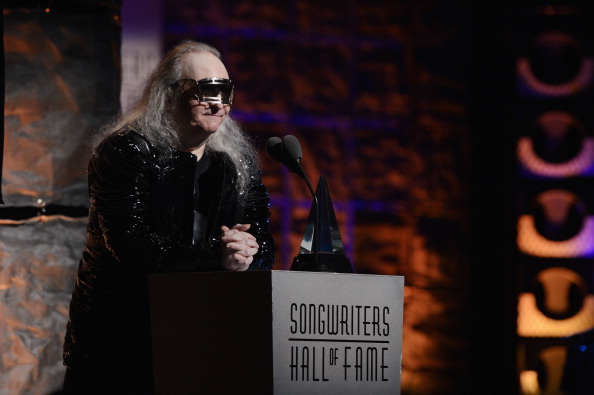
Jim Steinman is an American lyricist, composer, and record producer who has a net worth of $10 million.
Jim Steinman was one of the most distinctive and polarizing songwriters of the rock era, a composer whose operatic instincts, maximalist imagery, and unapologetic melodrama produced some of the biggest and most enduring pop and rock hits of the late 20th century. Best known as the creative force behind Meat Loaf's landmark 1977 album "Bat Out of Hell," Steinman specialized in songs that sounded less like radio singles and more like miniature musicals, full of crashing crescendos, spoken-word interludes, and larger-than-life emotions. At a time when punk and disco dominated the charts, Steinman doubled down on excess, writing sprawling epics that rejected subtlety entirely. The gamble paid off. "Bat Out of Hell" became one of the best-selling albums in music history, selling tens of millions of copies worldwide and spawning a decades-long creative partnership that defined both men's careers.
Beyond Meat Loaf, Steinman wrote major hits for artists as diverse as Bonnie Tyler and Celine Dion, proving that his theatrical sensibility could cross genres and generations. Though critics sometimes dismissed his work as overblown or indulgent, his songs proved remarkably durable, continuing to resonate long after trends shifted. Steinman's career was built on the belief that art should aim for extremes, and few popular songwriters ever pushed that philosophy further.
Early Life
James Richard Steinman was born on November 1, 1947, in Hewlett, New York, on Long Island. His father, Louis Steinman, owned a steel distribution business, while his mother, Eleanor, was a Latin teacher. Steinman developed an early fascination with classical and operatic music, influences that would later shape his highly dramatic compositional style. He attended Amherst College in Massachusetts, where he studied drama and music and quickly gained a reputation as an eccentric but ambitious creative presence. By his own account, his academic performance was uneven, but his artistic output was prolific. While still a student, he wrote and staged an original musical called "The Dream Engine," which attracted attention beyond the campus and helped set the course for his professional life.
Theater Roots and Meeting Meat Loaf
After graduating from Amherst, Steinman's early career unfolded primarily in the theater world. His work on "The Dream Engine" led to an introduction to Joseph Papp of the New York Shakespeare Festival, who commissioned Steinman to help write the musical "More Than You Deserve," which premiered at the Public Theater in 1974. One of the cast members was Marvin Lee Aday, later known as Meat Loaf. The collaboration proved pivotal. Steinman's grand, emotionally charged songs and Meat Loaf's powerful, theatrical voice turned out to be a perfect match. The two continued working together in various stage productions and touring shows, gradually developing material that would evolve into something much bigger.
"Bat Out of Hell"
Steinman originally conceived many of the songs that became "Bat Out of Hell" as part of a futuristic, post-apocalyptic musical inspired loosely by "Peter Pan." Unable to secure the rights he wanted, he reworked the material into a rock album. The result was defiantly unconventional. The album contained only seven tracks, most of them far longer than standard radio fare, including the nearly ten-minute title track and the eight-and-a-half-minute "Paradise by the Dashboard Light," which famously featured baseball-style play-by-play narration and a duet with Ellen Foley.
The project struggled to find industry support. Multiple record labels passed on the album, uncertain how to market something so bombastic and out of step with prevailing trends. Producer Todd Rundgren eventually signed on, and the album was released by Cleveland International Records. Initial sales were slow, but relentless touring and grassroots radio support helped it gain momentum. Over time, "Bat Out of Hell" became one of the best-selling albums of all time, regularly appearing near the top of global sales rankings alongside records like "Thriller" and "Hotel California."
Getty Images
Songwriting Beyond Meat Loaf
Although "Bat Out of Hell" defined Steinman's public reputation, his songwriting career extended far beyond that single collaboration. In 1983, he wrote Bonnie Tyler's chart-topping power ballad "Total Eclipse of the Heart," a song that distilled his operatic sensibility into a concise pop format without sacrificing drama. He later wrote "It's All Coming Back to Me Now," which became a major international hit for Celine Dion in the mid-1990s. Steinman also worked in musical theater, serving as lyricist for Andrew Lloyd Webber's "Whistle Down the Wind" and composing the score for "Tanz der Vampire," a vampire-themed musical that enjoyed long-running success in Europe.
Return to Meat Loaf and Later Projects
Steinman reunited with Meat Loaf for "Bat Out of Hell II: Back Into Hell" in 1993, which produced another massive hit with "I'd Do Anything for Love (but I Won't Do That)." The album reaffirmed the enduring appeal of their collaboration and introduced Steinman's style to a new generation of listeners. While later projects were sometimes marked by legal disputes and creative disagreements, the partnership never fully dissolved. Meat Loaf continued recording Steinman's songs well into the 2000s and 2010s, including albums like "Braver Than We Are."
Steinman also returned to his original theatrical ambitions with "Bat Out of Hell: The Musical," which premiered in Manchester in 2017 before reaching London and New York. The show finally realized his long-held vision of the material as a stage production, closing the loop on an idea that had been decades in the making.
Style, Reputation, and Legacy
Steinman's work was instantly recognizable. His songs favored maximal emotion, vivid imagery, and sweeping musical structures. Critics often accused him of excess, but fans embraced that very quality. Steinman himself acknowledged that his approach was polarizing, once remarking that he began at extremes and worked outward from there. That philosophy produced songs that felt less like compositions and more like experiences, pieces designed to overwhelm rather than simply entertain.
Jim Steinman died on April 19, 2021, at the age of 73, after years of declining health following a stroke. His influence remains unmistakable. Few songwriters so thoroughly ignored conventional boundaries, and fewer still achieved such lasting commercial success by doing so. Whether celebrated or criticized, Steinman carved out a singular place in popular music by insisting that bigger, louder, and more dramatic was always better.
/2013/12/GettyImages-146366927.jpg)
/2016/01/GettyImages-168561629.jpg)
/2012/02/GettyImages-51658467.jpg)
/2014/12/GettyImages-79613275.jpg)
/2014/08/gg2.jpg)
/2009/09/Celine-Dion-1.jpg)
/2017/10/Gilbert-OSullivan.jpg)
/2020/01/lopez3.jpg)
/2020/06/taylor.png)
/2019/11/GettyImages-1094653148.jpg)
/2019/04/rr.jpg)