
The article below is the second half of a story that we posted about the history of The Beatles and Michael Jackson. The other article describes everything that happened from Beatlemania to roughly 1984. During that period, The Beatles' catalog was bought and sold a number of times and eventually ended up in the hands of Michael Jackson. We'll summarize a few important points, but otherwise, you don't need to read the previous article to follow the story below. If you are interested in learning how one terrible business decision cost The Beatles their entire music catalog, click the following link: Part 1: How Paul McCartney Lost Ownership Of The Beatles Catalog.
How Michael Jackson Bought The Beatles' Catalog
When Part 1 of this article series concluded, the year was 1984, and an Australian business tycoon named Robert Holmes à Court had just announced that he was putting The Beatles' music catalog up for sale. Technically, Robert Holmes à Court was selling a company called ATV Music Publishing, which owned roughly 4,000 songs, including, most notably, a company called Northern Songs, which was the music publishing arm of The Beatles. Thanks to an absolutely terrible contract that John Lennon and Paul McCartney signed at the beginning of their career, Northern Songs owned the publishing rights to more than 250 Beatles songs, including all of their most popular hits from the height of Beatlemania.
Prior to the 1984 sale, Paul McCartney and John Lennon's widow, Yoko Ono, had been given at least two opportunities to purchase the catalog, but both times they passed, thinking the $40 million price tag was too high.
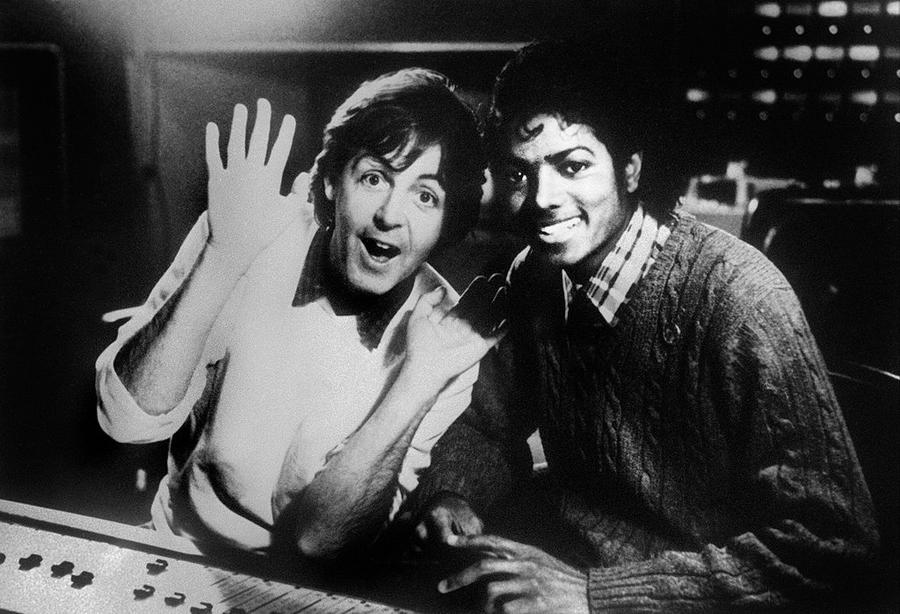
Meanwhile, in California, a 25-year-old Michael Jackson, fresh off the astronomical success of "Thriller," was in the midst of a two-year publishing rights shopping spree. Ironically, it was Paul McCartney who first taught Michael about the publishing rights business. In 1982, while recording the song "Say, Say, Say" together in London, Michael briefly lived with Paul and Linda McCartney. After dinner one night, Paul retrieved a thick leather book from a shelf. The book, Paul explained, listed every song right that he had purchased in the previous decade. As if that wasn't impressive enough, Paul bragged that in the last year alone, he had made over $40 million in royalties ($136 million in 2026 dollars) from his song rights. When Paul was done speaking, Michael looked at him and said:
"Someday, I'm gonna own your songs."
Paul laughed and responded:
"Great, good joke!"
AFP/Getty Images
Michael Wasn't Joking
Between 1982 and 1984, Jackson spent millions of dollars buying publishing rights from a wide variety of artists. His first big purchase was the entire catalog of Sly and the Family Stone. He then bought a series of classic singles like "Great Balls of Fire," "Shake Rattle Rattle and Roll," "When a Man Loves a Woman," and "Runaround Sue." When Jackson's longtime lawyer, John Branca, got wind that ATV was for sale in 1984, he approached Michael about making an offer. Michael instructed Branca to spare no expense in acquiring The Beatles' catalog.
The highest bid on the catalog was $40 million, so Jackson and Branca prepared an offer that was likely to scare everyone off: $47.5 million ($150 million in 2026 dollars). Robert Holmes à Court, tentatively accepted their offer, and both sides began the process of due diligence.
The negotiations between Jackson's and Holmes à Court's lawyers took ten months and cost Jackson personally over $1 million. Jackson's legal team spent months at the US Library of Congress studying the validity of each of the 4,000 song copyrights. In total, more than a hundred lawyers were needed to generate eight different contracts until both sides finally agreed on the deal. In October of 1985, the deal was done, and Michael Jackson's prediction officially came true:
He owned the entire Beatles music catalog.
Michael Jackson now controlled the publishing rights to every Beatles song. That meant he was free to license songs like "Yesterday," "All You Need is Love," and "Revolution" to any brand he chose. If he licensed a song for $100,000, the songwriters Lennon and McCartney would still get $25,000 each, and the publisher, Michael Jackson, would get $50,000. In 1987, Michael infuriated Paul when he licensed the song "Revolution" to Nike for $500,000. But there was nothing Paul could do about it.

An Empire Is Born
In 1995, Michael Jackson was approached by Sony with a deal that would permanently reshape the music publishing industry.
Sony offered to pay Michael $95 million (roughly $160 million today) to merge his ATV Music Publishing catalog with Sony's own publishing division. The result was a newly formed 50/50 joint venture: Sony/ATV Music Publishing.
From a financial standpoint, it was a masterstroke.
Not only did Michael nearly double his original $47.5 million investment in the Beatles catalog almost overnight, but he also retained a 50% stake in what instantly became one of the largest and most powerful music publishing companies in the world. Just as importantly, the deal diversified his risk. Instead of relying heavily on one legendary catalog, he now owned half of a rapidly expanding global portfolio.
And it's worth noting: Michael still retained 100% ownership of his own songs through his separate company, Mijac Music. In other words, he now had two parallel empires, one built on other artists' publishing rights and one built on his own recordings and songwriting.
Over the next two decades, Sony/ATV scaled at an extraordinary pace.
- By the mid-2000s, the catalog had grown to over 200,000 songs
- By the early 2010s, it controlled more than two million songs
- It acquired or administered rights tied to artists like Eminem, Lady Gaga, Bob Dylan, Neil Diamond, and countless others
At its peak, Sony/ATV was generating an estimated $1.25 billion per year in revenue, with roughly $500 million in annual profit.
By the mid-2010s, the company's total valuation was widely estimated in the $2–4 billion range. At the low end, Michael's 50% stake alone was worth around $1 billion. At the high end, significantly more.
And that doesn't even account for the strategic leverage that came with controlling one of the most valuable catalogs in music history.
Eventually, in 2016, the estate sold Michael's 50% stake in Sony/ATV back to Sony for $750 million, locking in one of the most profitable long-term investments in entertainment history.
A $47.5 million bet in 1985 had, over time, turned into a billion-dollar empire.
Carlo Allegri/Getty Images
Michael's Financial Problems And Death
Despite building one of the most valuable music publishing portfolios ever assembled, Michael Jackson's personal finances told a very different story.
At the height of his career, he earned hundreds of millions from album sales, touring, endorsements, publishing, and merchandising. But his spending consistently outpaced even those enormous earnings.
At his peak, Michael's lifestyle reportedly cost as much as $50 million per year to maintain.
His expenses included:
- $19.5 million to purchase Neverland Ranch, plus roughly $10 million per year in upkeep
- An additional $35 million transforming the property into a private amusement park
- Tens of millions on art, antiques, luxury cars, and collectibles
- $12 million paid to Debbie Rowe
- Around $20 million to settle a 1993 child molestation case
- Tens of millions more in ongoing legal fees
- An estimated $50–100 million lost on abandoned film and music projects
At the same time, his core business began to weaken. Music sales declined in the late 1990s. Touring became less consistent. Corporate partners grew more cautious due to reputational issues.
To sustain his lifestyle, Michael increasingly borrowed against his most valuable asset: his stake in Sony/ATV.
At one point, he secured a $380 million loan from Bank of America, using his catalog interest as collateral. The interest payments alone ran into the tens of millions annually.
Within a few years, he had exhausted that loan and accumulated roughly $120 million in additional debt.
By the time of his death in June 2009, Michael Jackson was approximately $500 million in debt and facing very real financial distress. Some lenders were already positioning to seize assets, and Neverland had narrowly avoided foreclosure just a year earlier.
In the final months of his life, his planned "This Is It" London residency was intended not just as a comeback, but as a financial lifeline.
Kevin Winter/Getty Images
The Posthumous Turnaround
Immediately after Michael's death, the executors of his estate, led by longtime attorney John Branca and music executive John McClain, moved quickly to stabilize the situation.
Their first priority was to stop the financial bleeding. But instead of simply liquidating assets and paying creditors, they pursued a much smarter strategy. They treated Michael's music, likeness, and brand as a long-term intellectual property business.
Some of the estate's most important early moves included:
- Selling future music rights to Sony for $250 million to provide immediate liquidity.
- Producing the concert documentary "This Is It," which grossed $268 million worldwide.
- Signing major licensing and partnership deals, including arrangements with Pepsi and Cirque du Soleil.
Those moves bought the estate time, paid down debts, and set up long-term recurring income streams. The Cirque du Soleil productions in particular became major revenue generators, especially the Las Vegas residency.
The results have been extraordinary:
- The estate has generated well over $2 billion in revenue since 2009.
- Its major debts have been repaid.
- Its underlying music and licensing assets have continued to appreciate in value.
One of the clearest signs of that value came in 2024, when the estate sold a 50% stake in Mijac Music to Sony Music Group for $600 million. That transaction implied a total valuation of $1.2 billion for Mijac alone. Around the time of the deal, it was reported that Mijac was generating roughly $75 million per year from recordings, publishing royalties, licensing, and merchandise.
In other words, half of Michael's personal catalog ended up being worth more than his entire estate was believed to be worth when he died.
The Long-Term Windfall
Michael's will divided his estate in the following way:
- 40% to his mother, Katherine Jackson
- 40% to his three children
- 20% to charity
When Katherine dies, her 40% stake passes to Michael's children, meaning they will ultimately control a combined 80% of the estate, or 26.7% each.
Recent court filings have revealed that the children have already received tens of millions of dollars in distributions, and total payouts from the estate are believed to be in the hundreds of millions.
With the biopic "Michael," continued streaming demand, licensing income, and new generations of fans discovering his music, the estate remains one of the most powerful posthumous entertainment businesses ever built.
The Lesson
Michael Jackson made one of the smartest music investments of all time when he bought the Beatles' catalog.
He also made some of the worst personal financial decisions imaginable.
In the end, the fortune he built was so valuable that even his own reckless spending could not destroy it permanently. It simply took a disciplined team, years of strategic dealmaking, and a posthumous brand reset to unlock the full value.
The lesson is simple:
Owning the right assets can make you incredibly rich. But only if someone knows how to manage them.
/2015/10/Michael-Jackson.jpg)
/2024/02/michael.jpg)
/2023/02/GettyImages-95476311.jpg)
/2015/06/mj1.jpg)
/2012/07/GettyImages-708621.jpg)
/2023/05/GettyImages-151089982.jpg)
:strip_exif()/2009/09/P-Diddy.jpg)
/2019/11/GettyImages-1094653148.jpg)
/2019/10/denzel-washington-1.jpg)
/2009/09/Jennifer-Aniston.jpg)
/2017/02/GettyImages-528215436.jpg)
/2020/02/Angelina-Jolie.png)
/2020/04/Megan-Fox.jpg)
:strip_exif()/2015/09/GettyImages-476575299.jpg)
/2009/09/Cristiano-Ronaldo.jpg)
/2019/04/rr.jpg)
/2020/01/lopez3.jpg)
/2020/06/taylor.png)
/2009/09/Brad-Pitt.jpg)
/2018/03/GettyImages-821622848.jpg)
/2009/11/George-Clooney.jpg)