
/2026/04/john-ternus-2.png)
/2020/02/Angelina-Jolie.png)
/2020/04/Megan-Fox.jpg)
/2009/11/George-Clooney.jpg)
/2018/03/GettyImages-821622848.jpg)
/2017/02/GettyImages-528215436.jpg)
/2019/11/GettyImages-1094653148.jpg)
/2009/09/Jennifer-Aniston.jpg)
/2009/09/Brad-Pitt.jpg)
:strip_exif()/2015/09/GettyImages-476575299.jpg)
:strip_exif()/2009/09/P-Diddy.jpg)
/2019/04/rr.jpg)
/2020/01/lopez3.jpg)
/2009/09/Cristiano-Ronaldo.jpg)
/2020/06/taylor.png)
/2019/10/denzel-washington-1.jpg)
What is John Ternus's net worth and salary?
John Ternus is an American engineer and business executive who has a net worth of $75 million. John Ternus is best known for his long career at Apple Inc., where he rose from an entry-level mechanical engineer to become Senior Vice President of Hardware Engineering and, ultimately, the company's eighth CEO.
Over more than two decades, Ternus quietly became one of the most influential product leaders inside Apple, overseeing the development of core hardware lines including the iPhone, iPad, Mac, and AirPods. He played a central role in shaping the physical design and performance philosophy of Apple's products, culminating in his leadership of the company's transition to Apple Silicon, one of the most consequential shifts in modern computing. Known for his calm demeanor, technical depth, and precise communication style, Ternus emerged as one of the few executives capable of bridging Apple's design-driven culture with its massive global supply chain. His promotion to CEO marks a generational transition following the long tenure of Tim Cook, placing him in charge of one of the most valuable and closely watched companies in the world.
Early Life and Education
John Patrick Ternus was born in May 1975. From an early age, he demonstrated a fascination with how physical objects were designed and assembled, an interest that naturally led him toward engineering. He attended the University of Pennsylvania, where he pursued a Bachelor of Science in Mechanical Engineering. While at Penn, Ternus was not only academically accomplished but also a dedicated athlete, lettering on the university's varsity swim team.
He graduated in 1997, and even at that early stage, his work reflected a focus on practical, user-centered engineering. His senior project, which involved building a mechanical feeding arm, hinted at a career that would blend technical precision with human interaction. This combination of mechanical expertise and usability would later become a defining feature of his contributions at Apple.
Early Career and Entry Into Apple
After graduating, Ternus joined a startup called Virtual Research Systems, where he worked as a mechanical engineer from 1997 to 2001. The company focused on early virtual reality hardware, including head-mounted displays and interface systems. Though the technology was ahead of its time, the experience gave Ternus valuable exposure to emerging hardware categories and complex physical design challenges.
In 2001, Ternus made a pivotal move by joining Apple's product design team. At the time, Apple was in the midst of a resurgence led by Steve Jobs, with products like the iMac and iPod redefining consumer electronics. Ternus entered the company at a moment when hardware design was becoming central to Apple's identity, setting the stage for his long-term impact.
Rise Through Apple's Hardware Organization
Ternus spent the early years of his Apple career working on external displays, including the Apple Cinema Display. His work on these products helped establish his reputation as a meticulous and reliable engineer capable of handling complex hardware challenges.
By 2005, he had advanced to a leadership role overseeing hardware engineering for the G5 iMac. This period proved critical in shaping his understanding of Apple's manufacturing ecosystem. Ternus spent significant time in Asia working directly with suppliers and production partners, gaining firsthand experience with the company's highly integrated supply chain. This operational knowledge would later become one of his key strengths.
Over the next several years, Ternus continued to climb Apple's ranks, eventually becoming Vice President of Hardware Engineering in 2013. In this role, he served under longtime hardware chief Dan Riccio and took on responsibility for some of Apple's most important product lines.
His portfolio expanded to include the iPad, where he oversaw multiple generations of the device, refining its design, performance, and manufacturing efficiency. He also played a major role in the development of AirPods, a product that transformed the wireless audio market and became one of Apple's most successful accessories. Additionally, Ternus contributed to the evolution of the iPhone, working on both internal hardware improvements and external design refinements.
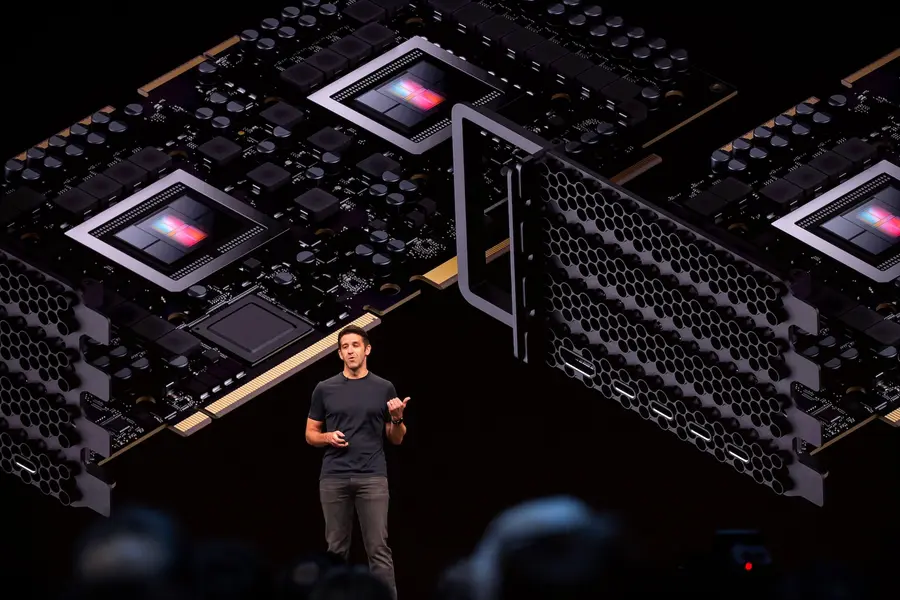
(BRITTANY HOSEA-SMALL/AFP via Getty Images)
Senior Vice President and Apple Silicon Transition
In January 2021, Ternus was promoted to Senior Vice President of Hardware Engineering, succeeding Dan Riccio. This promotion placed him among Apple's top leadership and made him one of the most visible executives in the company.
His tenure as SVP coincided with one of the most important transitions in Apple's history: the move away from Intel processors to Apple's own custom-designed chips, known as Apple Silicon. Under Ternus's leadership, Apple redesigned the Mac lineup to fully leverage these new processors, delivering significant improvements in performance, battery life, and thermal efficiency.
Products such as the MacBook Air, MacBook Pro, and Mac Studio were reimagined around the capabilities of the M-series chips. This transition not only strengthened Apple's control over its hardware and software ecosystem but also set a new benchmark for performance in personal computing.
Ternus became a regular presence at Apple keynote events, where his measured and articulate presentation style contrasted with the more theatrical approach of earlier Apple leaders. He was widely regarded as a steady and credible voice, capable of explaining complex engineering advancements in accessible terms.
Leadership Style and Reputation
Within Apple, Ternus developed a reputation as a disciplined and detail-oriented leader who prioritized collaboration and long-term thinking. Unlike some of his predecessors, he was not known for a strong public persona or outspoken leadership style. Instead, he focused on execution, engineering excellence, and maintaining Apple's high standards for product quality.
Colleagues often described him as approachable and pragmatic, with a deep understanding of both the technical and operational aspects of the business. His experience working directly with manufacturing partners gave him a unique perspective on the challenges of scaling complex hardware products across a global supply chain.
This combination of technical expertise, operational insight, and calm leadership made him a natural candidate for higher executive roles within the company.
Becoming CEO of Apple
In 2026, Ternus was selected to succeed Tim Cook as CEO of Apple, marking a significant generational shift in the company's leadership. At approximately 50 years old, he was seen as an ideal candidate who could lead the company for the next decade or more.
His appointment reflected Apple's continued emphasis on hardware innovation as a core pillar of its strategy. With deep knowledge of the company's product roadmap and engineering culture, Ternus was positioned to guide Apple through emerging challenges, including advancements in artificial intelligence, the evolution of augmented and virtual reality, and increasing geopolitical complexity in global manufacturing.
He became the eighth CEO in Apple's history, following a lineage that includes figures such as John Sculley and Steve Jobs. He inherited a company valued in the trillions, with a vast ecosystem of devices, services, and customers around the world.
Apple CEOs: Tenure & Market Cap at Exit
| CEO & Tenure | Market Cap at Exit |
|---|---|
| 1. Michael Scott Feb 1977 – Mar 1981 (4 years) | ~$1.8 Billion Post-IPO valuation |
| 2. Mike Markkula Mar 1981 – Apr 1983 (2 years) | ~$1.5 Billion |
| 3. John Sculley Apr 1983 – Jun 1993 (10 years) | ~$2.5 Billion |
| 4. Michael Spindler Jun 1993 – Feb 1996 (2.5 years) | ~$3 Billion |
| 5. Gil Amelio Feb 1996 – Jul 1997 (1.5 years) | ~$2.3 Billion |
| 6. Steve Jobs Jul 1997 – Aug 2011 (14 years) | ~$348 Billion |
| 7. Tim Cook Aug 2011 – Sept 2026 (15 years) | $4 Trillion |
| 8. John Ternus Sept 2026 – Present (Incoming) | Incoming Taking over $4T empire |
Compensation and Career Earnings
Ternus's compensation evolved significantly over the course of his career at Apple. During his years as a Vice President from 2013 to 2020, his base salary was likely in the mid-to-high six figures, supplemented by substantial stock-based compensation. His total annual earnings during this period were estimated to range between $5 million and $10 million.
After becoming Senior Vice President in 2021, his compensation aligned with Apple's standard executive structure. This included a base salary of around $1 million per year, annual cash bonuses typically ranging from $2 million to $3 million, and large equity awards in the form of Restricted Stock Units. These stock grants, often valued between $20 million and $26 million annually, made up the majority of his compensation.
Over more than two decades at Apple, Ternus accumulated significant wealth through salary, bonuses, and stock awards. His total career earnings are estimated to exceed $150 million to $200 million, with a substantial portion tied to long-term equity that vests over time.
As CEO, his compensation is expected to increase dramatically, following the model established by Tim Cook, whose annual target compensation often reached tens of millions of dollars.
/2026/04/john-ternus-2.png)
/2009/11/George-Clooney.jpg)
/2020/10/Rick-Fox.jpg)
/2026/04/hgtv-house.png)
/2026/01/Ilhan-Omar.png)
/2026/04/GettyImages-2237036037.jpg)
/2026/04/GettyImages-1182383742.jpg)
/2024/07/Screenshot-2024-07-17-175429.jpg)