
Before Daymond John became the sharply dressed branding expert on "Shark Tank," he was a kid from Hollis, Queens, trying to figure out how to turn style into survival. He grew up at the exact moment hip-hop was transforming from a local movement into a global cultural force. Hollis wasn't just another neighborhood. It was where Run-DMC, LL Cool J, and Salt-N-Pepa got their start. The music, the fashion, and the entrepreneurial energy were everywhere, and Daymond was absorbing all of it in real time.
At home, things were far less glamorous. His parents divorced when he was young, and he was raised by his mother, who worked constantly to support the family. By his teenage years, Daymond was already hustling, handing out flyers for $2 an hour and participating in a high school co-op program that allowed him to alternate between school and a full-time job. That experience shaped his mindset early. If he wanted money, he had to go out and earn it.
He didn't have capital or connections, but he had awareness and work ethic, plus a front-row seat to a cultural shift that most of corporate America hadn't yet recognized. That combination has resulted in Daymond John having a $350 million net worth today. Here's how he did it…
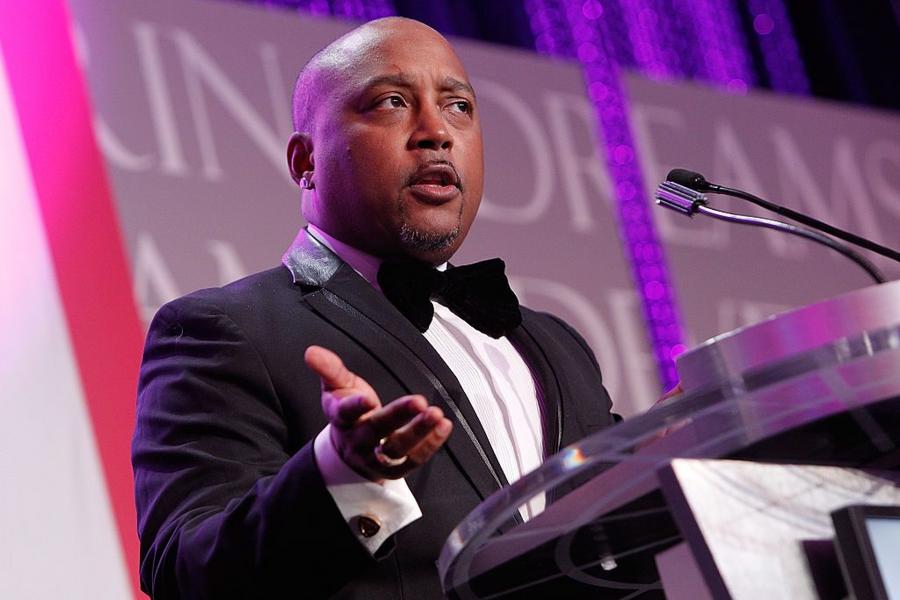
Rags to Riches – Daymond John / Paul Morigi/Getty Images
From a $20 Hat to an $800 Day
The business that changed everything started with something incredibly simple. In the early 1990s, one of the most popular accessories in hip-hop videos was a wool tie-top ski hat. Daymond went to buy one, saw the $20 price tag, and decided it was overpriced. Instead of buying it, he went home, learned how to sew from his mother, and teamed up with his neighbor Carlton Brown to make their own version.
They took the hats to the streets of Queens, Brooklyn, and Manhattan, selling them for $10 each. One day they made $800. That single day reframed everything. This wasn't just about fashion. It was about recognizing a gap between demand and price, then moving faster than everyone else to exploit it.
What Daymond saw, before most others did, was that hip-hop wasn't just music. It was a market, and it was expanding quickly.
A House, a Sewing Machine, and a $100,000 Bet
As demand grew, Daymond brought in additional partners, J. Alexander Martin and Keith Perrin, and officially launched FUBU, short for "For Us By Us." The name itself was the strategy. The brand wasn't trying to appeal to everyone. It was speaking directly to a customer who had been influencing fashion for years but had rarely been the target of major labels.
At the time, the operation was still extremely scrappy. Daymond continued working full-time at Red Lobster while building the business at night. The real turning point came from his mother, who took out a $100,000 mortgage on her house to fund the company, then moved out so the home could be converted into a factory, warehouse, and office. Sewing machines ran constantly, fabric filled every room, and the team often slept on the floor next to their equipment.
Daymond and his partners also leaned heavily into guerrilla marketing, placing their clothing on artists in music videos to build credibility. That strategy paid off when LL Cool J, a fellow Queens native, began wearing FUBU gear publicly. The defining moment came when LL appeared in a national Gap commercial wearing a FUBU hat, giving the brand massive exposure and instant legitimacy.
$300,000 in Orders… And No Way to Fill Them
In 1994, Daymond and his partners went to a major fashion trade show in Las Vegas, even though they couldn't afford a booth. They hustled the floor, pitching buyers directly, and walked away with $300,000 in orders.
There was just one problem. They had no way to manufacture the clothes.
Daymond approached 27 banks for financing and was rejected every time. With the business on the brink of collapsing under its own momentum, his mother placed an ad in the "New York Times" looking for a partner. That ad led to a deal with Samsung Textiles, which provided the manufacturing backbone FUBU needed to scale.
With production solved, growth accelerated quickly. FUBU expanded from hats into T-shirts, jerseys, denim, and outerwear, moving into major retailers like Macy's. By 1998, the company was generating more than $350 million in annual revenue, eventually surpassing $6 billion in global sales.
But that rapid growth came with a cost. As distribution expanded, the brand lost some of the scarcity and cultural edge that had fueled its rise. By the early 2000s, the U.S. market cooled, inventory piled up, and discounting began to erode FUBU's premium positioning.
Rather than forcing growth, Daymond and his partners pulled back from the U.S. market to protect the brand. While it appeared to disappear domestically, FUBU remained active overseas, particularly in Asia and Europe, where it continued to perform strongly through licensing deals.
Importantly, the company was never sold. Daymond and his original partners still own the brand today.
Years later, FUBU returned to the U.S. with a different strategy, focusing on limited releases and collaborations with brands like Puma, Forever 21, and Urban Outfitters. The approach was more controlled, tapping into nostalgia while introducing the brand to a new generation.
For Daymond, that evolution marked a shift from operator to strategist, a transition that would soon lead to a much bigger platform.
From FUBU to the Tank
When Daymond John walked onto the set of "Shark Tank" in 2009, he wasn't trying to become a television personality.
He was trying to figure out if this thing would even last a season.
At the time, the concept felt like a gamble. A panel of investors sitting under bright lights, listening to unknown entrepreneurs pitch half-formed businesses? It could just as easily have been a short-lived experiment that disappeared after a few episodes. But for Daymond, the appeal was simple. He had already lived through the hardest parts of building a company from scratch. He knew what it looked like when a founder actually understood their product, and he knew what it looked like when they were just guessing.
The show gave him a front-row seat to that distinction.
In the early seasons, he carved out a very specific lane. He wasn't the loudest Shark, and he wasn't throwing around the biggest offers. What he had was pattern recognition. Years of building FUBU had trained him to spot something most people missed: whether a product had a real connection to its customer or whether it was just another commodity with a logo slapped on it.
He paid close attention to the person behind the pitch. How they answered questions. Whether they understood their margins. Whether they had actually sold anything, or were still living in projections. More often than not, he bet on founders who reminded him of himself, scrappy, overlooked, and willing to grind.
That approach didn't always produce instant wins. Like every investor on the show, Daymond made deals that didn't pan out. But over time, his portfolio began to take shape. To date, Daymond has invested more than $8 million of his own money into companies that came through the Tank. The most important investment? Socks.
In 2014, two entrepreneurs stepped onto the stage with a business built around something almost comically simple: socks. The company was called Bombas. At first glance, it didn't look like a breakout opportunity. Socks are one of the most crowded, low-margin categories in retail. But as the pitch unfolded, it became clear that this wasn't really about socks. It was about positioning.
The founders had built a premium product with thoughtful design details, but more importantly, they had attached it to a mission. For every pair sold, another pair would be donated to someone in need. It added complexity to the business, but it also gave the brand a story that customers could connect with.
Several of the other Sharks hesitated. The valuation felt aggressive. The charitable model raised questions. It wasn't an obvious bet.
Daymond saw it differently.
He recognized the same elements that had powered FUBU in its early days: a clear audience, a strong identity, and founders who understood exactly who they were selling to. He made a deal, $200,000 for a 17.5% stake.
That investment would go on to become the most successful in "Shark Tank" history. Today, Daymond's stake in Bombas is worth at least $100 million based on the most conservative valuations.
But the bigger impact of "Shark Tank" wasn't just one investment.
Week after week, millions of viewers watched Daymond evaluate businesses, negotiate deals, and break down what separates a good idea from a real company. He wasn't just a former fashion mogul anymore. He had become one of the most recognizable investors in America, someone founders actively wanted in their corner.
That visibility turned into leverage. Speaking engagements, bestselling books, consulting through The Shark Group, partnerships with major brands. The platform he built on television ended up being just as valuable as anything he created in fashion.
And unlike many people who find success on TV, Daymond approached it the same way he approached a street corner in Queens decades earlier.
As an opportunity.
He started with $40 worth of fabric, a borrowed sewing machine, and a simple insight about a $20 hat. From there, he built a $6 billion brand, reinvented himself as an investor, and turned a reality show into a second empire.
Not bad for a guy who used to smell like shrimp at Red Lobster.
/2010/09/Daymond-John.jpg)
/2020/02/Kevin-O.jpg)
/2009/12/cham.jpg)
/2020/01/robert.jpg)
/2020/06/barbara-corcoron-1.jpg)
/2021/01/Billy-Blanks.jpg)
/2009/09/Cristiano-Ronaldo.jpg)
/2009/09/Brad-Pitt.jpg)
/2020/02/Angelina-Jolie.png)
/2009/11/George-Clooney.jpg)
/2020/04/Megan-Fox.jpg)
/2018/03/GettyImages-821622848.jpg)
/2020/01/lopez3.jpg)
/2009/09/Jennifer-Aniston.jpg)
:strip_exif()/2009/09/P-Diddy.jpg)
/2020/06/taylor.png)
/2019/11/GettyImages-1094653148.jpg)
/2019/04/rr.jpg)
/2017/02/GettyImages-528215436.jpg)
:strip_exif()/2015/09/GettyImages-476575299.jpg)
/2019/10/denzel-washington-1.jpg)