
Today is the 50th anniversary of the founding of Apple. To mark the occasion, Paul McCartney is reportedly playing a private concert for all Apple employees at their Cupertino headquarters.
But fifty years ago, Apple wasn't much more than an idea and a three-page document with three signatures. That's right, THREE signatures.
On April 1, 1976, Apple was founded by Steve Jobs, Steve Wozniak, and a guy named Ronald Wayne.
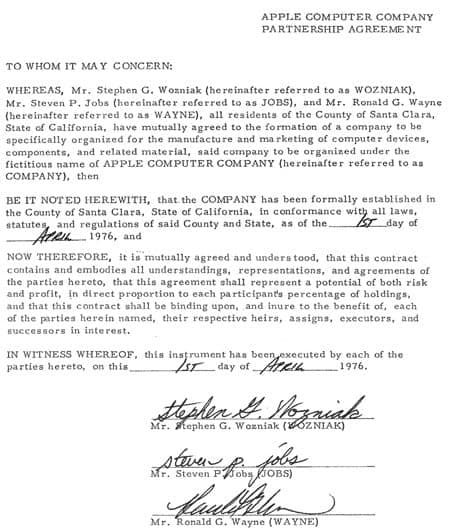
The agreement stated that the startup's three co-founders had "mutually agreed to the formation of a company… for the manufacture and marketing of computer devices."
On the day the contract was signed, Jobs was 21, Wozniak was 25, and Ronald was 41.
It was Jobs' idea to start a company with the genius engineer Wozniak. Jobs pulled in Ronald Wayne, his former co-worker at Atari, because he had experience forming businesses and, most importantly, could provide legal structure, capital, and adult supervision for the venture.
So on April 1, 1976, the three gathered and put their signatures on a contract that would eventually change the world. Here is the actual signature page of the Apple Computer Company Partnership Agreement:
How do you think Steve, Steve, and Ronald would react if you traveled back in time to April 1, 1976, and told them:
"Congrats, guys! Someday, this company is going to be worth around $4 trillion. It will become one of the most valuable and influential technology companies in history. Its products will reshape society in ways you can't even imagine. Presidents, kings, and the most famous celebrities in the world will travel to your headquarters just to meet the CEO… who, by the way, is currently a 16-year-old kid named Tim living in Alabama."
I think they would, quite reasonably, suggest you be committed to an insane asylum.
So, as the co-founders of one of the most valuable and influential companies in history, how rich did Steve, Steve, and Ronald become?
Let's start with the most infamous outcome…
Ronald Wayne: The Worst Financial Decision In History
When Apple was founded in 1976, Ronald Wayne wasn't just some random third name on a document. He played a real, tangible role in getting the company off the ground.
At 41 years old, Wayne was decades older than Steve Jobs and Steve Wozniak. He had experience starting and running businesses. He understood contracts, risk, and liability. In many ways, he was exactly what two ambitious but inexperienced young founders needed: a steady, pragmatic adult in the room.
Wayne drafted the original partnership agreement. He wrote the first Apple I manual. He even designed Apple's very first logo, an intricate illustration of Isaac Newton sitting under a tree.
In exchange for all of that, he received a 10% stake in the company.
And then, less than two weeks later, he gave it all up.
Just 12 days after signing the founding agreement, Wayne decided the risk wasn't worth it. Apple was structured as a partnership, which meant each founder could be held personally liable for any debts the company incurred. If Jobs and Wozniak ran up bills they couldn't pay, Wayne could be on the hook.
Unlike his younger co-founders, Wayne had assets to protect. He had already experienced business failures in the past. He wasn't interested in gambling everything on what, at the time, looked like a long-shot electronics startup.
So he made a decision that, in that moment, was completely rational. He sold his 10% stake.
Wayne accepted $800 upfront and later an additional $1,500 to fully sever any future claims on Apple. Total: $2,300.
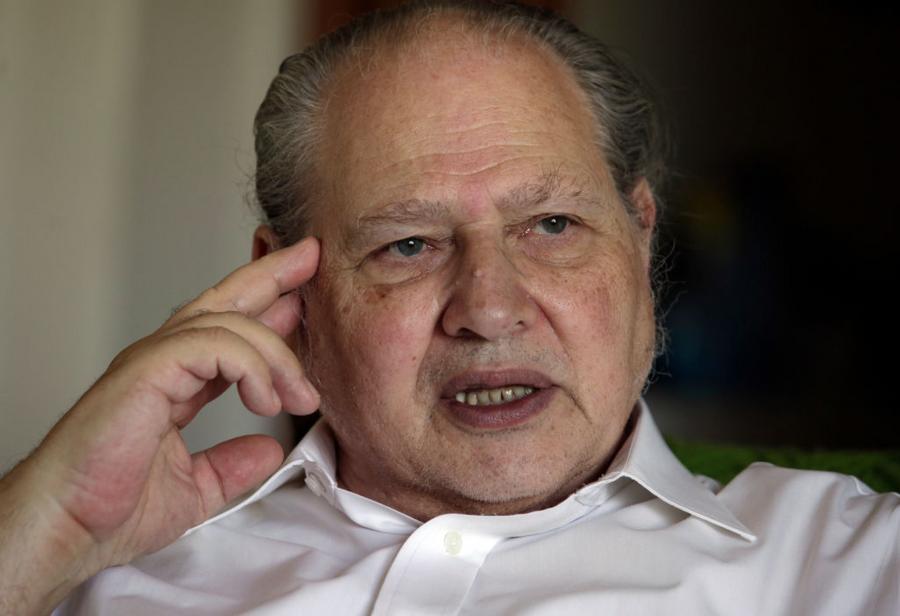
Ronald Wayne (Karen T. Borchers/Mercury News via Getty Images)
From that point on, he was out. No equity. No upside. No second chances.
Meanwhile, Apple began to grow.
In its first year, the company generated $175,000 in revenue. The following year, that number jumped to $2.7 million. By 1980, Apple went public, creating hundreds of millionaires overnight. Within a few years, revenue crossed $1 billion.
Wayne watched all of this from the outside.
Fast forward to today, and Apple Inc. is worth roughly $3.7 trillion.
That means the 10% stake Wayne sold for $2,300 would be worth about $370 billion.
To put that in perspective, that fortune would place him among the richest people in modern history, ahead of nearly every billionaire on the planet.
Even in a more realistic scenario, where he sold off the vast majority of his shares over time and ended up with just 1%, Wayne would still be worth around $37 billion today.
Instead, he spent decades working a variety of modest jobs, including roles at Atari and later at a government laboratory. He eventually retired to a quiet life in rural Nevada.
And perhaps the most surprising part of the story…
He says he has no regrets.
Wayne has repeatedly explained that his passion was never computers. He preferred working on slot machines and mechanical systems. More importantly, he believed that staying with Apple would have meant living a life filled with stress, risk, and pressure that he simply didn't want.
At one point, he summed it up perfectly:
"If I had stayed with Apple, I would have wound up the richest man in the cemetery."
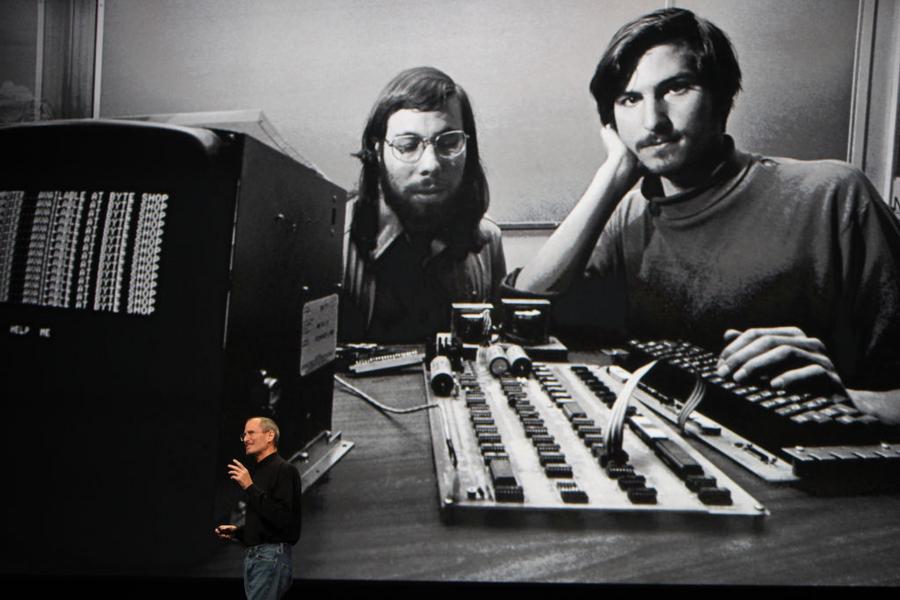
(Photo by Kimberly White/Corbis via Getty Images)
Steve Jobs: The $700 Billion "What If"
If Ronald Wayne represents the worst early exit in business history, Steve Jobs represents something far more complicated.
In the early 1980s, as Apple exploded in popularity thanks to the Apple II and then the Macintosh, Jobs owned roughly 20% of the company. When Apple went public in December 1980, that stake instantly made him worth hundreds of millions of dollars on paper.
Everything was lining up perfectly. And then it all fell apart.
In 1983, Apple hired former Pepsi executive John Sculley as CEO. At first, Jobs and Sculley worked well together. But behind the scenes, tensions were building. Jobs had a reputation for being brilliant but extremely difficult to work with. Employees described him as erratic, temperamental, and often impossible to manage.
By 1985, Apple's board had seen enough.
In a dramatic power struggle, Jobs was stripped of his operational responsibilities. Furious, he attempted to organize a coup to regain control of the company. When that failed, his role was reduced to essentially nothing.
So he did something that would go on to define his financial legacy. He walked away.
And in a move that still shocks people today, Jobs sold his entire 20% stake. He kept just a single share, purely so he could continue receiving the company's annual reports.
The sale netted him roughly $100 million after taxes. That's the same as around $300 million in today's dollars.
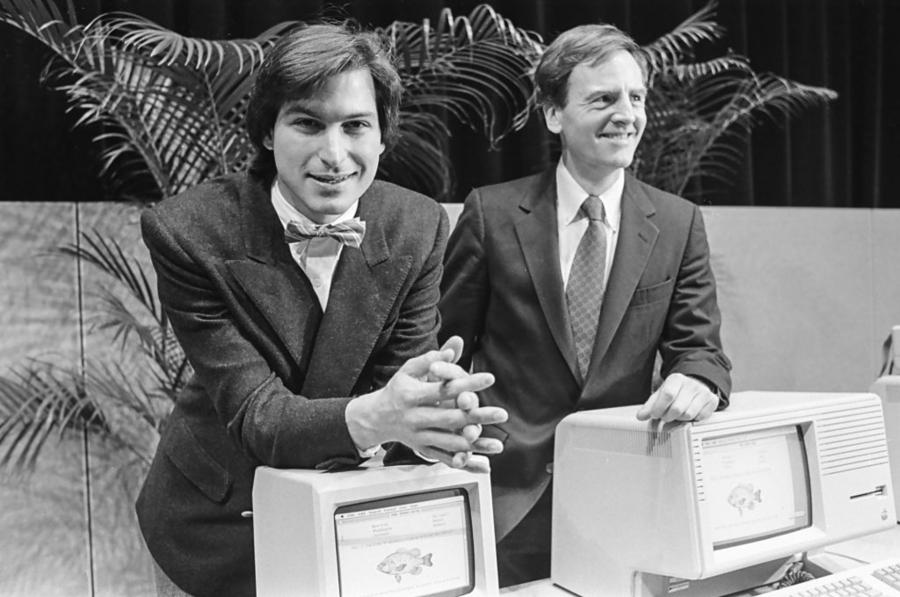
Steve Jobs and John Sculley in 1984 (Photo by Cap Carpenter/MediaNews Group/The Mercury News via Getty Images)
At the time, he was just 30 years old. From a purely emotional standpoint, the decision makes sense. Jobs felt betrayed. He wanted a clean break. He didn't want to be tied to a company he no longer controlled.
Meanwhile, Jobs set out to rebuild his career from scratch.
Next (pun intended), he founded a new company called NeXT, pouring millions of his own money into the venture. The company struggled for years and nearly ran out of cash multiple times.
But that wasn't his only move.
In 1986, Jobs spent $10 million to buy a small graphics division from filmmaker George Lucas. That company would eventually be renamed Pixar.
For years, Pixar also struggled. Then, in 1995, it released a little animated film called "Toy Story."
As you know, Pixar became a creative and commercial powerhouse, producing hit after hit. In 2006, The Walt Disney Company acquired Pixar in a deal worth $7.4 billion in stock, making Jobs Disney's largest individual shareholder.
Meanwhile, Apple itself was struggling badly in the mid-1990s.
So in 1997, Apple made a move that would reshape its future: it acquired NeXT for $427 million and brought Jobs back as an advisor, and soon after, as CEO.
This time, instead of holding onto a massive founder stake, Jobs negotiated a much smaller equity position. Apple granted him about 5.5 million shares, roughly equal to about 1% of the company at the time.
When Jobs died in 2011, his net worth was approximately $10.2 billion. Here's the part that surprises almost everyone:
- Around $8 billion came from his Disney stake
- Only about $2 billion came from Apple
In other words, the co-founder of Apple became a billionaire primarily because of Pixar, not Apple.
Now let's zoom out and consider the "what if."
Today, Apple Inc. is worth roughly $3.7 trillion.
If Jobs had simply held onto his original 20% stake, that position would be worth around $740 billion.
That would likely make him the richest person in the world by around $100 billion.
Of course, there's a twist.
It's entirely possible that Apple never becomes Apple without Jobs being forced out, reinventing himself, and eventually returning with a completely new perspective. Without that exile, there may be no Pixar, no iPhone-era Apple, and no trillion-dollar company.
After Steve's death in 2011, the bulk of his estate passed to his widow, Laurene Powell Jobs. Over the years, Laurene has gradually sold off most of those holdings, using the proceeds to build a diversified portfolio spanning media, philanthropy, and venture investments.
Today, her net worth is around $10 billion.
Had she simply held onto those original Apple and Disney shares and done nothing, that same fortune would likely be worth closer to $50 billion today.
Steve Wozniak: The Happiest Non-Billionaire in Silicon Valley
If Ronald Wayne represents the ultimate missed opportunity, and Steve Jobs represents the complicated "what if," then Steve Wozniak represents something entirely different.
Wozniak could have been one of the richest people in the history of the world.
He just didn't care.
As the engineering genius behind the Apple I and, more importantly, the Apple II, Wozniak was the technical backbone of Apple's early success. The Apple II wasn't just a cool gadget. It was one of the first highly successful mass-produced personal computers, and it helped ignite the entire PC revolution.
When Apple went public in December 1980, Wozniak owned roughly 7.9% of the company. On paper, that stake was worth around $140 million at the time, an enormous fortune for a 30-year-old engineer.
Today, that same stake would be worth in the neighborhood of $250–$300 billion, depending on the day.
But almost immediately, Wozniak started moving in the opposite direction of most billionaires.
Unlike Jobs, who had a reputation for being intensely focused on control and vision, Wozniak was deeply uncomfortable with the idea that some early Apple employees were being left behind. Many of the engineers who had helped build the company didn't receive meaningful equity in the IPO.
So Wozniak did something almost unheard of. He gave them his own.
Without making a big public statement, he distributed millions of dollars worth of his personal Apple stock to dozens of early employees who had been excluded from the windfall. It was an extraordinary gesture that instantly changed lives.
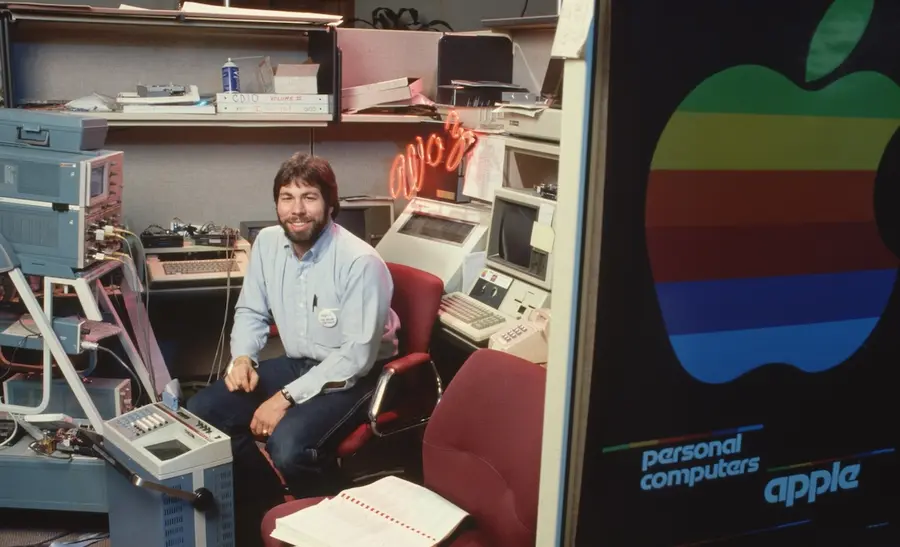
(Photo by © Roger Ressmeyer/CORBIS/VCG via Getty Images)
And it wasn't a one-time thing.
Over the years, Wozniak:
- Gave away roughly $10 million worth of stock to friends, family, and colleagues
- Donated millions more to schools, museums, and community organizations
- Personally funded large projects like the US Festivals in the early 1980s, spending more than $12 million of his own money to create massive music and technology gatherings
The festivals lost money. Wozniak didn't care.
"I never wanted money, so I pretty much tried to get rid of it."
That mindset stayed consistent for decades.
He poured money into education, donating computers and teaching students directly. He helped fund institutions like the Children's Discovery Museum of San Jose. He co-founded the Electronic Frontier Foundation, which still plays a major role in defending digital rights.
At various points, he sold additional shares or diluted his ownership further, steadily moving away from the massive stake he once held.
Then, in 2025, on his 75th birthday, a group of internet commenters pointed out what should be obvious by now: if Wozniak had simply held onto his shares, he would likely be worth well over $100 billion.
To everyone's surprise, Wozniak himself jumped into the discussion and responded directly.
"I gave all my Apple wealth away because wealth and power are not what I live for… I am the happiest person ever."
Today, by his own estimate, Wozniak's wealth is modest relative to his co-founders, roughly $10 million plus a couple of homes.
Which, in Silicon Valley terms, is almost hard to comprehend.
Three Founders, Three Financial Destinies
Here's a fun side anecdote: Apple went public in December 1980. If you bought $10,000 worth of Apple shares at the IPO and never sold, today you'd be sitting on $33 million.
That's three times Steve Wozniak's current net worth and exponentially more than Ronald Wayne ever made off the company.
- Ronald Wayne walked away with $2,300.
- Steve Jobs died worth around $10 billion, with the majority of that fortune coming from Pixar and Disney, not Apple.
- Steve Wozniak could have been worth hundreds of billions, but chose instead to give much of his wealth away and live a life guided by a very different definition of success.
- Countless random private investors have made enormous fortunes.
And it all started exactly fifty years ago today.
Which makes you wonder…
What companies are being started right now that we'll be talking about the same way fifty years from now, on April 1, 2076?
/2009/09/Steve-Jobs.jpg)
/2009/10/Steve-Wozniak.jpg)
/2010/09/Steve-Young-1.jpg)
/2020/01/laurene.jpg)
/2015/11/Steve-Harvey.jpg)
/2021/09/steve-mcqueen.jpg)
/2018/03/GettyImages-821622848.jpg)
/2009/09/Brad-Pitt.jpg)
/2020/04/Megan-Fox.jpg)
/2009/09/Cristiano-Ronaldo.jpg)
/2009/09/Jennifer-Aniston.jpg)
/2009/11/George-Clooney.jpg)
:strip_exif()/2015/09/GettyImages-476575299.jpg)
/2019/04/rr.jpg)
/2020/01/lopez3.jpg)
/2017/02/GettyImages-528215436.jpg)
/2020/06/taylor.png)
:strip_exif()/2009/09/P-Diddy.jpg)
/2019/10/denzel-washington-1.jpg)
/2020/02/Angelina-Jolie.png)
/2019/11/GettyImages-1094653148.jpg)