
It's one of those stories that sounds too perfect, too ironic, and too darkly poetic to be true.
A brilliant inventor creates a futuristic, self-balancing scooter… only to die years later by accidentally riding that very invention off a cliff.
You've probably heard some version of it. It gets passed around as trivia, pops up in comment sections, and resurfaces every few years as one of those "craziest deaths ever" facts.
But is it actually true? Like many great urban legends, the answer is… sort of. With a caveat.
From Coal Miner To Half-Billionaire
The person at the center of this urban legend is a British entrepreneur named James "Jimi" Heselden.
Jimi died on September 26, 2010, at the age of 62. And yes, he did die in an accident involving a Segway. But he wasn't the one who invented the innovative transportation contraption. He OWNED the company that owned Segway. He had actually acquired the business just 10 months before his death.
Jimi was born in Leeds, England, in 1948, and left school at just 15 years old. He went on to work as a coal miner, a physically demanding and often dangerous job that defined much of his early life.
That career came to an abrupt end in the 1980s when the UK mining industry collapsed and thousands of workers were laid off. Heselden suddenly found himself unemployed with little more than a redundancy payout.
Instead of fading into obscurity, he used that money to rent a small workshop and start experimenting.
He ended up inventing a product that would be used in war zones and disaster zones. It would make him a fortune. But it wasn't the Segway. It was a really big sandbag.
The Billion-Dollar Idea: Hesco Bastion
Heselden's breakthrough invention was a deceptively simple product: a collapsible wire mesh container lined with heavy-duty fabric that could be quickly filled with sand, dirt, or gravel.
Think of it as a supercharged version of a sandbag.
But instead of requiring hours of manual labor, his system could be deployed in minutes using machinery.
Originally designed for flood control, the product, later known as the Hesco Bastion, caught the attention of the military.
The advantages were obvious:
- Faster to deploy
- More durable than traditional sandbags
- Scalable for large defensive structures
Soon, governments around the world were placing massive orders.
Hesco barriers became standard equipment for NATO forces and were widely used in Iraq, Afghanistan, and other conflict zones. They were also deployed in disaster areas for flood control, including in the United States.
What started as a small workshop experiment turned into a global business.
And it made Heselden extraordinarily wealthy. Estate records after his death would later reveal that Jimi's net worth was around $550 million.
The Rise, Hype, And Collapse Of The Segway
To understand why Jimi Heselden was able to acquire Segway in 2009, you have to rewind to one of the most bizarre and overhyped product launches in modern tech history.
The Segway wasn't just another gadget. At one point, it was supposed to change the world.
The story begins with Dean Kamen, a prolific engineer who had already built a reputation as a genius long before the Segway existed. By the late 1990s, Kamen had developed groundbreaking medical devices, including portable insulin pumps and dialysis machines. He was also working on a highly advanced wheelchair called the iBOT, a machine that could balance on two wheels and even climb stairs using gyroscopic technology.
While developing the iBOT, Kamen realized that the same self-balancing system could be adapted into a consumer transportation device. Internally, the project was code-named "Ginger."
What followed wasn't just hype. It was one of the first truly viral tech stories of the early internet era.
Kamen poured more than $100 million into research and development and operated under extreme secrecy. Almost no one outside his inner circle knew what "IT" actually was. At one point, a publisher reportedly paid a six-figure advance for a book about the invention… without even knowing what the product was.
That vacuum of information triggered a frenzy.
High-profile investors made outrageous predictions. Venture capitalist John Doerr claimed it would be the fastest company in history to reach $1 billion in sales. Tech insiders speculated that it would revolutionize cities, eliminate cars, and reshape how humans moved through the world. Rumors ranged from hoverboards to anti-gravity devices.
For nearly a year, the mystery product spread across the internet, television, and print media in what would later look like a prototype of modern viral hype.
Then came the reveal.
On December 3, 2001, Kamen unveiled the Segway PT on national television. The reaction was immediate deflation. After all the buildup, the world was introduced to a two-wheeled, upright scooter. Technologically, it was brilliant. Commercially, it never had a chance.
Several core problems quickly emerged:
- Price: At roughly $5,000, it was far too expensive for most consumers
- Practicality: Weighing around 100 pounds, it was difficult to transport or store
- Regulation: Cities didn't know where to allow it. Too fast for sidewalks, too slow for roads, leading many municipalities to restrict or ban it
But the biggest problem wasn't any of those.
It was the hype.
The Segway wasn't just released as a product. It was introduced as something that would fundamentally change civilization. Once people saw what it actually was, it could only feel like a disappointment.
At the same time, the device was arguably overengineered to a fault. Built with extreme safety redundancies and precision components, it was expensive, heavy, and difficult to maintain. It wasn't a cheap, scrappy consumer gadget. It was a near-perfect piece of engineering that didn't fit the real world.
Instead of replacing the automobile, the Segway became a niche product, used primarily by security guards, warehouse workers, and tourist groups. Culturally, it drifted into punchline territory, immortalized by mall cops and sitcom gags rather than revolutionizing transportation.
By the late 2000s, the company had burned through tens of millions of dollars and failed to meet even modest expectations. What had once been one of Silicon Valley's most hyped inventions had quietly become a struggling business.
When Jimi Heselden stepped in to buy Segway Inc. in December 2009, he wasn't acquiring a hot tech company. He was buying what many analysts considered a distressed asset, likely at a steep discount compared to the capital originally invested.
And just ten months later, that same company would become forever linked to one of the strangest and most persistent urban legends in modern business history.
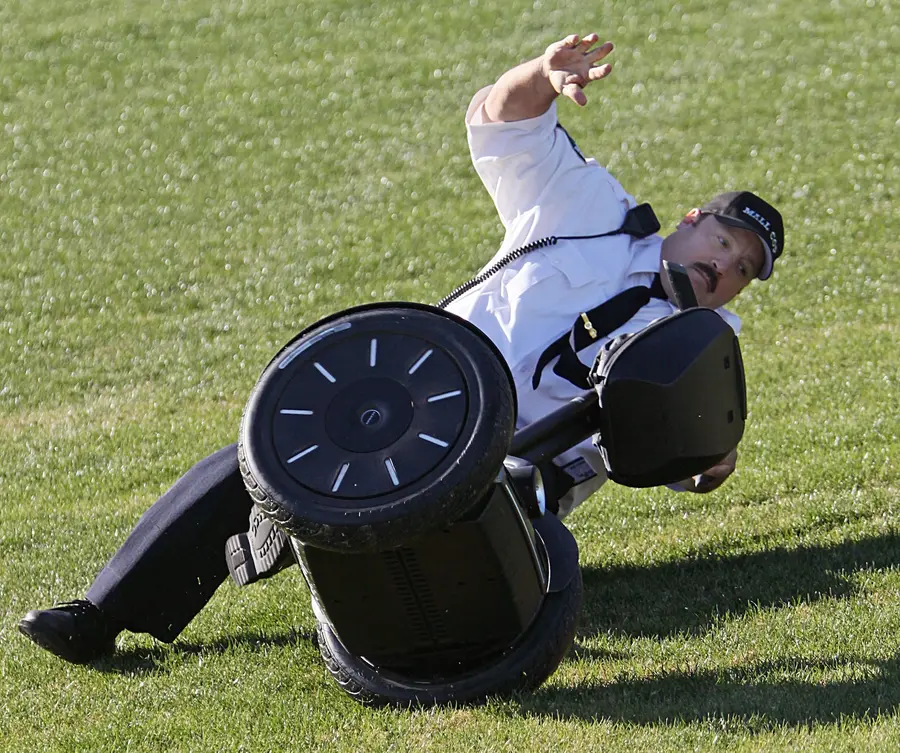
(Photo By Tom Pennington/Getty Images for the Texas Motor Speedway)
The Fatal Accident That Created The Myth
On the morning of September 26, 2010, just ten months after acquiring Segway Inc., Jimi Heselden set out for what should have been a routine walk on his property in West Yorkshire, England.
He was riding an off-road model known as the Segway x2 Adventure, a more rugged version of the device designed for uneven terrain. At some point along a narrow footpath overlooking the River Wharfe, Heselden encountered another person walking a dog.
According to the official investigation, Heselden attempted to be courteous and make room on the tight path by reversing his Segway.
That decision proved fatal.
While backing up, he lost control of the vehicle and went over the edge of a steep embankment, plunging roughly 30 feet into the river below. He died from multiple blunt force injuries to his chest and spine. Authorities later ruled the incident a tragic accident and confirmed there was no mechanical fault with the Segway itself.
What Happened to Dean Kamen – The Actual Segway Inventor?
Dean Kamen is still alive! After selling Segway Inc. in 2009, Dean went back to inventing life-changing medical technology.
Operating out of his massive DEKA Research & Development headquarters in New Hampshire, Kamen pivoted away from consumer transportation and focused his engineering teams on solving complex human problems. Under his leadership, DEKA partnered with DARPA to develop the LUKE arm, an incredibly advanced, highly dexterous robotic prosthetic for military veterans and amputees.
He also dedicated over a decade of his life to developing the Slingshot. The Slingshot is a vapor compression water purifier roughly the size of a dorm refrigerator that can turn absolutely any water source—whether it is ocean water, chemical waste, or raw sewage—into perfectly safe drinking water. His obsessive quest to deploy the machine globally to solve the world's water crisis was chronicled in the 2014 documentary film "SlingShot."
Beyond his patents and inventions, Kamen's most lasting legacy might be his work in education. In 1989, he founded FIRST (For Inspiration and Recognition of Science and Technology), a non-profit organization that hosts global robotics competitions for students. Today, FIRST reaches hundreds of thousands of kids across the globe every year, turning engineering and coding into a highly celebrated competitive sport.
Today, Dean Kamen is still hard at work. He currently spearheads the Advanced Regenerative Manufacturing Institute (ARMI), a massively funded initiative backed by the Department of Defense aimed at literally manufacturing human tissue and organs to solve the global organ transplant shortage. While the Segway may have been a rare commercial misstep, Kamen's $500 million fortune remains heavily insulated by his status as one of the most prolific and important medical inventors in modern history.
/2025/02/missing_profile.jpg)
/2015/01/Dean-Kamen.jpg)
/2018/01/GettyImages-2348175.jpg)
/2026/04/jay-z-billioniare.png)
/2026/04/carmel-enhanced.png)
/2026/04/herb-alpert-scaled.jpg)
:strip_exif()/2015/09/GettyImages-476575299.jpg)
/2017/02/GettyImages-528215436.jpg)
/2019/11/GettyImages-1094653148.jpg)
/2020/06/taylor.png)
/2009/09/Brad-Pitt.jpg)
/2020/02/Angelina-Jolie.png)
/2019/10/denzel-washington-1.jpg)
/2009/09/Jennifer-Aniston.jpg)
/2018/03/GettyImages-821622848.jpg)
/2020/04/Megan-Fox.jpg)
/2019/04/rr.jpg)
/2020/01/lopez3.jpg)
/2009/11/George-Clooney.jpg)
/2009/09/Cristiano-Ronaldo.jpg)
:strip_exif()/2009/09/P-Diddy.jpg)