
In late 2020, movie star Ryan Reynolds and television star Rob McElhenney announced they were buying a Welsh professional soccer team called Wrexham. The deal was officially transacted in 2021.
It was definitely a head scratcher. What were these two comedic actors going to do with a Welsh soccer club? Was it a joke? An elaborate vanity project? A mutual midlife crisis splurge?
Fast forward a few years, and their investment has turned into one of the most impressive sports-business turnarounds of the modern era.
In just four years, the duo transformed Wrexham A.F.C. from a near-bankrupt fifth-tier team generating barely £1 million in annual revenue into a global sports brand now valued at $500 million.
The strategy was simple, but wildly unconventional: treat a 150-year-old football club like a Silicon Valley startup. Burn cash. Scale audience. Monetize globally.
And it worked.
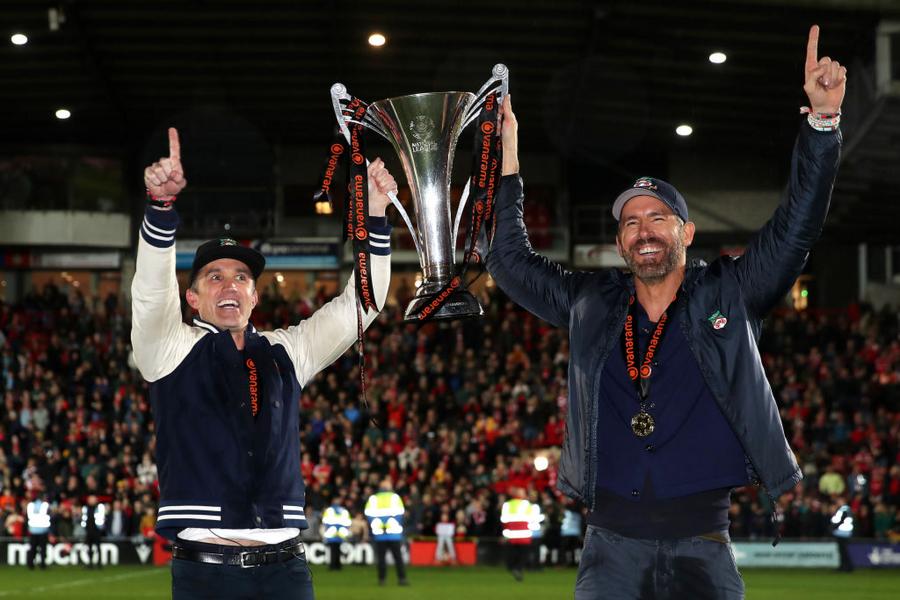
Jan Kruger/Getty Images
From Bankruptcy Risk To Break-Even Survival
Founded in 1864, Wrexham is one of the oldest professional football clubs in the world. But by the early 2000s, years of mismanagement had pushed it to the brink of extinction.
The club entered administration in 2004. It was relegated out of the Football League in 2008 after 87 consecutive years. By 2011, it was facing a winding-up order over unpaid taxes.
At one point, fans operating under an organization called the Wrexham Supporters Trust raised £127,000 (~$165,000) in a single day just to keep the club alive.
Under supporter ownership, Wrexham stabilized. But "stable" meant scraping by.
Annual revenue hovered between £1.1 million (~$1.4 million) and £2.5 million (~$3.2 million). There was no meaningful broadcast income. No global sponsorships. No path to growth.
Then COVID hit, wiping out matchday revenue entirely.
By 2020, the club needed outside capital or a dramatic shift in direction.
The "Free" $2 Million Purchase
A lot of headlines will state that Reynolds and McElhenney "bought" Wrexham for $2 million. That's not technically what happened.
Reynolds and McElhenney reached a deal with the Wrexham Supporters Trust that allowed them to acquire 100% ownership for a nominal fee. In other words, they put no money down. But they did make some legally binding commitments.
First and foremost, they agreed to inject roughly £2 million (~$2.6 million) directly into the club's operations.
They also agreed to several non-negotiables:
- The club would never move out of Wrexham
- The name and crest would remain untouched
- Investment would extend to infrastructure and the women's team
The Startup Strategy: Lose Money To Make Money
Reynolds and McElhenney didn't come in trying to run a profitable lower-league football club.
They came in trying to build a global media brand.
That meant spending aggressively.
Over their first few years, Reynolds and McElhenney injected more than £15 million (~$19 million) of their own money into the club to fund rapid expansion and cover operating losses.
That capital went toward:
- Paying above-market wages to attract higher-level players
- Breaking transfer records to accelerate promotions
- Expanding staff and upgrading infrastructure
- Funding significant promotion bonuses tied to on-field success
The result was predictable on paper, but still striking in reality.
Revenue exploded. Losses followed.
In the most recent season, Wrexham generated £33.35 million (~$44 million) in revenue, a record for a third-tier club without Premier League parachute payments.
But they also posted an operating loss of roughly £14.85 million (~$20 million), bringing total losses under their ownership to more than £25 million (~$32 million).
To traditional sports owners, that would look reckless.
To startup founders, it reflects a deliberate decision to prioritize growth over short-term profitability.
The Revenue Explosion
The growth trajectory is almost absurd:
- Pre-2021: ~£1.1 million (~$1.4 million)
- 2021–22: £6 million (~$7.7 million)
- 2022–23: £10.4 million (~$13.3 million)
- 2023–24: £26.7 million (~$34 million)
- 2024–25: £33.35 million (~$44 million)
Next season is projected to land between £46 million (~$59 million) and £50 million (~$64 million).
Even more remarkable is where that money is coming from.
Wrexham is no longer a local Welsh football club. It has evolved into a North American-facing media-driven sports brand.
Today, 57.7% of revenue comes from outside the UK and Europe, primarily the United States and Canada.
The breakdown looks like this:
- Sponsorships: £17.3 million (~$22 million)
- Matchday revenue: £5.9 million (~$7.5 million)
- Merchandise: ~£5 million (~$6.4 million)
Before Reynolds and McElhenney arrived, sponsorship revenue was under £2 million (~$2.6 million). Now it is the engine of the entire business.
The "Welcome To Wrexham" Flywheel
The most important asset in this entire story doesn't appear on the income statement.
The FX/Hulu documentary series "Welcome to Wrexham" doesn't directly pay the club. But it is the reason everything else works.
The show turned a small Welsh team into a global story. It created emotional investment. It built a fan base in the United States. And most importantly, it made Wrexham commercially relevant.
Blue-chip brands like United Airlines, Meta Quest, and HP aren't paying top-tier sponsorship dollars because of league position.
They are paying for audience and attention.
Wrexham effectively turned itself into a content-driven marketing platform.
The club also pays a "marketing contribution" back to the show's production entities, roughly £2.59 million (~$3.3 million) last year, reflecting how central the series is to its commercial strategy.
Zero Debt And A $500 Million Valuation
Despite the aggressive spending, one of the most important financial decisions the owners made was structural. They avoided loading the club with long-term debt.
At one point, Wrexham carried a £27.5 million (~$35 million) loan tied to its growth strategy. Reynolds and McElhenney chose to eliminate it themselves rather than leave it on the balance sheet.
That clean structure made the club far more attractive to outside investors.
In late 2025, minority investors, including Apollo Sports Capital, bought into the club at a valuation between $450 million and $500 million.
That transaction validated the entire strategy and allowed the club to repay earlier shareholder loans.
The Bigger Picture
This is more than an underdog sports story. It is a case study in how modern sports franchises can be built and scaled.
For decades, lower-league football clubs were limited by local economics, ticket sales, and regional sponsorships. Wrexham broke out of that model by building a global audience and then monetizing it through sponsorships, content, and merchandise.
But it is important to recognize how many unique factors had to line up for this to work.
Most clubs are not acquired by globally recognized celebrities with built-in audiences. Most do not land a hit international documentary series. And very few have owners willing to absorb tens of millions in losses while prioritizing long-term brand growth over short-term financial stability.
Wrexham's rise is partly a function of strategy, and partly a function of access. The strategy can be studied and adapted. The access is much harder to replicate.
What Reynolds and McElhenney demonstrated is that a football club's value is no longer tied strictly to its league position or local fan base. Global attention, storytelling, and brand identity can dramatically expand that ceiling.
At the same time, their success does not create a simple blueprint that every struggling club can follow.
It shows what is possible under the right conditions.
And in Wrexham's case, those conditions came together in a way that almost never happens.
/2015/09/magic.jpg)
/2026/04/kenny-g-starbucks.jpg)
/2016/12/GettyImages-514824568.jpg)
/2026/03/nathan-thumb-image.png)
/2026/03/logan-pokemon.jpg)
/2026/04/GettyImages-2269970122.jpg)
/2009/09/Jennifer-Aniston.jpg)
/2019/10/denzel-washington-1.jpg)
/2009/11/George-Clooney.jpg)
/2009/09/Cristiano-Ronaldo.jpg)
/2020/02/Angelina-Jolie.png)
/2019/11/GettyImages-1094653148.jpg)
/2017/02/GettyImages-528215436.jpg)
/2020/06/taylor.png)
:strip_exif()/2015/09/GettyImages-476575299.jpg)
/2019/04/rr.jpg)
/2018/03/GettyImages-821622848.jpg)
/2020/01/lopez3.jpg)
/2009/09/Brad-Pitt.jpg)
/2020/04/Megan-Fox.jpg)
:strip_exif()/2009/09/P-Diddy.jpg)