
January 5, 2010, was an extremely fateful and fortunate day for a random IT worker named Ryan Graves. At that point in his life, Graves had followed a fairly traditional corporate path. After graduating from Miami University, he worked for a year as a consultant before landing a job at General Electric. Between January 2008 and February 2010, Ryan was an "IT Program Leader" for GE. Keep that end date in mind: February 2010.
As you can tell, thus far, on the surface, there was nothing especially "startup" about Ryan Graves' career. Also note that he was an IT guy. He worked on databases. He wasn't a software engineer, and he was not a startup guy.
Behind the scenes, though, he was deeply focused on breaking into the tech world.
In his free time, Ryan studied emerging companies, tracking entrepreneurs and investors, and immersing himself in early platforms like Foursquare. He even took on unpaid work just to get closer to that ecosystem.
One of his most important tools to keep an eye on the emerging tech world was Twitter.
On January 5, 2010, an unknown entrepreneur named Travis Kalanick posted a tweet that looked more like a casual thought than a job listing. He was searching for someone who wanted to help build a pre-launch, location-based service. There was no formal application process, no recruiter, no pitch deck circulating. Just a short message sent out into the internet. Here's the actual exchange, which is still preserved on Twitter:
@KonaTbone heres a tip. email me 🙂 graves.ryan[at]gmail.com
— =ryan graves= (@ryangraves) January 6, 2010
Ryan quit GE a month later. Four years later, that 47-character Twitter reply made him a billionaire…
From Tweet to Employee #1
Kalanick responded to Graves' message, and the two quickly connected. Within weeks, Graves joined what was then called UberCab as its first employee. He officially started on March 1, 2010, receiving a meaningful equity stake in exchange for taking a major career risk on an unproven idea.
At that stage, Uber was not the global giant people recognize today. It was a concept built around summoning black cars through a smartphone app, which, at the time, sounded niche and uncertain. Graves saw enough potential to commit fully, stepping into a role that would make him the company's first CEO.
The Reality: Building Something From Nothing
The popular version of this story tends to skip over the next several years, but that's where the real work happened. Graves was not a passive early hire who simply held onto equity. He was deeply involved in building the business from the ground up, working closely with Kalanick to refine the model and execute the launch.
In those early months, the work was messy and demanding. The product was still evolving, operations had to be built manually, and every new city presented a new set of logistical and regulatory challenges. Graves played a central role in orchestrating Uber's first launch in San Francisco on May 31, 2010, helping prove that the concept could work in practice.
By the end of that year, Kalanick took over as CEO, and Graves transitioned into an operational leadership role that would ultimately define his impact.
Scaling Uber Into a Global Business
Over the next several years, Graves served as Chief Operating Officer and later Senior Vice President of Global Operations. During that time, Uber expanded aggressively into new markets around the world, transforming from a single-city experiment into a global platform.
This phase of the company's growth required relentless execution. Launching in new cities meant recruiting drivers, navigating local laws, managing supply and demand, and adapting the service to different markets. Graves was known internally as someone who could take the company's ambitions and turn them into functioning operations on the ground.
While others were more visible publicly, his role was critical to making Uber's rapid expansion possible.
Paper Billionaire Status
Upon joining Uber, it's generally estimated that Ryan was given 5% of the company. Over the years, as Uber raised massive amounts of capital, his equity was diluted. By 2014, he owned 3.4% of the company.
In June 2014, Uber raised money at a $17 billion valuation. At that level, his stake was worth around $600 million.
In December 2014, just seven months later, Uber raised money at a $41 billion valuation. At that valuation, Ryan's 3.4% stake gave him a paper net worth of $1.4 billion.
A Quiet Exit During a Turbulent Period
By 2017, Uber had become one of the most valuable private companies in the world, but it was also facing intense scrutiny over its internal culture and leadership. A series of controversies ultimately led to Travis Kalanick stepping down.
Graves' departure looked very different. In August 2017, he stepped away from his executive role without fanfare, remaining on the board for a period before leaving entirely in May 2019, shortly after the company's IPO. There was no public fallout or dramatic exit. He simply moved on.
The Payoff: A 2% Stake
Uber went public in 2019 at a $70 billion valuation. At the IPO, Graves owned 2% of the company, which, coincidentally, kept his net worth at $1.4 billion. Just two weeks after the IPO, on May 27, 2019, Graves officially resigned from Uber's board of directors. Because he is no longer an officer, a director, or a shareholder who owns more than 5% of the company, he is no longer required to report his stock sales to the SEC. His current holdings are private.
As I type this article, Uber's market cap is $150 billion. A 2% stake would give him a net worth of $3 billion.
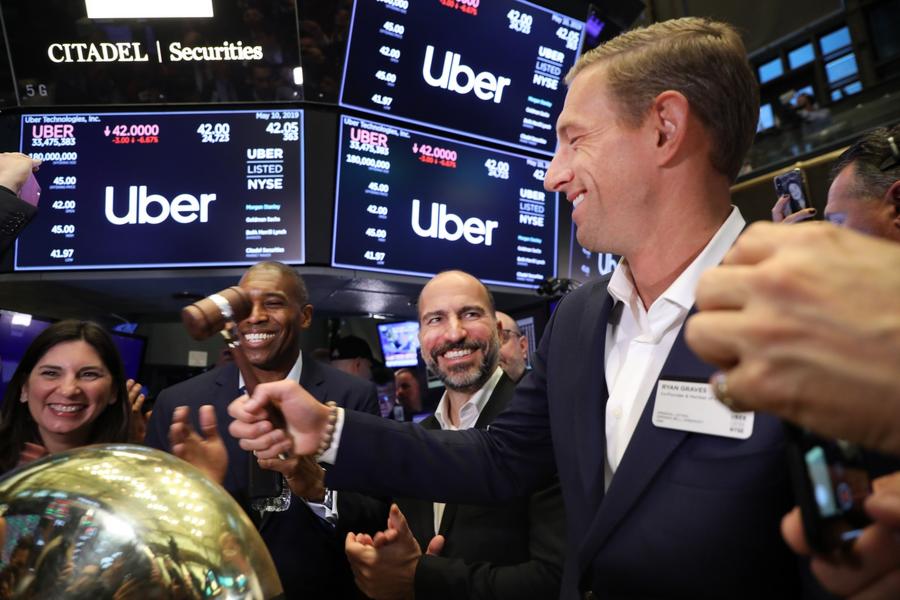
Spencer Platt/Getty Images
Life After Uber
After leaving Uber, Graves shifted away from the intensity of Silicon Valley. He founded Saltwater, a family office focused on investing in capital-efficient and practical businesses rather than high-burn startups. His investments have included companies like Metromile and Coco Robotics.
He relocated to Kauai, Hawaii, where he lives with his wife and four sons. His lifestyle reflects a deliberate move toward privacy and balance, centered around family and personal interests like surfing. In late 2021, entities controlled by Graves paid $20 million for a 245-acre legacy ranch in Woody Creek, Colorado.
The Ultimate Return on Investment
Venture Capitalists tend to use Return on Investment ("ROI") as a way to brag about their wins. For example, if a VC put $10 million into a company that eventually sold for $1 billion, that would be an absolutely amazing ROI.
Think about Ryan Graves' ROI. He flipped a 47-character Twitter reply into a $1.4 billion (minimum) fortune!
Best of all, he hasn't spent the last decade furiously seeking out his next big hit. Rather than letting the tech machine consume him, he used his winnings to buy his way out of it.
Ryan Graves proves that sometimes, the most lucrative thing you can do is just raise your hand and say, "Here's a tip. Email me."
/2015/03/rg2.jpg)
/2019/05/rg.jpg)
/2022/10/Adam-Goldberg.jpg)
/2022/03/Ketanji-Brown-Jackson.jpg)
/2019/04/GettyImages-696041476.jpg)
/2016/11/mark-zuckerberg.jpg)
/2009/11/George-Clooney.jpg)
/2020/02/Angelina-Jolie.png)
/2019/10/denzel-washington-1.jpg)
/2019/04/rr.jpg)
/2020/01/lopez3.jpg)
/2009/09/Cristiano-Ronaldo.jpg)
:strip_exif()/2015/09/GettyImages-476575299.jpg)
/2020/06/taylor.png)
/2018/03/GettyImages-821622848.jpg)
/2009/09/Jennifer-Aniston.jpg)
/2017/02/GettyImages-528215436.jpg)
/2009/09/Brad-Pitt.jpg)
/2020/04/Megan-Fox.jpg)
/2019/11/GettyImages-1094653148.jpg)
:strip_exif()/2009/09/P-Diddy.jpg)