
In a decade of having Apple TV, I have rented exactly one movie.
It's not because I'm cheap. I pay for half a dozen streaming services, so the idea of then paying extra for a one-off rental just goes against my wiring. And as you've probably experienced, almost every movie that starts out as a paid rental shows up on a streaming service within a couple of months anyway.
But on October 5, 2023, I made an exception.
That night, I paid $4.99 to rent the movie "BlackBerry," the true story of the incredible rise and catastrophic fall of Research In Motion, the company behind the pioneering BlackBerry smartphone.
It was worth every penny. Even when it popped up on Hulu for free in February 2024, I still didn't regret my purchase.
"BlackBerry" is one of those rare perfect movies. It's an incredible true story. It's smart. It's funny. And, most appropriately for any CelebrityNetWorth reader, it's a story about the most unlikely people on earth making massive fortunes in a totally innovative and unexpected way.
And I have good news. If you have not seen "BlackBerry," it was just added to Netflix a few days ago.
If you've seen the movie, you'll definitely agree that the most interesting real-life character is company co-founder, Douglas Fregin.
Fregin is the eccentric, headband-wearing genius engineer who serves as the company's creative backbone, the guy actually building the technology that made BlackBerry possible. He was the one in the lab designing early circuit boards, solving the technical problems behind secure mobile communication, and helping turn a scrappy startup into a global communications powerhouse. In many ways, he was Research In Motion's version of Steve Wozniak.
And thanks to one extremely risky decision, Fregin ended up as the only person involved in Research In Motion to walk away a billionaire.
Not because he built the company better than his partners. But because he knew exactly when to leave it.
By the way. Doug is extremely secretive and private. He doesn't give interviews, and there aren't many photos of him online. The only photos available to license in Getty Images are from 2014, when Doug participated in the Toyota of Long Beach Grand Prix:
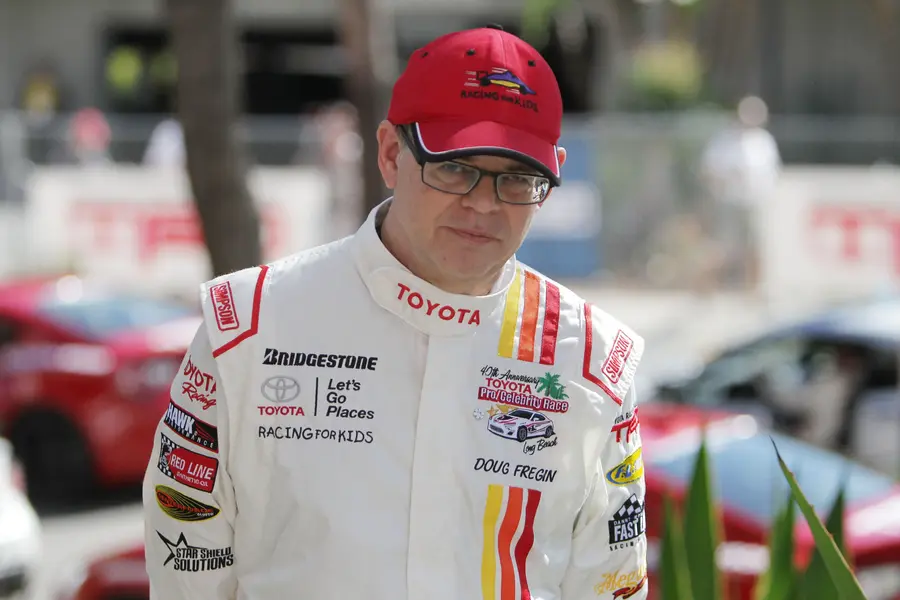
Douglas Fregin (Photo by Leon Bennett/WireImage)
Research In Motion
The company that would eventually create the BlackBerry, Research In Motion, was actually founded in 1984 by Doug Fregin and his childhood friend Mike Lazaridis.
As teenagers in the 1970s, the two were already experimenting with electronics, winning a science fair with a working solar-powered water heater. A decade later, they reunited with just $15,000 and a shared belief that wireless communication was going to change everything.
At first, RIM wasn't building phones. It was essentially a high-end engineering shop taking on whatever advanced wireless or electronics projects it could land.
Their first major breakthrough came in the late 1980s and early 1990s, when they began developing wireless data transmission systems. Around the same time, they built the DigiSync Film KeyKode Reader, which revolutionized film editing by allowing studios to scan film barcodes at high speed instead of manually processing them frame by frame. The technology was so impactful that it earned RIM a Technology and Engineering Emmy Award in 1994 and an Academy Award for Technical Achievement in 1999.
But the real opportunity wasn't Hollywood.
It was email.
The Accidental Birth of BlackBerry
In the early 1990s, email was exploding in corporate America, but there was one massive limitation: you could only access it from a desktop computer.
Lazaridis became obsessed with a simple idea: what if you could receive and send email anywhere, instantly?
That sounds obvious today. At the time, it was revolutionary.
The problem was that the underlying wireless networks were incredibly limited. Bandwidth was tiny. Connections were unreliable. Devices had to be small, durable, and power-efficient. Most engineers in the industry didn't think it was practical.
This is where Doug Fregin came in.
While Lazaridis focused on the vision, Fregin focused on making it physically possible. He designed the early circuit boards, optimized power usage, and helped build hardware that could reliably send tiny packets of data over weak wireless networks. Every constraint, battery life, signal strength, size, had to be engineered from scratch.
RIM's first real step in this direction was a two-way pager released in the mid-1990s. It allowed users to send and receive short messages over wireless networks, a major leap beyond traditional one-way pagers.
Then came the breakthrough.
In 1999, RIM released the first true BlackBerry device: a small, keyboard-equipped handheld that could send and receive real-time email. It used RIM's proprietary network and servers to "push" messages instantly to the device, something no competitor could do reliably at the time.
That "push email" feature changed everything.
Executives became addicted almost overnight. Lawyers, bankers, and government officials suddenly had their inbox in their pocket at all times. The devices were so habit-forming they earned the nickname "CrackBerry."
And just like that, a niche engineering company from Canada became the center of the mobile communication universe.
From Niche Gadget to Global Obsession
What started as a clever piece of engineering quickly became a full-blown cultural and corporate phenomenon.
By the early 2000s, BlackBerry devices were everywhere that power and money intersected. Investment bankers, hedge fund managers, corporate executives, lawyers, politicians, they all had one clipped to their belt or glued to their hand.
And it wasn't just a status symbol. It was a competitive advantage.
For the first time in history, high-level professionals could respond to emails instantly, no matter where they were. Deals moved faster. Decisions happened in real time. Entire industries quietly reshaped themselves around the expectation of constant availability.
BlackBerry didn't just create a product. It rewired behavior.
The devices were so addictive that users joked about needing rehab. The nickname "CrackBerry" stuck, and it wasn't an exaggeration. People checked their devices at dinner, in meetings, in bed, on vacation. If your BlackBerry buzzed, you looked. Immediately.
And Wall Street noticed.
The IPO and the First Fortune
Research In Motion went public in 1997 with a valuation of roughly $470 million.
At the time, Doug Fregin owned 5% of the company, giving his stake a value of around $23.5 million.
That already felt like a massive win. A little over a decade after launching the company with just $15,000, Fregin had quietly become one of Canada's newest multi-millionaires.
But that was just the beginning.
As the dot-com boom accelerated, investors became obsessed with anything tied to wireless communication and the internet. RIM checked both boxes.
By early 2000, the company's market cap had exploded to roughly $18.6 billion.
At that point, his stake was worth $930 million.
2000 – 2007: The Peak of BlackBerry & RIM
After surviving the dot-com crash and a brutal, years-long patent lawsuit with a company called NTP that nearly shut down its U.S. service, Research In Motion entered its most dominant phase.
By 2005, the company had over 4 million subscribers. By 2007, that number was approaching 10 million and growing rapidly. BlackBerry had become the default communication tool for the global business class.
The stock reflected that dominance.
RIM's market cap climbed back to roughly $15 billion by the mid-2000s, and investor confidence returned in full force. To most observers, the company looked unstoppable.
Doug Fregin's stake, which had been diluted over time to around 2.7%, was now worth roughly $400 million.
And this time, unlike the dot-com era, the business fundamentals seemed real. Revenues were strong. Adoption was accelerating. The product had no serious competitor.
If you were inside the company, this probably felt like the beginning of something even bigger.
But in January 2007, something happened that would change everything.
The iPhone Moment
On January 9, 2007, Steve Jobs walked onto a stage and introduced the iPhone.
Inside Research In Motion, the reaction was dismissive.
Executives publicly pointed out what they saw as obvious flaws. The battery life would be terrible. The touchscreen keyboard would never work for serious business users. The device relied too heavily on data networks that weren't yet robust enough.
From their perspective, it looked like a flashy consumer gadget, not a real threat.
But not everyone saw it that way.
Just a few months later, in May 2007, Doug Fregin made a move that, at the time, made very little sense to outsiders.
He retired.
No long goodbye. No extended transition. He simply stepped away from the company he had co-founded more than two decades earlier.
At the time of his departure, Research In Motion stock was trading at roughly $60 per share, giving the company a market cap of around $30–35 billion. Over the following months, as he gradually sold his shares, the stock continued to climb.
By the end of 2007, Doug Fregin had converted his stake into somewhere between $1 billion in cash. And that was on top of hundreds of millions he made from earlier sales.
He cashed out and walked away.
Timing is Everything
For a minute, this actually seemed like a terrible move.
Just over a year later, on June 19, 2008, the stock hit an all-time high of $147.55 per share, pushing Research In Motion's market cap to roughly $84 billion.
If Fregin had still owned roughly 2.7% of the company at that peak, his stake would have been worth approximately $2.3 billion.
If he had somehow maintained his original 5% stake, it would have been worth roughly $4.2 billion.
From the outside, it looked like he had jumped out of a rocket ship seconds before it reached orbit.
Unfortunately (for RIM shareholders), that moment would prove to be the absolute peak.
The Fall
The decline wasn't immediate.
At first, it looked like a normal pullback. After peaking in mid-2008, the stock slipped into the $80s… then the $60s… then the $40s. Investors told themselves it was temporary. BlackBerry still had millions of loyal users. It still dominated corporate email. It still felt essential.
But the underlying reality had already shifted.
By 2010, the stock was struggling to hold $60. By 2011, it was cut in half again. And by late 2012, shares were trading under $10.
From peak to trough, BlackBerry stock would eventually fall by more than 95%.
And the people who held on the longest paid the highest price.
The Co-Founders Who Stayed
At the 2008 peak, Jim Balsillie, the company's aggressive, deal-making co-CEO, owned roughly 5% of the company, a stake worth around $3.4 billion.
He didn't sell.
He held on as the iPhone and Android took over. He held on as BlackBerry missed product cycles, lost market share, and struggled to adapt to a touchscreen world.
By the time Balsillie finally exited in 2012, his stake was worth somewhere between $167 million and $390 million, depending on the timing of his sales.
Mike Lazaridis, the company's visionary co-founder, followed a similarly painful path.
At the peak, Mike was actually the richest of the three, with a stake worth around $3.8 billion.
But instead of selling, he did something even more remarkable.
He bought more.
Corporate filings show that in 2012, as the stock was collapsing, Lazaridis increased his ownership from about 5.1% to 5.7%, effectively doubling down on a falling knife.
It didn't work.
By 2013, he was forced to sell large blocks of shares for a fraction of their former value. His fortune dropped below the billionaire threshold, erasing billions in paper wealth that had once seemed permanent.
Meanwhile, Doug Fregin was busy enjoying one of the most successful "stealth" retirements in financial history.
While his former partners were appearing on magazine covers and fighting a losing war against Apple and Google, Doug was effectively a ghost. He didn't write a memoir, he didn't launch a "disruptive" VC firm, and he didn't even upgrade his wardrobe—remaining, by all accounts, the same low-key guy who preferred Hawaiian shirts and a workshop to a boardroom.
In 2013, he reunited with his old friend Mike Lazaridis to found Quantum Valley Investments. They put $100 million of their own money toward a simple, if lofty, goal: turning their hometown of Waterloo, Ontario, into the global hub for quantum computing.
When he isn't funding the next generation of subatomic computing, Doug indulges in the one hobby that actually gets him in front of a camera: high-speed auto racing. He's become a fixture in pro-am racing circuits like the Ferrari Challenge and the Toyota Grand Prix of Long Beach. It's the perfect hobby for a guy like Fregin—a pursuit defined by precision engineering and wearing a helmet that makes it impossible for anyone to recognize him.
And what about the other two? While the stock crash was painful, don't feel too bad for Mike and Jim. They remain two of the most influential (and wealthy) figures in Canada.
- Mike Lazaridis: Current net worth $600 million. Beyond Quantum Valley, he has donated hundreds of millions to found the Perimeter Institute for Theoretical Physics and the Institute for Quantum Computing. He's effectively spent the last decade trying to solve the hardest problems in physics, with a net worth still estimated in the high hundreds of millions.
- Jim Balsillie: Current net worth $500 million. Jim pivoted from smartphones to global policy and space. He is a major shareholder and director of MDA Space (a leader in satellite technology) and founded the Council of Canadian Innovators. He has made multiple attempts to buy an NHL team.
In the end, all three men walked away with more money than they could ever spend. But Doug Fregin is the only one who did it without the stress of a collapsing empire. He is living proof of the most important rule in wealth preservation: It's not about how much you make on the way up; it's about how much you keep on the way down.
/2023/06/Mike-Lazaridis.jpg)
/2010/03/Jim-Balsillie.jpg)
/2020/06/jb2.jpg)
/2023/04/jobs.jpg)
/2021/01/jc.jpg)
/2009/10/Steve-Wozniak.jpg)
/2017/02/GettyImages-528215436.jpg)
/2020/06/taylor.png)
/2009/11/George-Clooney.jpg)
/2019/04/rr.jpg)
/2009/09/Cristiano-Ronaldo.jpg)
/2009/09/Brad-Pitt.jpg)
/2009/09/Jennifer-Aniston.jpg)
/2019/10/denzel-washington-1.jpg)
/2020/02/Angelina-Jolie.png)
/2019/11/GettyImages-1094653148.jpg)
/2020/04/Megan-Fox.jpg)
/2020/01/lopez3.jpg)
:strip_exif()/2015/09/GettyImages-476575299.jpg)
/2018/03/GettyImages-821622848.jpg)
:strip_exif()/2009/09/P-Diddy.jpg)