
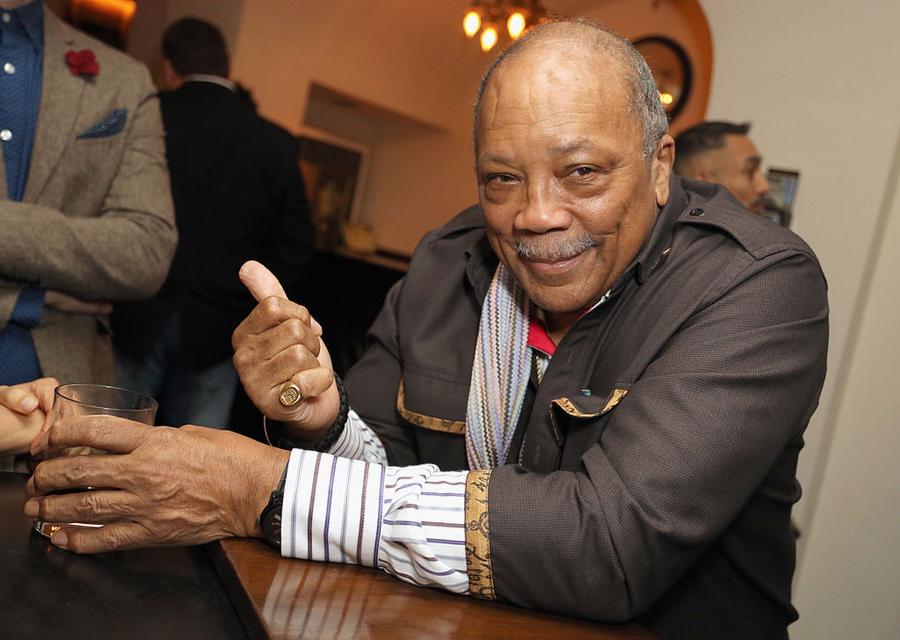
It was just revealed that the estate of legendary producer Quincy Jones sold a significant portion of his music and media assets to investment firm HarbourView Equity Partners. The deal includes recorded music, publishing rights, and even participation in non-music properties like "The Fresh Prince of Bel-Air," along with a partnership around Jones' name, image, and likeness.
One key detail was notably absent from every report: the price. No official number has been disclosed. Not even a range.
However.
By looking at comparable deals and, more importantly, the actual assets involved, we can start to build a very educated estimate. An estimate that we think ultimately lands in the $300 million to $500 million range. For what it's worth, when he was alive, we assigned a $400 million value to his catalog when calculating his $500 million net worth.
To understand just how large this deal might be, it helps to start with a much smaller, more straightforward catalog sale.
Rachel Murray/Getty Images
Using Slipknot as a Benchmark
In late 2025, HarbourView reportedly acquired a majority stake in the catalog of heavy metal band Slipknot for approximately $120 million.
Slipknot is hugely successful within its genre, but it is still a niche act compared to mainstream pop superstars. Here are some stats on Slipknot:
- 30 million albums sold worldwide
- Seven studio albums, including multiple No. 1 debuts on the Billboard 200
- A fiercely loyal global fanbase driven heavily by touring and merchandise
- Highest-charting single: "Psychosocial," which peaked at No. 67
- Limited crossover radio presence and relatively modest long-tail publishing income compared to pop catalogs
Even at $120 million, this reflects a strong but genre-specific catalog, with most of its value tied to album sales and fan-driven consumption rather than decades of radio, licensing, and sampling revenue.
Now, let's compare that to what Quincy Jones brought to the table.
What Was Included in Quincy Jones' Sale
Unlike the Slipknot deal, which centers on one band's recording catalog, the Quincy Jones transaction is vastly broader and more valuable. Here's what HarbourView acquired:
- The Michael Jackson Trifecta
- Production and songwriting interests in "Off the Wall," "Thriller," and "Bad"
- "Thriller" alone has sold an estimated 70+ million copies worldwide
- "Bad" produced five No. 1 Billboard Hot 100 singles
- Combined, these albums represent one of the most valuable royalty streams in music history
- It is important to note that Jones did not own the master recordings for these albums (those belong to Sony and the Jackson estate). Instead, HarbourView acquired his "producer points"—a contractual percentage of royalties earned from every physical sale, digital stream, and sync license.That said, a few percentage points of Thriller is still worth more than most artists' entire master catalogs.
- Publishing and Signature Compositions
- Ownership stakes in compositions like "Soul Bossa Nova" (famously used in the "Austin Powers" films)
- Production work on major hits like George Benson's "Give Me the Night"
- Ongoing licensing revenue across film, TV, and advertising
- Sampling Royalties
- Continuous income from songs that sample his work
- Includes major tracks like 2Pac's "How Do U Want It" and Kanye West's "Good Life"
- Long-tail revenue that grows as new artists continue to sample classic recordings
- Television and Media Income
- Executive producer participation in "The Fresh Prince of Bel-Air"
- Ongoing syndication, streaming, and licensing revenue from a globally recognized TV franchise
- Name, Image, and Likeness (NIL)
- Rights tied to Quincy Jones' name, image, and legacy
- Future opportunities in documentaries, biopics, brand deals, licensing, and emerging AI use cases
Put simply, comparing Slipknot's $120 million catalog sale to Quincy Jones' assets is like comparing a successful band to an entire entertainment ecosystem.
Slipknot:
- ~30 million albums sold
- Limited Billboard Hot 100 success
- Primarily recording-based revenue
Quincy Jones:
- Central role in albums that have sold well over 100 million copies combined
- Multiple No. 1 singles tied to his production work
- Ongoing publishing, sampling, and licensing income
- Television and media royalties
- Global brand value tied to his name and legacy
And perhaps most importantly, Quincy Jones' catalog is not just historically successful. It is evergreen. "Thriller" still streams. It still sells. It still licenses. It still generates revenue every single year, decades after its release.
So What Was It Worth?
Again, no official number has been disclosed.
But when you line up the assets involved and compare them to recent deals across the industry, it becomes very difficult to imagine this transaction landing anywhere near $120 million.
Here are some of the largest recent catalog sales for context:
- Bruce Springsteen: ~$500 million for his publishing and recorded music catalog
- Bob Dylan: ~$300–$400 million for his songwriting catalog (publishing)
- Genesis: ~$300 million for publishing and recorded music rights
- Michael Jackson (partial stake sold to Sony): ~$600 million for 50% of his catalog
- The Notorious B.I.G. (reported negotiations): ~$100–$150 million for partial rights
- Slipknot: ~$120 million for a majority stake in their catalog
Based on comparable sales, the diversity of income streams, and the sheer cultural weight of the catalog, a reasonable estimate would place the Quincy Jones deal somewhere in the $300 million to $500 million range.
Who Gets The Money?
Whenever a deal of this size happens after someone's death, the next obvious question is: who actually receives the money?
In Quincy Jones' case, the proceeds would flow into his estate, which is then distributed according to his will or trust. Jones is survived by seven children, including actress Rashida Jones, and at the time of his death, he was not married and did not have a surviving spouse.
Before any distributions are made, however, the estate itself likely takes a significant hit from taxes.
At the federal level, large estates are subject to a 40% estate tax on amounts above the exemption threshold. Given that Quincy's net worth was estimated at $500 million, a substantial portion of his estate could be subject to taxation, depending on how his assets were structured and what estate planning strategies were in place.
For a simple "napkin math" estimate, let's assume the catalog sale generated somewhere between $300 million and $500 million:
- Estimated gross proceeds: $300–$500 million
- Potential estate tax (up to ~40%): $120–$200 million
- Estimated net after taxes: $180–$300 million
From there, the remaining proceeds would be distributed to his heirs.
If we assume an even split among his seven children:
- Estimated number of heirs (children): 7
- Estimated payout per child: ~$25 million to $43 million
Of course, this is a simplified estimate. In reality, Jones likely had trusts, charitable giving plans, and other estate structures in place that could significantly reduce taxes and alter how assets are distributed.
It's also possible that certain assets were already transferred or earmarked before his death, which would further change the final numbers.
Still, even with conservative assumptions, this deal likely represents a massive generational wealth transfer, with each of Quincy Jones' children potentially receiving tens of millions of dollars from just this one transaction alone.
/2020/02/quincy.jpg)
/2017/07/GettyImages-475154623.jpg)
/2016/09/Quincy-Jones-III.jpg)
/2016/08/GettyImages-533595602.jpg)
/2022/01/GettyImages-88440914.jpg)
/2025/08/The-Weeknd.jpg)
/2009/09/Jennifer-Aniston.jpg)
/2009/11/George-Clooney.jpg)
/2009/09/Brad-Pitt.jpg)
/2009/09/Cristiano-Ronaldo.jpg)
/2020/01/lopez3.jpg)
/2020/04/Megan-Fox.jpg)
/2020/02/Angelina-Jolie.png)
/2019/10/denzel-washington-1.jpg)
/2019/11/GettyImages-1094653148.jpg)
:strip_exif()/2009/09/P-Diddy.jpg)
/2018/03/GettyImages-821622848.jpg)
/2020/06/taylor.png)
/2019/04/rr.jpg)
/2017/02/GettyImages-528215436.jpg)
:strip_exif()/2015/09/GettyImages-476575299.jpg)