
For people who enjoy reading stories about extreme wealth, March 12 should be a holiday. If it was a holiday, today we would be celebrating the 40th anniversary of the launch of one of the greatest wealth-creating machines in human history. What happened 40 years ago today? That's the day a database company in Silicon Valley called Oracle went public.
The events of March 12, 1986, would eventually mint thousands of millionaires and one of the absolute largest personal fortunes in human history.
How much wealth did Oracle generate for its founder, and where is that wealth today? How rich would you be today if you had been lucky enough to buy $10,000 worth of ORCL on March 12, 1986, and held for the next 40 years, collecting dividends and new shares from stock splits? Let's find out!
Early History of Oracle
Oracle was founded in 1977 by Larry Ellison, Bob Miner, and Ed Oates under the name Software Development Laboratories (SDL). Ellison had read a research paper by an IBM computer scientist about relational database models and immediately realized the massive commercial potential.
Fun fact: Their very first customer was the CIA. The CIA hired the trio to build a database system, and the code name for that project was "Oracle." A few years later, realizing the power of the brand, they officially changed the company's name to Oracle Systems Corporation.
The IPO & The Divergent Paths
March of 1986 was a legendary month for tech IPOs. Literally ONE DAY after Oracle went public on March 12, a little Seattle software company called Microsoft had its own IPO.
When Microsoft went public, Bill Gates owned 45% of his company. Over the next 40 years, Bill sold literally 98% of his Microsoft shares. Today, he owns less than 1% of the company he founded. Hindsight is 20/20, but Bill made a massive mistake. Let's say Bill was just slightly less aggressive with his stock sales over the decades. Let's say today he still owned 30% of Microsoft. Today, Microsoft has a market cap of $3 trillion, so with a 30% stake, Bill Gates would be a trillionaire. And if you think it's crazy that a founder would still own so much of their company four decades after it went public…
When Oracle went public at $15 per share on March 12, 1986, Larry owned 39% of the company. Instead of selling, Larry held on with a vice grip. In fact, through aggressive share buyback programs that retired outstanding stock, Larry's ownership percentage actually increased over the decades. Today, at 81 years old, Larry Ellison owns roughly 42% of Oracle.
Because he never sold, his fortune has remained directly tethered to Oracle's explosive growth.
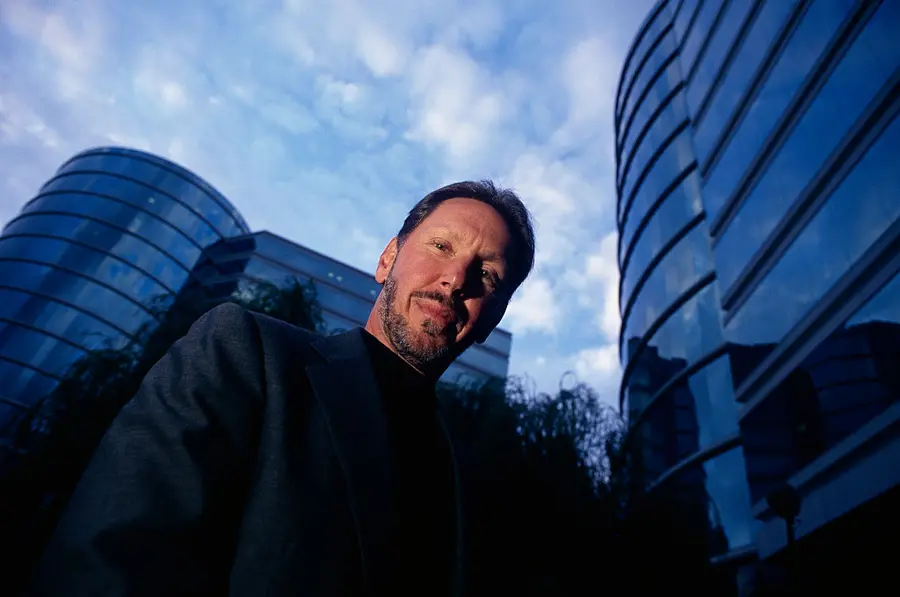
(Photo by mark peterson/Corbis via Getty Images)
How Oracle Became an AI Powerhouse
For decades, Oracle was viewed as a powerful but relatively conservative enterprise database dinosaur—dominant, but far removed from the buzz of consumer tech. But as the AI arms race exploded, Oracle found itself sitting on exactly what companies like OpenAI needed: massive, high-performance cloud infrastructure and specialized GPU clusters.
When Oracle announced massive multi-billion-dollar infrastructure deals with OpenAI and phenomenal cloud growth projections, the stock went nuclear. And because Larry still owned 42% of the company, this stock surge generated unprecedented wealth.
In September 2025, when Oracle hit an all-time high, Larry Ellison's net worth increased by $100 billion in a matter of months. On September 10, he very briefly overtook Elon Musk to become the #1 richest person in the world with a net worth briefly touching an unthinkable $400 billion.
Oracle's stock price has lagged quite a bit since those September highs, but today, Larry's net worth sits comfortably around $214 billion, making him the #6 richest person on earth. Bill Gates' net worth is currently $105 billion, which makes him the world's 17th richest person.
My Favorite Billionaire
Larry Ellison is the billionaire you'd invent if you were 15. A real-life Tony Stark. He is unapologetically extravagant, fiercely competitive, and completely unbothered by modesty.
While other billionaires talk about "quiet luxury," Larry buys $175 million mansions in Florida, then buys the $300 million luxury resort next door just to complete the vibe. He owns a fleet of private planes, including decommissioned military fighter jets. He runs the Indian Wells tennis tournament. He owns 1.4% of Tesla. In 2012, he bought 98% of the Hawaiian island of Lāna'i for $300 million. Not a house. The entire 140-square-mile island.
But his biggest flex just happened. Larry's son, David Ellison, is the CEO of Skydance Media and recently orchestrated the takeover of two legacy Hollywood studios. First, he acquired Paramount in an $8 billion merger. Then, just weeks ago, David followed that up by finalizing an astonishing $110 billion acquisition of Warner Bros. Discovery. How did David secure the financing to swallow a media empire of that size? His dad stepped in. Larry Ellison provided a massive personal guarantee of over $40 billion in equity financing to back the Warner Bros. deal. Imagine walking into a boardroom and personally backing a $40 billion corporate buyout check using your stock portfolio as the ultimate trump card.
$10,000 Invested In 1986
So, how much would you be worth today if you followed Larry's lead, bought a bunch of ORCL shares on IPO day, and never sold?
Here is exactly how a $10,000 investment would have transformed over four decades:
- The Initial Purchase: Buying in at the initial offering price of $15 per share, your $10,000 would have netted you exactly 666 shares of Oracle stock.
- The Stock Splits: Over the years, Oracle conducted 10 separate stock splits (a mix of 2-for-1 and 3-for-2 splits between 1987 and 2000). Because of the compounding math of those splits, a single original IPO share multiplied by a factor of 324.
- The Pre-DRIP Share Count: Your original block of 666 shares would have ballooned into a massive stockpile of 215,784 shares.
- The DRIP Snowball: Oracle, like many tech companies, didn't issue a dividend in its early years, finally initiating one in 2009. If you had immediately enrolled in a Dividend Reinvestment Plan (DRIP) to automatically buy more stock with your quarterly cash payouts, your stockpile would have grown over the last 17 years to roughly 280,000 shares today.
At today's trading price of roughly $150 per share, your $10,000 investment would be worth an incredible $42 million.
And just like Larry, you wouldn't need to sell a single share to live like royalty. Oracle currently pays an annual dividend of $2.00 per share. Without lifting a finger, your ~280,000 shares would generate roughly $560,000 in purely passive dividend income every single year.
/2025/09/larry-ellison-1996.jpg)
/2020/03/GettyImages-1057592782.jpg)
/2017/03/GettyImages-52596483.jpg)
/2025/07/gates.png)
/2024/01/bill-gates.jpg)
/2026/03/apple-ipo-image.png)
/2009/09/Cristiano-Ronaldo.jpg)
:strip_exif()/2009/09/P-Diddy.jpg)
/2019/10/denzel-washington-1.jpg)
/2009/09/Jennifer-Aniston.jpg)
/2020/01/lopez3.jpg)
/2020/02/Angelina-Jolie.png)
:strip_exif()/2015/09/GettyImages-476575299.jpg)
/2018/03/GettyImages-821622848.jpg)
/2020/06/taylor.png)
/2020/04/Megan-Fox.jpg)
/2019/04/rr.jpg)
/2009/09/Brad-Pitt.jpg)
/2019/11/GettyImages-1094653148.jpg)
/2017/02/GettyImages-528215436.jpg)
/2009/11/George-Clooney.jpg)