
A few weeks ago, I published an article exploring the financial legacy left behind by the late John F. Kennedy Jr. In that article, I specifically tried to answer two questions:
- How much money did JFK Jr. actually have when he died in 1999?
- And who ultimately inherited it?
When JFK Jr.'s will was filed in Manhattan Surrogate's Court in late 1999, the document simply stated that his estate was worth "more than $1 million." To the casual observer, that might have sounded surprisingly modest for the heir to America's most famous political dynasty. After all, JFK Jr.'s grandfather, Joseph P. Kennedy, was one of the richest people in America in the 1930s, 40s, and 50s.
Joe Kennedy earned his first fortune on Wall Street during the roaring 1920s. A shrewd and aggressive investor, he built wealth through stock pools, arbitrage, and strategic speculation during one of the most exuberant bull markets in American history. Crucially, he also knew when to step away. By 1929, sensing that the market had become dangerously overheated, Kennedy began liquidating many of his positions and shifting into short positions just before the crash.
He later joked that he knew the market had peaked when even his shoe-shine boy started giving him stock tips.
But Wall Street speculation was only the beginning.
During the Great Depression, Kennedy used his capital to buy assets that other investors were desperately trying to unload. He accumulated real estate at deeply discounted prices and expanded into other industries, including film distribution and production. In the late 1920s, he acquired control of Film Booking Offices of America and helped assemble what eventually became RKO Pictures, one of the major Hollywood studios of the era.
In 1945, Kennedy purchased Chicago's massive Merchandise Mart for just under $13 million. At the time, the building was considered something of a financial oddity—too large, too expensive, and difficult to manage. Kennedy saw something different: scale, stability, and steady rental income.
Over the following decades, the Mart became one of the crown jewels of the Kennedy fortune and generated a reliable stream of cash for the family. In 1998, nearly 30 years after Joe Kennedy's death, the family sold the property to Vornado Realty Trust for roughly $625 million.
The reason JFK Jr.'s probate filing said "more than $1 million" becomes clearer once you understand how the Kennedy fortune was structured.
Probate filings only reveal assets held directly in a person's name. They do not reveal wealth held inside private trusts.
And thanks to Joe Kennedy, the Kennedys have been using private trusts longer—and more effectively—than almost any family in American political history.
Which brings us back to the two questions from my previous article.
- How much money did JFK Jr. actually have when he died in 1999?
- And who ultimately inherited it?
Answer #1: In the months after his death, contemporary financial reports pegged JFK Jr.'s true net worth to be between $30 million and $100 million. Adjusted for inflation, that would be roughly $60 million to $200 million today.
Answer #2: JFK Jr. died without children, and his wife died in the same crash. Therefore, under the terms of his will, his estate passed to his sister, Caroline Kennedy, and her three children:
- Rose Kennedy Schlossberg
- Tatiana Kennedy Schlossberg
- John B. Kennedy Schlossberg
At the time of the crash, they were 11, 9, and 6 years old, respectively. Tragically, Tatiana just died the past December at the age of 35 after a battle with leukemia. Rose, 37, is a Peabody Award-winning filmmaker. John, 33 (who goes by Jack), is currently running for Congress to represent New York's 12th district.
And as any Congressional candidate is required to do, yesterday Jack filed his Congressional Financial Disclosure Report. You can read the full 25-page document here if you're interested. But I'm also about to summarize what it reveals. Because for the first time in decades, a public filing has given us a small but fascinating glimpse into the modern financial structure of the Kennedy dynasty.
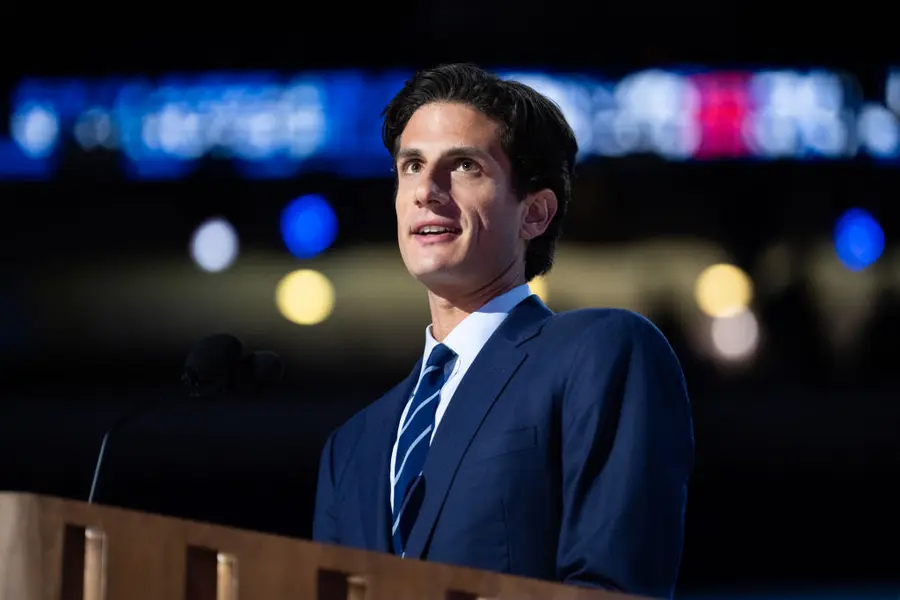
(Tom Williams/CQ-Roll Call, Inc via Getty Images)
What Jack Schlossberg's Financial Disclosure Reveals
Long story short, the disclosure suggests that the 33-year-old Jack Schlossberg is personally worth somewhere in the neighborhood of $20 million.
Like most congressional financial disclosures, Schlossberg's filing lists asset ranges rather than precise values. But even within those ranges, the document paints a remarkably clear picture.
First, it shows that the 33-year-old Schlossberg personally controls a multi-million-dollar investment portfolio spread across several brokerage accounts at JPMorgan and Goldman Sachs. Those accounts contain a fairly typical mix of modern wealth-management assets, including:
- Index funds and exchange-traded funds
- Municipal bonds issued by New York public authorities
- Precious metals funds tied to gold and silver
- Private credit and venture investment funds
- Individual stock positions
The individual stock holdings list positions in companies such as:
- Apple
- Microsoft
- Amazon
- Nvidia
- Visa
- Coca-Cola
- JPMorgan Chase
- Walmart
The filing also reveals positions in private investment vehicles. One of the largest listed assets is an interest in the Antares Strategic Credit Fund, which is valued somewhere between $1 million and $5 million.
He is also an investor in a restaurant in Ojai, California, called Rory's Place. Jack's sister, Rose, is married to the "Rory" in Rory's Place. According to his filing, this investment is worth between $1,000 and $15,000. Furthermore, the filing showed the restaurant paid him ZERO dollars last year and between $15,000 and $50,000 in the previous year.
Scattered throughout the filing are references to several family trusts connected to Schlossberg. These trusts hold diversified portfolios of index funds and ETFs, but they also control a handful of much more intriguing assets. These trusts are the real driver of Jack's wealth.
Scattered throughout the filing are references to several family trusts connected to Schlossberg. These trusts hold diversified portfolios of index funds and ETFs, but they also control a handful of much more intriguing assets.
One trust lists ownership stakes in Wolf Point Owners LLC, a major commercial real-estate development on the Chicago River. This asset is valued at between $1 million and $5 million.
A separate trust also includes ownership stakes in Red Gate Farm LLC, the Martha's Vineyard estate originally purchased by Jacqueline Kennedy Onassis. Schlossberg's disclosure lists trust interests tied to the property valued between $500,000 and $1 million, while another direct ownership stake in the property is listed at $1 million to $5 million.
| Asset Category & Major Holdings | Estimated Value |
|---|---|
| Personal Brokerage Portfolio Goldman Sachs & JPMorgan (Index Funds, ETFs, Gold) | $6.0M – $12.0M |
| Chicago Real Estate Trust interest in Wolf Point Owners LLC | $2.0M – $5.0M |
| Family Trust Assets Diversified portfolios and Article Fifth Trust holdings | $2.0M – $6.0M |
| Martha's Vineyard Estate Ownership stake in Red Gate Farm | $1.5M – $6.0M |
| Oil & Gas Royalties Interests held through Arctic Royalty LP | $100k – $300k |
| Cash & Liquid Accounts Disclosed checking and money market balances | $100k – $200k |
| Estimated Net Worth (Midpoint) | ~$20.0 Million |
When Joseph P. Kennedy set up his first family trusts nearly a century ago, his goal was to ensure that his descendants would never have to worry about money—and by extension, would always have the freedom to pursue power.
Looking at Jack Schlossberg's 2026 disclosure, it's clear the plan worked.
While Jack's $20 million net worth is substantial, the real takeaway isn't the number—it's the stability. His wealth isn't tied to a volatile startup or a single high-salary job; it is anchored in the same types of assets his grandfather and great-grandfather favored: blue-chip stocks, essential real estate, and government-backed bonds.
Whether Jack wins his seat in NY12 or not, the Kennedy financial engine remains the most successful 'blind trust' in American history. It is a quiet, 100-year-old compounding machine that allows the family to lose elections, endure tragedies, and exit the spotlight for decades, only to re-emerge exactly where they left off: wealthy, influential, and ready for the next campaign."
/2026/03/jack-schlossberg.jpg)
/2026/02/jfk-jr-scaled.jpg)
/2025/07/pelosi.jpg)
/2022/12/leon-black.jpg)
/2026/01/Ilhan-Omar.png)
/2025/09/ilhan-tim.jpg)
/2020/02/Angelina-Jolie.png)
/2009/09/Brad-Pitt.jpg)
/2019/04/rr.jpg)
/2018/03/GettyImages-821622848.jpg)
/2019/10/denzel-washington-1.jpg)
/2019/11/GettyImages-1094653148.jpg)
:strip_exif()/2015/09/GettyImages-476575299.jpg)
/2020/06/taylor.png)
/2017/02/GettyImages-528215436.jpg)
/2020/01/lopez3.jpg)
/2020/04/Megan-Fox.jpg)
/2009/09/Cristiano-Ronaldo.jpg)
/2009/11/George-Clooney.jpg)
/2009/09/Jennifer-Aniston.jpg)
:strip_exif()/2009/09/P-Diddy.jpg)