
In the early 1990s, long before he was running a presidential campaign, serving in the White House, or getting arrested for alleged financial crimes while living on the yacht belonging to a fugitive Chinese billionaire, Steve Bannon was living a far quieter life. He was an anonymous investment banker.
At the time, he was working on a media deal that suddenly hit a familiar Wall Street snag: the buyer was short on cash. Instead of walking away, Bannon was presented with an unusual alternative. Rather than take his full advisory fee in cash, he could accept a slice of the upside.
Yada yada yada…
Over the next three decades, that decision would quietly generate tens of millions of dollars in syndication royalties from "Seinfeld."
The Deal That Changed Everything
After serving in the Navy and earning an MBA from Harvard, Bannon worked at Goldman Sachs before launching his own boutique investment bank, Bannon & Co., in 1990. The firm specialized in media and entertainment deals at a time when Hollywood film libraries and television rights were starting to be viewed as serious financial assets rather than creative side projects.
To understand how this connects to "Seinfeld," we need to rewind a bit.
"Seinfeld" was created by comedian Jerry Seinfeld and writer Larry David. What began as a modest NBC pilot in 1989, initially titled "The Seinfeld Chronicles," slowly evolved into one of the most successful sitcoms in television history. Behind the scenes, the show was produced by Castle Rock Entertainment, the independent production company that handled financing, packaging, and ownership of the series.
Castle Rock itself was co-founded by director Rob Reiner and had built a strong reputation in both film and television. On the movie side, it had produced hits like "When Harry Met Sally…" and "Misery." On the television side, its most valuable asset was quickly becoming "Seinfeld," which by the early 1990s was entering its third season and beginning to gain real momentum.
In the early 1990s, Bannon & Co. advised Westinghouse Electric during the sale of Castle Rock Entertainment to Ted Turner's Turner Broadcasting.
Here's where it gets interesting.
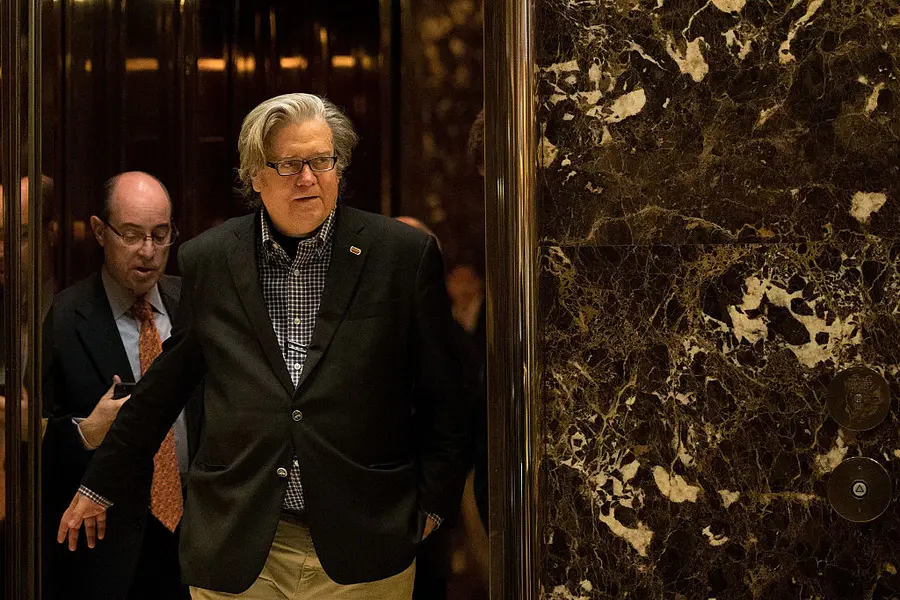
Drew Angerer/Getty Images
According to Bannon's own account in later interviews, when it came time to close the deal, Turner was short on cash. Westinghouse wanted out. Bannon reportedly urged them to move forward anyway, calling it a great deal.
Westinghouse then turned to him and said, essentially: If it's such a great deal, why don't you take part of your advisory fee in equity?
Instead of taking his full fee in cash, Bannon and his firm accepted a stake in a package of television rights tied to five Castle Rock shows.
One of those shows was still finding its footing.
"Seinfeld."
At the time of the deal, "Seinfeld" was still building its audience. It would not become the cultural and financial juggernaut it's now remembered as until a few seasons later.
"Seinfeld" ran from 1989 to 1998 and became one of the most lucrative sitcoms of all time. Netflix famously paid more than $500 million for the global rights in a five-year deal that began in 2021, and subsequent renewals and cable syndication cycles (reportedly fetching upwards of $250,000 per episode) have kept the cash floodgates open. As of 2026, the series has generated over $4.8 billion in total revenue.
How Much Could That Stake Be Worth?
The exact size of Bannon's stake has never been publicly disclosed, and "Hollywood Accounting" is notoriously complex. However, unlike individual actors who often only receive smaller residuals, Bannon's firm held backend equity points through the production company.
Multiple financial outlets have pointed out that even a 1% participation in a nearly $5 billion machine would translate to roughly $50 million in cumulative earnings.
If the participation were smaller, say half a percent, you're still talking about $25 million. While there's no public filing that breaks down the exact figure, industry experts note that Bannon likely held a "gross" participation stake, which is far more protected from the creative deductions that typically dilute "net" profits.
All from taking equity instead of cash on one advisory deal.
From Sitcom Royalties To Political War Chest
Those royalties became part of the financial cushion that allowed Bannon to pivot careers.
After selling his investment bank in the late 1990s, he moved deeper into media, producing films and later becoming executive chairman of Breitbart News. He helped finance documentaries, supported investigative projects through the Government Accountability Institute, and eventually became CEO of Donald Trump's 2016 presidential campaign before serving as White House chief strategist.
Ironically, much of that trajectory was underwritten by a show often described as being "about nothing."
How Much Did Jerry And Larry Make???
Of course, if Steve Bannon potentially made tens of millions off "Seinfeld," the natural follow-up question is:
What about Jerry Seinfeld and Larry David???!!!
From the outset of the show, Jerry Seinfeld and Larry David each owned 7.5% of the series' backend equity points. However, at the height of the show's success in the 1990s, Jerry and Larry shrewdly renegotiated their deals with NBC to double their backend participation to 15% each.
That timing could not have been better.
When "Seinfeld" was first sold into syndication in 1998, the deal reportedly generated $1.7 billion. With 15% ownership stakes, Jerry and Larry each walked away with approximately $255 million from that initial syndication cycle alone.
And that was just the beginning.
Between original episode salaries, additional syndication cycles, DVD sales, merchandise, and later streaming deals, both Jerry and Larry have earned at least $800 million each from "Seinfeld."
A Bit Of Cosmic Irony
The story has not been without controversy.
Given Bannon's political positioning and accusations from critics regarding rhetoric published under his leadership at Breitbart, some writers and former "Seinfeld" staffers—including Peter Mehlman and Jason Alexander—publicly expressed discomfort that he continued to profit from a show closely associated with Jewish creators and cast members.
Bannon has denied allegations of antisemitism.
Regardless of where anyone stands politically, the financial lesson is clear:
- Sometimes the most lucrative career move isn't founding a hedge fund or launching a startup.
- Sometimes it's saying yes when a client challenges you to put your money where your mouth is.
- In the world of high-value assets, being an owner beats being an advisor every time.
In other words: Take less cash. Take more upside.
And hope that a quirky NBC sitcom about four neurotic New Yorkers becomes a multibillion-dollar syndication machine.
Yada yada yada. Decades later, it could make you $50 million.
/2016/10/Stephen-K.-Bannon.jpg)
/2019/09/GettyImages-823254230.jpg)
/2019/09/GettyImages-133980815.jpg)
/2019/09/GettyImages-470192503.jpg)
/2010/02/GettyImages-164499690.jpg)
/2009/09/Larry-David.jpg)
/2020/04/Megan-Fox.jpg)
/2009/09/Brad-Pitt.jpg)
/2019/04/rr.jpg)
/2018/03/GettyImages-821622848.jpg)
/2020/06/taylor.png)
/2009/11/George-Clooney.jpg)
/2020/01/lopez3.jpg)
/2020/02/Angelina-Jolie.png)
/2017/02/GettyImages-528215436.jpg)
/2009/09/Jennifer-Aniston.jpg)
:strip_exif()/2009/09/P-Diddy.jpg)
/2019/11/GettyImages-1094653148.jpg)
/2009/09/Cristiano-Ronaldo.jpg)
/2019/10/denzel-washington-1.jpg)
:strip_exif()/2015/09/GettyImages-476575299.jpg)