
On Sunday, Mexican security forces killed Nemesio Oseguera Cervantes, the man known globally as "El Mencho," during a military operation in Tapalpa, Jalisco.
Authorities said he was captured in the raid, injured during the confrontation, and died while being transported to Mexico City for medical treatment. At least nine other cartel members were killed in the operation, and three Mexican security personnel were injured. Two additional suspects were detained. Officials said they seized armored vehicles and heavy weapons, including rocket launchers described as capable of downing aircraft.
For more than a decade, El Mencho was not just one of the world's most violent drug lords. He was one of its wealthiest.
As founder and supreme commander of the Jalisco New Generation Cartel, or CJNG, he oversaw what intelligence agencies describe as a diversified, vertically integrated criminal conglomerate generating billions of dollars per year. Early financial crackdowns, including Mexico's Operation Blue Agave, froze more than $1 billion linked to nearly 2,000 individuals and companies tied to the cartel. Even that massive seizure now appears small compared to what investigators believe the organization ultimately controlled.
His death removes one of the most financially powerful figures in the global narcotics trade. The empire he built, however, remains vast.
A Personal Fortune Estimated in the Billions
Because the CJNG operated entirely within the black market, precise accounting is impossible. But U.S. and Mexican intelligence agencies have spent years mapping its financial footprint.
The U.S. Drug Enforcement Administration previously estimated El Mencho's personal net worth at at least $500 million, with investigators noting it likely exceeded $1 billion.
At the time of his death, the U.S. State Department had placed a $15 million bounty on him. The Mexican government offered an additional 300 million pesos. Those figures reflected not only his notoriety, but the scale of the criminal enterprise he commanded.
Unlike cartel leaders of previous eras who focused primarily on cocaine corridors, El Mencho built a diversified revenue machine that functioned more like a multinational corporation than a traditional trafficking group.
An $8 Billion Cocaine Business — and Billions More in Meth and Fentanyl
Under El Mencho's leadership, the CJNG expanded aggressively into synthetic drugs, positioning itself at the center of the fentanyl pipeline into the United States.
Intelligence estimates suggest the cartel nets more than $8 billion annually from cocaine trafficking and approximately $4.6 billion annually from crystal methamphetamine. It is also considered one of the dominant players in fentanyl production and distribution, a trade that has produced extraordinary margins due to low manufacturing costs and high street value.
Even conservative modeling places CJNG's total annual drug revenue well into the double-digit billions.
The cartel's drug operations spanned production labs in Mexico, distribution hubs near the U.S. border, maritime smuggling routes, and partnerships across Latin America, Asia, and Europe. Prosecutors in U.S. cases described El Mencho's son, Rubén Oseguera González, as serving as the cartel's No. 2, overseeing labs, weapons procurement, and enforcement operations alongside his father.
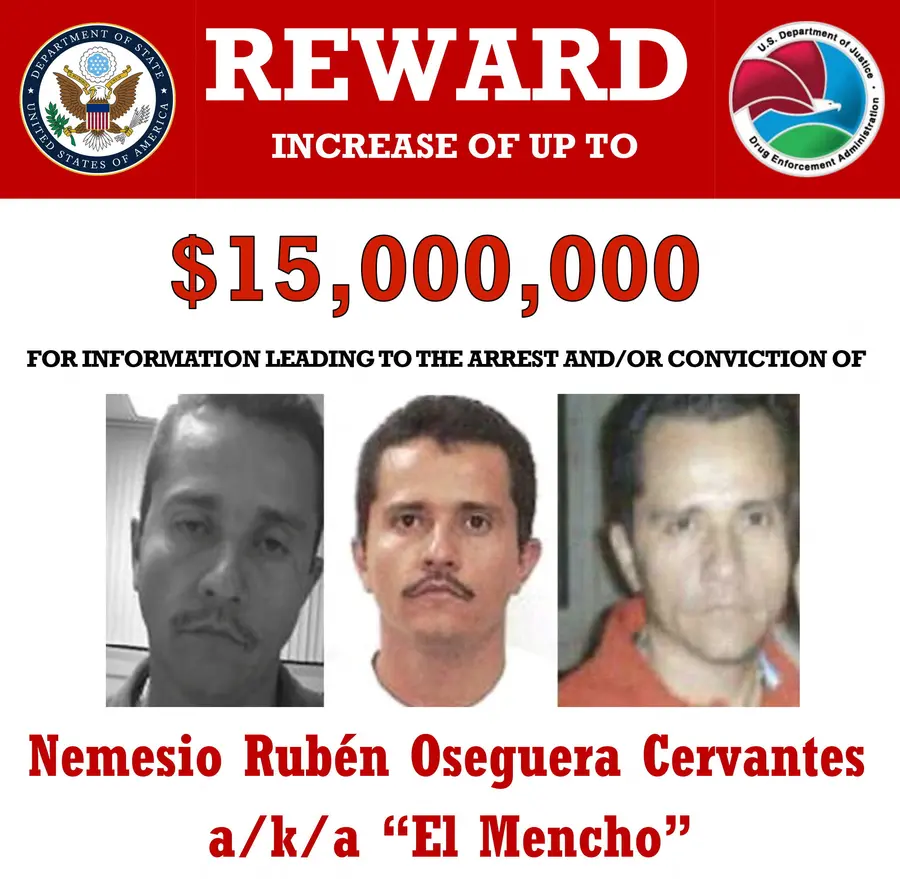
Department/Handout via REUTERS.
Fuel Theft, Oil Smuggling, and White-Collar Crime
Drugs were only part of the portfolio.
According to the U.S. Treasury Department, the CJNG generates hundreds of millions of dollars annually through *huachicol*, or fuel theft. The cartel siphons gasoline from Mexico's state-owned pipelines and has been linked to crude oil smuggling across the U.S. border. Court filings in U.S. prosecutions allege that fuel-theft proceeds were recycled into weapons purchases, methamphetamine production equipment, and payroll for cartel hitmen.
The organization also earns heavily from:
- Extortion of local businesses
- Human smuggling operations
- Illegal logging
- Large-scale real estate schemes
- Sophisticated timeshare fraud operations targeting foreign tourists
Taken together, these ventures form a diversified criminal balance sheet designed to withstand shocks in any single market.
A $50 Billion Asset Base
The Mexican government has estimated that the CJNG controls roughly $50 billion in total assets.
Those assets include:
- Luxury estates in Mexico and the United States
- Commercial properties
- Agricultural businesses, including avocado operations
- High-end vehicle fleets
- Warehouses and logistics hubs
- Vast arsenals of military-grade weapons
During Sunday's raid, authorities seized cartel-owned armored vehicles and heavy weaponry, reinforcing how profits were reinvested not only into legitimate-looking enterprises but into paramilitary capability. Prosecutors have alleged the cartel brokered weapons purchases and military-style training from foreign mercenary contacts, further professionalizing its enforcement arm.
The scale of the enterprise is illustrated by the case of El Mencho's son. In March 2025, Rubén Oseguera González, known as "El Menchito," was sentenced to life in a U.S. prison. A federal judge ordered him to forfeit more than $6 billion in drug trafficking proceeds, a figure representing only a portion of the broader cartel's revenue.
Immediate Fallout
El Mencho's killing triggered one of the most widespread outbreaks of cartel violence in recent years.
In at least 13 states, armed groups set fire to vehicles, supermarkets, and banks, blocking highways and paralyzing cities in what appeared to be a coordinated response. In Jalisco alone, officials said roughly 20 branches of a state-run bank were set ablaze or damaged, and more than 20 roads were blocked with burning vehicles.
Concerts and soccer matches were canceled. Flights were diverted. At least one port halted operations. Some states canceled classes, and airlines and bus operators suspended routes. Panic briefly erupted at Guadalajara International Airport as videos circulated showing travelers fleeing the terminal, though authorities later said flights were operating normally.
The U.S. government warned its citizens to shelter in place in parts of five Mexican states.
Such tactics serve not only as retaliation but as economic signaling. By targeting infrastructure and commerce, cartel factions demonstrate that the organization's operational capacity and revenue streams remain intact despite the loss of its founder.
The Billion-Dollar Question
The death of a cartel leader does not automatically dismantle the cartel's balance sheet.
The CJNG's infrastructure, supply chains, laundering networks, and diversified revenue streams are institutional, not personal. U.S. prosecutors have described a structured hierarchy with El Mencho at the top and trusted family members and lieutenants overseeing key divisions.
Whether the organization fractures or consolidates under new leadership will determine the next chapter. But the financial engine El Mencho built, measured in billions in annual drug revenue and tens of billions in assets, was designed to survive individual arrests and even assassinations.
El Mencho's life ended in a military raid. The criminal conglomerate he built may prove far harder to eliminate.
/2014/11/Screen-Shot-2017-11-15-at-4.26.22-PM.png)
/2018/11/GettyImages-52242812-1-e1541703554359.jpg)
/2009/12/El-Chapo-Guzman.jpg)
/2025/11/mercedes.png)
/2014/02/GettyImages-474227707.jpg)
/2015/07/arrest.jpg)
/2020/06/taylor.png)
/2018/03/GettyImages-821622848.jpg)
/2009/09/Brad-Pitt.jpg)
/2019/10/denzel-washington-1.jpg)
/2009/09/Jennifer-Aniston.jpg)
/2009/09/Cristiano-Ronaldo.jpg)
/2020/04/Megan-Fox.jpg)
/2020/02/Angelina-Jolie.png)
/2019/04/rr.jpg)
:strip_exif()/2015/09/GettyImages-476575299.jpg)
/2017/02/GettyImages-528215436.jpg)
/2019/11/GettyImages-1094653148.jpg)
:strip_exif()/2009/09/P-Diddy.jpg)
/2009/11/George-Clooney.jpg)
/2020/01/lopez3.jpg)