
When you hear someone has a "net worth of $5 billion," what does that actually mean? They almost certainly do not simply have $5 billion in cash sitting in a checking account. How is that net worth made up? What are the assets? What are the liabilities? How many homes does a multi-billionaire own? What does it cost to maintain a billionaire lifestyle?
Well, thanks to a recent Epstein document release we have a really interesting example to learn from via billionaire financier Leon Black.

Andrew Toth/Getty Images
Leon Black is the co-founder of Apollo Global Management, the private equity and credit giant that today oversees just under $1 trillion in assets. For decades, Black was one of the most powerful figures in alternative asset management.
Unfortunately for Black, he was also a longtime associate of Jeffrey Epstein. They socialized together, and Leon apparently tapped Jeffrey for tax and estate planning advice. Through that tax and estate planning relationship, Epstein collected and organized a granular picture of Leon Black's finances. The results of this work were just made public as part of the Justice Department's broader investigation into the Epstein scandal.
Specifically, the Justice Department turned up a granular 2014–2015 financial analysis summary detailing Black's assets, debts, spending, and liquidity when his net worth was estimated at approximately $5 billion, down to the exact dollar balances held in dozens of bank accounts.
It's extremely rare to get this kind of X-ray into a billionaire's financial anatomy. So let's examine it.
Breaking Down a $5 Billion Fortune
According to the documents released on March 31, 2015, Leon Black's net worth was estimated at $5 billion (today he's worth $15 billion, FYI). Here's how it broke down:
1) The Main Driver: Apollo
Approximately $2.3 billion of his wealth was tied to business investments, primarily:
- His personal stake in Apollo Global Management
- Investments in Apollo-managed funds
- More than $2 billion of his net worth was effectively one concentrated bet: Apollo stock.
This is typical of billionaire founders. They don't diversify the way financial advisors tell ordinary investors to. Their wealth is often overwhelmingly tied to the company they built.
Publicly traded blue-chip stocks? Barely relevant. His portfolio of "marketable securities" was worth only about $13 million. For a $5 billion individual, that's pocket change.
Art and Collectibles
One of the most eye-opening takeaways from the 2014–2015 financial summaries is that Leon Black's "stuff" was not just expensive, it was a central pillar of his net worth.
In the March 31, 2015, financial analysis, roughly $2.8 billion of Black's estimated $5 billion net worth was attributed to personal assets. That category included fine art, rare books, Chinese bronzes, and other collectibles. In other words, his collection of physical objects was valued higher than his core business investments, including his Apollo stake and Apollo fund holdings.
Black's best-known purchase came in 2012, when he paid nearly $120 million for Edvard Munch's "The Scream" at Sotheby's. At the time, it was one of the most expensive artworks ever sold at auction and instantly became a symbol of the scale at which the ultra-wealthy collect art. It also highlighted something most people do not realize until they see a balance sheet like this. In billionaire land, a painting is not just decoration. It can be a store of value, a status asset, a portable form of wealth, and, crucially, collateral.
The documents show just how literal that collateral point can be. Black had a $484 million loan from Bank of America that was secured by his art collection, including works by painters such as Degas, Cézanne, and Picasso. That means the art was not merely sitting on walls. It was functioning as a balance-sheet tool that could be leveraged for liquidity, often at interest rates far lower than most people can get on a mortgage.
Beyond "The Scream," Black has repeatedly made splashy acquisitions that reinforce how expansive his collection is:
- In 2013, he reportedly paid just under $40 million for a Raphael chalk drawing.
- He built a rare book collection valued in the documents at around $82 million, a category that later included purchases such as a rare Babylonian Talmud that reportedly sold for more than $9 million in 2015.
- The financial summary valued his Chinese bronzes at roughly $335 million, reflecting a major commitment to a highly specialized collecting category.
This is the part of billionaire finance that feels most foreign to normal people. If you have a $5 billion fortune, you do not just buy a house and a diversified stock portfolio. You also buy museum-level objects. Then you treat those objects like financial instruments when it benefits you, borrowing against them rather than selling investments and triggering capital-gains taxes.
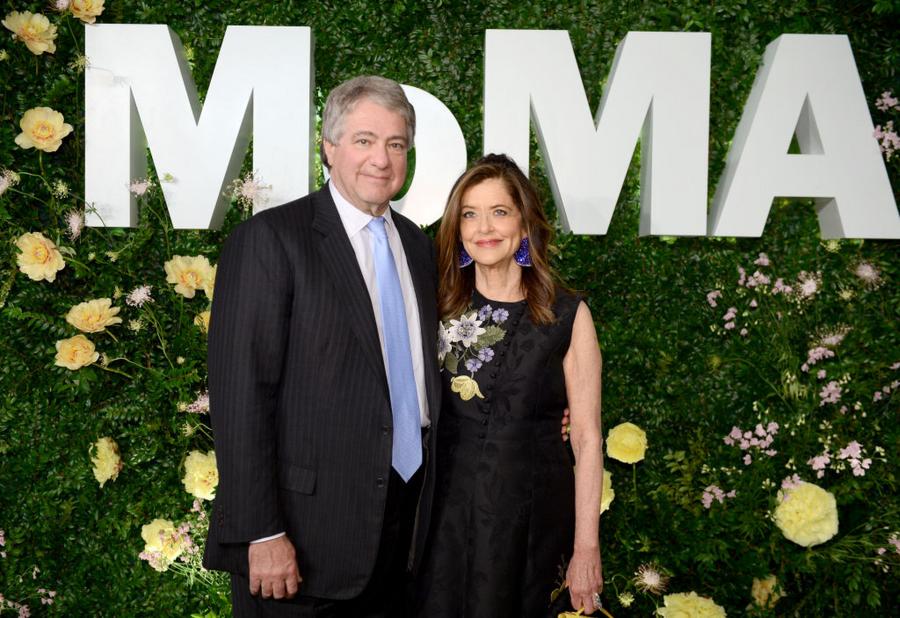
Leon Black and Debra Black (Photo by Andrew Toth/Getty Images for The Museum of Modern Art)
How Much Cash Does a Billionaire Keep?
As of 2015, Black had approximately:
$154 million in cash
Spread across 69 bank accounts at institutions including:
- Bank of America
- JPMorgan Chase
- Deutsche Bank
- Wells Fargo
Some accounts were in his name. Others were held through trusts and LLCs.
Interestingly, despite the massive balances, the interest rates were negligible. The highest yield listed was 0.15%, thanks to the near-zero rate environment post-2008.
So yes, even billionaires parked money in low-yield accounts.
Do Billionaires Have Debt?
Absolutely.
One of the most fascinating details in the documents was a:
$484 million loan from Bank of America
Collateral: artwork by Degas, Cézanne, Picasso, and others.
Interest rate: approximately 1.43%.
Why borrow if you're worth $5 billion?
Because selling appreciated assets triggers capital-gains taxes. Borrowing against them doesn't.
This is one of the most powerful wealth-preservation tools available to the ultra-rich:
- Keep the appreciating asset
- Borrow cheaply against it
- Avoid realizing taxable gains
He also reportedly borrowed at under 2% to finance a yacht and a Gulfstream jet.
Debt, in this context, isn't desperation. It's optimization.
How Many Homes Does a $5 Billion Person Own?
According to the documents, Black owned:
- Seven homes
- Eleven cars
- A Gulfstream jet
- A Benetti yacht
His Manhattan townhouse alone is worth tens of millions. His Hamptons estate required substantial ongoing landscaping and maintenance.
What Does It Cost to Live Like This?
The documents included a snapshot of household spending for the first two months of 2015.
Total: $1.2 million in 60 days.
Selected line items included:
- $27,000 dining out
- $35,000 clothing
- $67,000 wine and liquor
- Nearly $48,000 landscaping
- Six-figure property taxes
- Tens of thousands in maintenance and utilities
There was even a $7,688 meal at Joe's Stone Crab and five-figure purchases at Bergdorf Goodman and Zachys.
This wasn't annual spending. It was two months.
At the same time, the family had committed to approximately $70 million in charitable donations.
Unusual Investments
Beyond Apollo and art, Black also held:
- $126 million in Apollo-related fund investments
- A $34 million stake in a for-profit education company co-founded by Michael Milken
- A small stake in high-end sushi restaurant Kappo Masa
- Timber funds
- Venture capital
- Chinese private equity
Again, very little traditional retail-style investing.
The Real Lesson
When people fantasize about having billions, they usually imagine:
- Infinite liquidity
- Zero stress
- No debt
- A diversified stock portfolio
The reality, at least in this case, looks different:
- Most wealth concentrated in one primary business
- Massive exposure to illiquid assets
- Heavy use of leverage
- Dozens of trusts and LLCs
- Borrowing hundreds of millions despite multi-billion-dollar net worth
The $5 billion number wasn't stacks of cash sitting in a vault. It was a carefully engineered structure of equity, collectibles, loans, trusts, and strategic debt.
Since 2015, Apollo's stock has risen dramatically, and Black's net worth has grown substantially beyond that snapshot.
But the 2015 documents remain something rare: a detailed blueprint of how a modern private equity billionaire organizes wealth.
/2019/11/lb.jpg)
/2015/09/floyd21.jpg)
/2026/03/jack-schlossberg.jpg)
/2026/02/jfk-jr-scaled.jpg)
/2018/09/GettyImages-52647531.jpg)
/2014/02/Marc-Rowan-1.jpg)
/2020/01/lopez3.jpg)
/2019/04/rr.jpg)
:strip_exif()/2015/09/GettyImages-476575299.jpg)
/2019/11/GettyImages-1094653148.jpg)
/2020/02/Angelina-Jolie.png)
/2017/02/GettyImages-528215436.jpg)
/2009/09/Jennifer-Aniston.jpg)
/2018/03/GettyImages-821622848.jpg)
/2020/06/taylor.png)
/2009/11/George-Clooney.jpg)
/2009/09/Cristiano-Ronaldo.jpg)
/2019/10/denzel-washington-1.jpg)
/2009/09/Brad-Pitt.jpg)
/2020/04/Megan-Fox.jpg)
:strip_exif()/2009/09/P-Diddy.jpg)