
Jennifer Garner is a commercial actress who is also known for being one of two Jennifers who seem to be physically unable to detach from Ben Affleck. Fun fact: Before she became a commercial actor, apparently, she starred in some films and at least one television show. I can't personally confirm this. I primarily know her as a commercial spokeswoman.
If you have consumed any ad-supported media in the last five years, whether on a television, laptop, or phone, you understand that Jennifer Garner's face is unavoidable. If you watch TV for longer than an hour, it's nearly guaranteed that you will be interrupted by Jennifer Garner selling you Neutrogena, Capital One, or her children's food company, Once Upon A Farm.
I am a parent, so I am very familiar with Once Upon A Farm. For non-parent readers, here's something you should know:
Roughly 15 years ago, the entire parenting industrial complex convened and quietly agreed that from that point forward, children between the ages of 2 and 5 would consume nearly all of their calories via squeezable food pouches. Only a handful of narrow carve-outs were exempted and can continue to exist in solid form:
- Croissants
- Chicken fingers
- Mac and cheese
- Pizza with no sauce
- Plain pasta with butter
Outside of those five strict exceptions, all food would henceforth be dispensed from a soft plastic tube.
I know what you're thinking.
"This CAN'T be true."
It's true.
"What about microplastics? What about the environment? Are millions of plastic caps and empty pouches clogging landfills? And are we sure it's healthy for children to suck their meals out of a bag?"
No more questions.
There are dozens of pouch brands. Functionally, they all do the same thing. The main difference is price and refrigeration. Some cost around $1.50 per pouch and live comfortably on a shelf. Others cost closer to $3.50 per pouch and must be kept cold at all times. Once Upon A Farm falls squarely into the second category 🙂
Considering just how public-facing Jennifer has been over the last few years with "her" brand, you might assume she owns a significant equity stake. Perhaps even 100%. Or maybe you, like me, assumed she raised some venture capital (not to be confused with her Capital One Venture X credit card) and now owns a slightly smaller stake, like 80-90%. Well, wonder no more!
Earlier today, Once Upon A Farm submitted a registration statement with the Securities and Exchange Commission outlining its intent to go public. According to the filing, the company is seeking to raise up to $209 million in an initial public offering that would value the business at roughly $760 million at the top end of the proposed price range. The filing also reveals that over the first nine months of last year, the company generated $176.7 million in revenue. Unfortunately, in the same period, the company actually lost $40 million.
The filing is dense, technical, and mostly unreadable unless you enjoy footnotes about stock appreciation rights. However. Buried on page 138 of the roughly 160-page prospectus is a section titled "PRINCIPAL AND SELLING STOCKHOLDERS." Here is a very important table from this section:
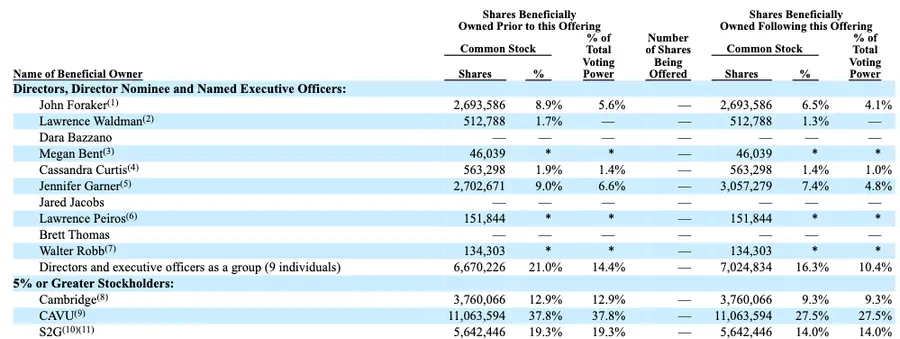
In English, that chart reveals that before the planned IPO (as in, right now), Jennifer owns 2,702,671 shares of the company, equal to 9% of the total equity.
9%!?
As it turns out, Once Upon A Farm has already sold a huge portion of the business to venture capital. If you look at that "5% or greater" section, you'll see that three VC firms – Cambridge, CAVU, and S2G – own a combined 70% of the company. The next largest shareholder after the VCs and Jen is co-founder John Foraker, who owns 8.9%.
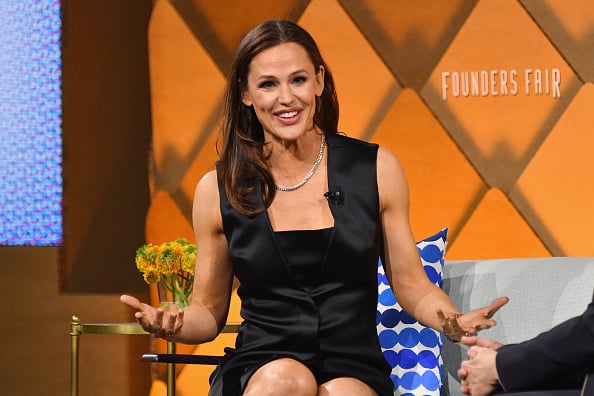
Getty
The IPO prospectus also reveals that Jennifer is planning to sell a portion of her shares as part of the public offering. Specifically, the filing lists Garner as a selling stockholder, meaning some of the shares being offered will come from her personal holdings rather than from newly issued company stock. This is not unusual, but it is notable given how closely her public image is tied to the brand.
After the IPO, she'll own around 7.4% of the company. At the top end of Once Upon A Farm's proposed valuation, her remaining stake would be worth roughly $55–60 million on paper.
The prospectus also lays out how Garner has already been paid, and how much more cash she is guaranteed to receive regardless of what the stock does after the IPO.
Under a spokesperson and co-founder agreement formalized in 2022, Garner received an upfront $1 million cash payment. That same agreement granted her a substantial block of stock options, many of which vest in connection with the IPO. When those options are included, her beneficial ownership rises from 2.7 million shares to just over 3 million shares, which is the figure reflected in the post-offering ownership table.
In other words, her equity stake did not come solely from being there on day one. A meaningful portion of it was awarded as compensation for her ongoing role as the public face of the brand.
Beyond that initial payment and equity, the filing outlines a guaranteed $7 million cash payout schedule tied to her continued involvement and the ongoing use of her "family farm" branding through 2028:
- January 31, 2026: $2 million
- January 31, 2027: $2 million
- January 31, 2028: $3 million
I'll be honest. If I were Jennifer Garner, I would probably demand to own a lot more than 7% of a company in exchange for being its full-time public face, plus $2 million a year in cash. Then again, I know absolutely nothing about the economics of running a consumer packaged goods business. I'm sure it's extraordinarily expensive, deeply annoying, and exhausting for many years on end. Wait a minute, that's exactly how it feels raising a child who lives on Once Upon A Farm pouches!
/2020/01/Jennifer-Garner.jpg)
/2014/08/GettyImages-163778032.jpg)
/2019/03/GettyImages-472259974.jpg)
/2014/04/money.jpg)
/2014/09/GettyImages-466411752.jpg)
/2021/05/jessicathumb.jpg)
/2018/03/GettyImages-821622848.jpg)
:strip_exif()/2009/09/P-Diddy.jpg)
/2017/02/GettyImages-528215436.jpg)
/2009/09/Jennifer-Aniston.jpg)
:strip_exif()/2015/09/GettyImages-476575299.jpg)
/2020/06/taylor.png)
/2020/04/Megan-Fox.jpg)
/2009/09/Cristiano-Ronaldo.jpg)
/2020/01/lopez3.jpg)
/2019/10/denzel-washington-1.jpg)
/2019/11/GettyImages-1094653148.jpg)
/2009/11/George-Clooney.jpg)
/2019/04/rr.jpg)
/2020/02/Angelina-Jolie.png)
/2009/09/Brad-Pitt.jpg)