
If you took a time machine back exactly ten years, to December 4, 2015, you'd land in a world where Adele's "25" was shattering sales records, "Star Wars: The Force Awakens" dominated every billboard, and cable news was buzzing nonstop about the upcoming presidential primaries. Flip on CNN or Fox News to catch the latest poll updates, wait for the commercial break, and I can almost guarantee the first face you'd see was Mike Lindell's.
A decade ago, Mike Lindell was a widely admired and respected business tycoon. The epitome of the American dream. An inspirational rags-to-riches story. A man who overcame drug addiction and then launched what became a highly successful company, My Pillow. He was everywhere. His upbeat late-night infomercials were so ubiquitous that you could barely watch cable television after 9 p.m. without seeing Lindell enthusiastically pitching his pillows.
At the time, MyPillow was generating roughly $110 million per year in gross revenue. Based on comparable businesses, the company easily could have been valued between $300 million and $500 million had it ever pursued acquisition offers. As such, in late 2015, we conservatively estimated Mike's net worth to be $100 million. One could argue that his net worth, based on the absolute highest potential enterprise value of My Pillow, would have pushed his net worth into the $200-300 million range.
Fast forward to the present, and unfortunately, all the pillows in the world wouldn't soften Mike Lindell's financial fall…
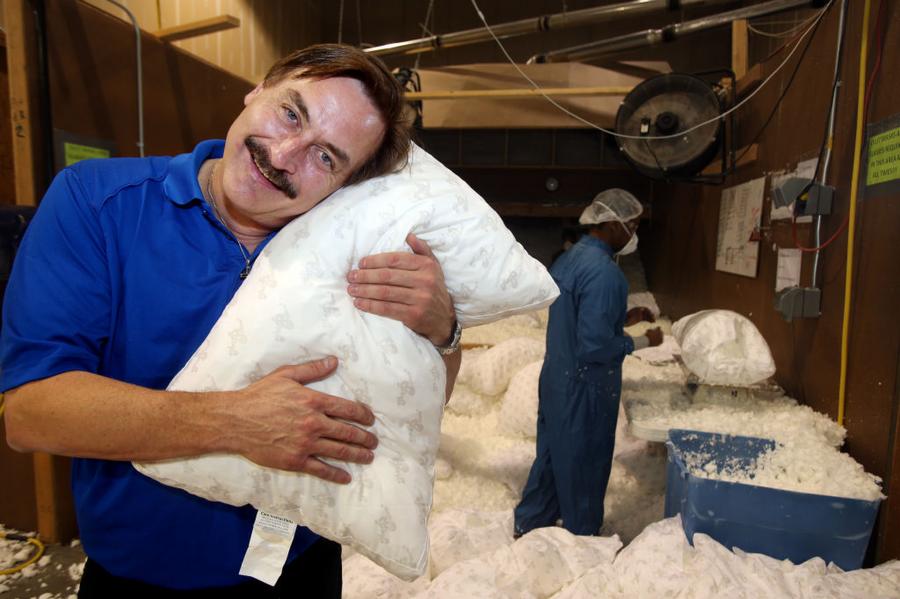
(Photo by Joel Koyama/Star Tribune via Getty Images)
From Crack to Pillows
Long before Mike Lindell became the grinning mustachioed salesman in late-night infomercials, he spent years drifting between entrepreneurial ambition and self-destruction. Raised in Minnesota, he struggled with insomnia and chronic pain long before drugs entered the picture. As a young man, he survived a series of near-death experiences, including a violent car accident, a failed skydive, and a motorcycle crash. By his twenties, he owned bars in the Minneapolis suburbs, a lifestyle that accelerated what would become a decades-long addiction to cocaine and, later, crack.
Despite the chaos, Lindell was always chasing business ideas. In 2003, during one of the more erratic periods of his addiction, he became fixated on the notion that he could invent the perfect pillow. For years he had been pulling apart foam pillows by hand, reshaping them until they briefly fit his needs before collapsing overnight. One morning, after another sleepless night, he sat at his kitchen table scribbling "MyPillow" across sheets of paper, sketching logos with manic conviction. The idea stuck.
Lindell spent the next several years experimenting with foam blends on his deck, tearing thousands of pieces of material by hand with help from his sons. He eventually found an old hammermill, a rusted agricultural machine used for grinding corn, and rebuilt it to shred foam consistently. With that breakthrough, he produced a few hundred pillows and attempted to sell them to local retailers. Every major chain turned him down.
Desperate, he borrowed $12,000 to rent a mall kiosk during the 2004 holiday season. The kiosk failed spectacularly. He had priced the pillow too low, was losing money on every sale, and the product didn't fit standard pillowcases. He borrowed more money from the dwindling pool of friends willing to help him, mortgaged his house repeatedly, and returned to counting cards at casinos after hours to keep the business alive. Every time the pressure mounted, he relapsed.
The turning point came after the kiosk shut down. A customer called to say the pillow had changed his life and encouraged Lindell to exhibit at the Minneapolis Home + Garden Show. Lindell brought 300 pillows to the event and sold every one. That success led to more shows, more fairs, and an exhausting cross-country grind in which Lindell and a small crew traveled from state to state selling pillows out of trucks. His marriage collapsed. He lost his house. He was still using drugs heavily.
In 2009, after a 19-day crack binge, his dealer refused to sell to him until he got clean. That intervention finally broke the cycle. Within days of quitting drugs, Lindell borrowed $30,000 from the owners of a mulching company, caught up on debts to his foam and sewing suppliers, and threw himself back into rebuilding MyPillow.
The next breakthrough came in 2011, when a feature article in the Minneapolis Star Tribune triggered a flood of online orders. Lindell realized that his personal story resonated with people. He began designing newspaper ads modeled after the article and soon committed to the strategy that would define the company: an infomercial.
The first half-hour MyPillow infomercial aired at 3 a.m. on October 7, 2011. Lindell bought every off-hour timeslot he could afford, betting the company's survival on late-night insomniacs. The gamble worked. Within months, MyPillow grew from 50 to 500 employees and approached $100 million in sales. Deals with Telebrands, Bed Bath & Beyond, Walmart, QVC, and other major retailers followed. Had he sought acquisition offers, MyPillow easily could have fetched $300 million, and maybe closer to $500 million, which even after taxes would have made Mike Lindell a centimillionaire. For a brief, dazzling stretch, Lindell had finally built the empire he had chased for decades.
The Downfall
The collapse of Mike Lindell's fortune and business empire was not sudden. It unfolded in layers, each amplifying the damage from the last.
The turning point began when Lindell redirected his time, money, and corporate infrastructure toward disproven claims of widespread fraud in the 2020 presidential election. What started as political advocacy quickly became an all-consuming financial black hole. Lindell poured tens of millions of dollars of his personal wealth into failed investigations, fringe conferences, documentary-style videos, and the launch of Frank Social, a social media platform that reportedly burned through roughly $1 million per month. At the height of this spending spree, he also issued a public $5 million challenge promising to pay anyone who could disprove his so-called election "packet data." A technology expert did exactly that, and after an arbitration panel sided against Lindell, he was legally compelled to pay.
These efforts triggered enormous lawsuits from Dominion Voting Systems and Smartmatic, each accusing him of defamation and seeking staggering financial damages. The cost of defending those cases proved ruinous. Multiple law firms withdrew from representing Lindell and MyPillow after he fell millions of dollars behind on legal fees.
In October 2023, a law firm called Parker Daniels Kibort and Lewin & Lewin filed paperwork in both Minnesota and Washington, D.C., seeking permission to drop him as a client. According to a legal filing, the lawyers were looking to be excused from the case due to lack of payment. Mike had reportedly failed to pay "millions of dollars" in legal fees. The lawyers had been representing Mike and My Pillow in defamation lawsuits brought by voting machine companies Dominion Voting Systems and Smartmatic. Dominion alone sued Mike for $1.3 billion in damages.
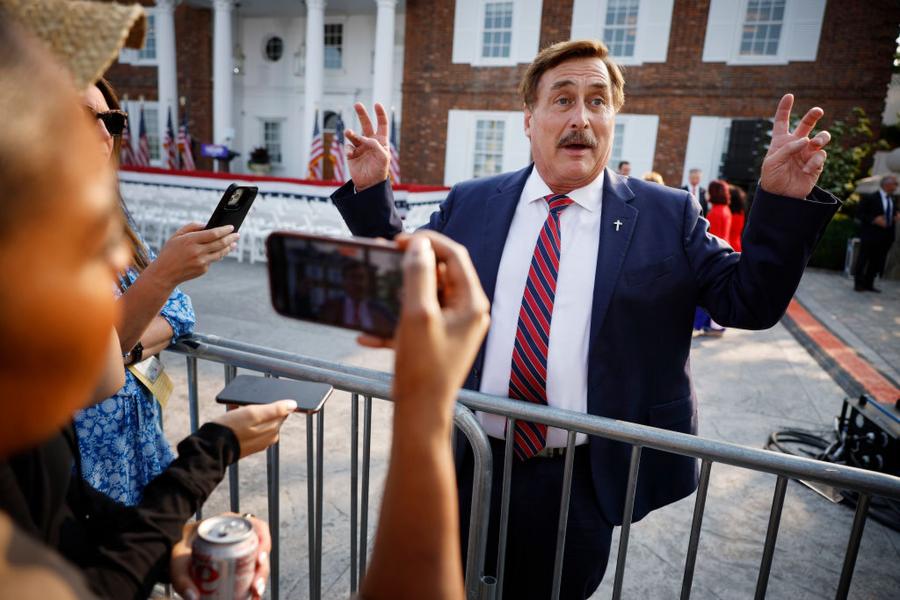
Chip Somodevilla/Getty Images
Here's the filing from Mike's soon-to-be-former lawyers:
"On October 2, 2023, Parker Daniels Kibort and Lewin & Lewin was informed by Defendants [Lindell and My Pillow] that they are not able to get caught up with or make any payment on the large amount they owe in arrears nor pay for anywhere near the estimated expense of continuing to defend against the lawsuits going forward, including either the legal fees or litigation costs…"
The law firm also claimed that continuing to represent Lindell and My Pillow "could threaten the very existence of the firm."
A day after that filing was made, Mike appeared on Steve Bannon's "War Room" and gave further details about his current situation:
"I can't pay the lawyers. We can't pay. There's no money left to pay them. I don't know where that leaves us."
In a separate interview with NBC, Mike elaborated:
"We've lost everything. Every dime. All of it is gone."
He later acknowledged that he had spent between $25 and $50 million of his own money on election-related ventures, leaving him without reserves just as the lawsuits intensified. Court-ordered sanctions, arbitration rulings, and IRS disputes added new layers of financial obligation. He has described a situation in which he owns little more than two homes and a truck, all of which he has attempted to liquidate to cover debts. Even modest penalty payments have become unmanageable. In emotional court testimony, he has stated that he is unable to borrow money, unable to pay lawyers, and unable to meet payment plans he previously agreed to.
Exacerbating his financial problems was the utter obliteration of MyPillow's business. The company had once been a staple at major retailers like Walmart, Bed Bath & Beyond, QVC, and the Home Shopping Channel. One by one, those partners severed ties. Advertising channels backed away as well. Lindell has claimed that MyPillow's annual revenue, which once topped $110 million, collapsed to roughly $5 million — a 95% drop that forced layoffs, warehouse closures, and a drastic scaling-back of operations.
As a result of all these factors, we reduced Mike Lindell's net worth to ZERO. And depending on the outcome of the defamation cases, zero could simply be the starting point.
/2018/07/GettyImages-818994954.jpg)
/2018/06/Mike-Lindell.jpg)
/2010/05/Rudy-Giuliani.jpg)
/2016/04/tg.jpg)
/2025/07/tyrese-samantha.jpg)
/2020/03/damon-dash.jpg)
/2020/02/Angelina-Jolie.png)
:strip_exif()/2015/09/GettyImages-476575299.jpg)
/2009/09/Jennifer-Aniston.jpg)
/2020/04/Megan-Fox.jpg)
/2019/04/rr.jpg)
:strip_exif()/2009/09/P-Diddy.jpg)
/2020/01/lopez3.jpg)
/2019/11/GettyImages-1094653148.jpg)
/2020/06/taylor.png)
/2018/03/GettyImages-821622848.jpg)
/2017/02/GettyImages-528215436.jpg)
/2009/09/Brad-Pitt.jpg)
/2009/09/Cristiano-Ronaldo.jpg)
/2009/11/George-Clooney.jpg)
/2019/10/denzel-washington-1.jpg)