
In the 1980s, a major-conference college football coach earned between $100,000 and $400,000. The highest-paid coaches in the world were Oklahoma's Barry Switzer and Alabama's Ray Perkins. They made around $500,000 per year when all bonuses were factored in.
Georgia Tech's Bobby Ross is widely credited as the first coach to break the $1 million barrier (including endorsements and incentives) after winning the 1990 national championship. Lou Holtz at Notre Dame and Steve Spurrier at Florida soon joined the seven-figure club in the early 1990s. And that's roughly where the upper echelon of college coaching salaries remained for a while. For example, these were the highest-paid coaches in college football in 1999:
- Steve Spurrier, Florida — $1.9 million
- Bobby Bowden, Florida State — $1.2 million
- Mack Brown, Texas — $1 million
- Phillip Fulmer, Tennessee — $1 million
- Rick Neuheisel, Washington — $1 million
- Joe Paterno, Penn State — $1 million
- Bill Snyder, Kansas State — $1 million
- Tommy Tuberville, Auburn — $1 million
- And these were the salaries for the highest-paid coaches 40 years ago, in 1982:
- Bear Bryant, Alabama — $450,000
- Barry Switzer, Oklahoma — $270,000
- Jackie Sherrill, Texas A&M — $240,000
- Lou Holtz, Arkansas — $226,000
- Jerry Claiborne, Kentucky — $152,000
Then came massive TV deals. Then came NIL.
Today, the MARKET RATE for a top program head coach is $10 million per year.
As you may have heard, last month, Lane Kiffin announced that he was ditching Ole Miss mid-season. At the time of his departure, Kiffin and Ole Miss were sitting atop the team's best season on record, with a real shot at a championship.
What could possibly have lured Lane away from Ole Miss in the middle of what may prove to be their greatest season ever? A reported $90 million guaranteed contract from LSU. Kiffin's new deal will pay him $13 million per year (up from $9 million), with escalators that could significantly balloon his salary based on playoff appearances and performance. Kiffin's contract also includes a buyout worth 80% of his remaining salary if he's fired without cause. Should that happen in year one of the deal, Kiffin would be owed $72.8 million. If he did get fired, he'd receive monthly installments through 2032—even if he got another job elsewhere.
Believe it or not, that utterly insane deal does not even make Lane Kiffin the highest-paid college coach in the world. That honor belongs to…
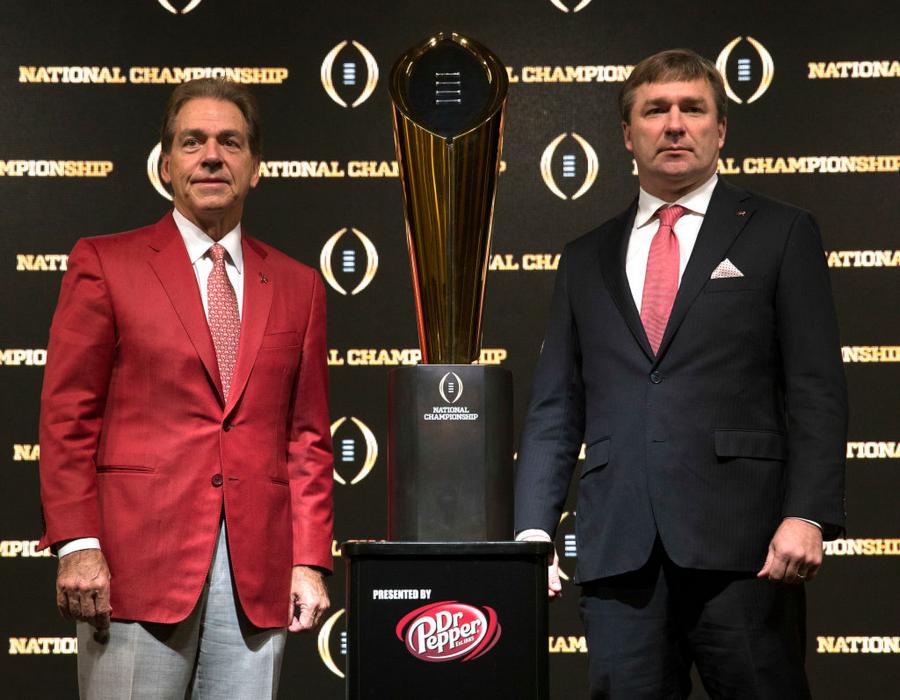
Alabama's Nick Saban and Georgia's Kirby Smart (Mike Zarrilli/Getty Images)
The 20 Highest Paid College Football Coaches
#20. Jedd Fisch – Washington ($7.75 million/year)
After rebuilding Arizona, Fisch signed a seven-year deal with Washington that averages $7.75 million annually. He rounds out the top 20, proving that even programs in transition are paying nearly $8 million for leadership in the new Big Ten.
#19. Luke Fickell – Wisconsin ($7.8 million/year)
Wisconsin lured Fickell away from Cincinnati with a deal that reset the market for the Badgers. At nearly $8 million per year, he is tasked with modernizing the program's identity to compete with the conference heavyweights.
#18. Shane Beamer – South Carolina ($8.15 million/year)
Beamer's extension rewards him for stabilizing the Gamecocks and delivering high-profile upsets. His salary reflects the escalating cost of doing business in the SEC, where even mid-tier records command elite compensation.
#17. Bret Bielema – Illinois ($8.2 million/year)
Bielema has quietly become one of the Big Ten's highest earners. His ability to keep Illinois competitive in a ruthless conference earned him a raise that pushed him past the $8 million threshold.
#16. Mario Cristobal – Miami ($8.3 million/year)
After a record-breaking Year 1 payout of $22.7 million (which included massive buyout coverage), Mario Cristobal's salary has settled into the $8.3 million range. He is currently on a ten-year, $80 million contract that runs through 2031. With Miami investing heavily in the roster, the pressure is on Cristobal to deliver consistent ACC championships.
#15. Matt Rhule – Nebraska ($8.5 million/year)
Rhule is in the midst of a heavily back-loaded eight-year contract. While his salary is set to escalate to over $12 million in the final years of the deal, his base compensation for the current calendar year sits at roughly $8.5 million.
#14. Josh Heupel – Tennessee ($9.0 million/year)
Tennessee elevated Josh Heupel into the $9 million tier after an 11–2 breakthrough season that reenergized the program. His extension through 2029 solidified him as the long-term face of Vols football. Heupel's fast-paced offense, a marquee win over Alabama, and a return to national relevance justified the raise. Tennessee is heavily committed financially, too: his buyout sits around $37.5 million. That number reflects the program's belief that Heupel can navigate the SEC's toughest landscape and deliver sustained postseason success.
#13. Mike Norvell – Florida State ($10.0 million/year)
Following an undefeated regular season in 2023, Norvell signed a massive extension that bumped his salary north of $10 million. While recent campaigns have been turbulent, his contract remains one of the most lucrative in the ACC.
#12. Deion Sanders – Colorado ($10.0 million/year)
Deion Sanders, AKA "Coach Prime," continues to command a premium. His recent extension increased his base salary to $10 million starting in 2025, reflecting the unprecedented financial impact and media attention he brings to the Big 12.
#11. Bill Belichick – North Carolina ($10.1 million/year)
North Carolina shocked the college football world by hiring the winningest head coach in NFL history. Bill Belichick signed a five-year, $50 million deal to jumpstart the Tar Heels and instantly became one of the sport's top earners. The results so far have been rocky. UNC hasn't beaten a Power Four opponent under Belichick, and several blowout losses have raised eyebrows. The university is tied to him financially through 2027, with more than $20 million guaranteed if they pull the plug early. UNC is still betting that Belichick's legendary football mind eventually translates to the college game.
#10. Kalen DeBoer – Alabama ($10.25 million/year)
Replacing Nick Saban is an impossible task for almost anyone, but Alabama chose Kalen DeBoer to carry the dynasty forward. After building Washington into a national contender, DeBoer accepted an eight-year deal paying $10.25 million annually, with built-in raises up to $11.75 million. The contract includes seven-figure bonuses for SEC championships, playoff berths, and national title runs. Alabama also attached a $60+ million buyout, signaling a long-term commitment. Early growing pains aside, DeBoer has Alabama back in position to compete deep into the postseason.
#9. Dan Lanning – Oregon ($10.4 million/year)
Oregon turned Dan Lanning into one of the sport's highest-paid young coaches after he quickly transformed the Ducks into a powerhouse. His restructured 2025 deal pays about $10.4 million annually and runs well into the next decade. Lanning's Ducks posted an .870 winning percentage and captured a conference title in their Big Ten debut, prompting Oregon to make sure he stays put. His buyout, estimated between $50–60 million, makes him extremely difficult to poach and signals Oregon's intent to compete financially with the SEC and Big Ten elite.
#8. Eliah Drinkwitz – Missouri ($10.75 million/year)
With his name swirling in the coaching carousel as a potential replacement for James Franklin at Penn State, Drinkwitz doubled down on Mizzou. The university offered him a six-year extension worth $64.5 million. The $10.75 million average annual value rewards him for back-to-back 10-win seasons.
#7. Steve Sarkisian – Texas ($10.8 million/year)
Texas has doubled down on Steve Sarkisian with two major extensions in two years, pushing his compensation to $10.8 million annually. Back-to-back College Football Playoff appearances secured his place among the big-money coaches. Texas's move into the SEC amplified the stakes, and the school made sure Sarkisian wouldn't be tempted by NFL interest. The buyout exceeds $60 million, binding Texas to Sarkisian's long-term vision. Despite some stumbles in the Arch Manning era, Texas believes he is still the coach who can deliver a championship in Austin.
#6. Dabo Swinney – Clemson ($11.3 million/year)
Dabo Swinney's decade of dominance at Clemson earned him a 10-year, $115 million contract that remains one of the richest in the sport. His $11.3 million salary is backed by two national titles and the highest win total in program history. The challenge now is maintaining that excellence as Clemson navigates roster turnover and an increasingly competitive ACC. Swinney's buyout is near $60 million, and Clemson has shown no sign of wavering despite a recent downturn. His contract is structured to let him decide when his tenure ends.
#5. Lincoln Riley – USC (~$11.5 million/year)
Because USC is a private school, exact numbers aren't disclosed, but multiple reports place Lincoln Riley above $11 million annually. His arrival from Oklahoma was one of the biggest coaching moves of the century, complete with a blockbuster contract believed to include perks like luxury housing and top-tier personal travel benefits. Riley's USC tenure started fast but has been inconsistent, with defensive problems limiting playoff hopes. Even so, USC remains fully committed to its offensive-minded star coach, whose salary signals the school's determination to restore national championship ambitions.
#4. Curt Cignetti – Indiana ($11.6 million/year)
The leap at Indiana was seismic. In 2024, Curt Cignetti's salary was $4.5 million while leading the Hoosiers to an historic 11-win season. Indiana wasted no time locking him down, rewarding his turnaround with an eight-year, $93 million contract extension ($11.6M AAV).
#3. Ryan Day – Ohio State ($12.5 million/year)
Few coaches have lived up to sky-high expectations as consistently as Ryan Day. After guiding Ohio State to a national championship, he secured a seven-year, $87.5 million deal worth roughly $12.5 million per year. The Buckeyes have hovered in the playoff conversation every season under his watch, and his contract reflects Ohio State's desire to maintain stability at the top of one of the sport's premier programs. The deal is heavy on bonuses and buyout protections, ensuring Day remains one of college football's financial heavyweights.
#2. Lane Kiffin – LSU ($13.0 million/year)
Lane Kiffin's mid-season move from Ole Miss to LSU instantly became one of the wildest coaching storylines in recent history. His new seven-year, $90 million deal pays him $13 million per year and includes one of the most aggressive buyout protections ever written: LSU must pay 80% of his remaining salary if he's fired without cause, with no offset even if he takes another job. The contract also features a "championship escalator" clause that would automatically push him above the nation's top-paid coach if he wins a national title. LSU is taking an enormous swing — and paying accordingly.
#1. Kirby Smart – Georgia ($13.3 million/year)
Kirby Smart stands alone at the top of the college football salary mountain. His 10-year, $130 million extension vaulted him to a staggering $13.3 million per year, making him the highest-paid college football coach in the world. Georgia structured his deal with full guarantees through 2028 and significant guarantees beyond that, creating a buyout well north of $100 million. Smart's results justify the cost: multiple national championships, perennial top-five finishes, and the most consistently dominant program of the past decade. Georgia isn't just paying for past success — they're paying to keep the machine running for years to come.
/2022/01/GettyImages-631364606.jpg)
/2015/07/Lane-Kiffin.jpg)
/2026/01/college-salaries.png)
/2022/07/GettyImages-1237749512.jpg)
/2019/01/GettyImages-460966186.jpg)
/2025/10/GettyImages-2179681542.jpg)
:strip_exif()/2009/09/P-Diddy.jpg)
/2009/09/Jennifer-Aniston.jpg)
/2019/11/GettyImages-1094653148.jpg)
/2020/04/Megan-Fox.jpg)
/2009/11/George-Clooney.jpg)
/2019/04/rr.jpg)
/2020/06/taylor.png)
/2017/02/GettyImages-528215436.jpg)
/2009/09/Cristiano-Ronaldo.jpg)
/2009/09/Brad-Pitt.jpg)
/2020/02/Angelina-Jolie.png)
/2019/10/denzel-washington-1.jpg)
/2018/03/GettyImages-821622848.jpg)
:strip_exif()/2015/09/GettyImages-476575299.jpg)
/2020/01/lopez3.jpg)