
/2020/02/Enzo-Ferrari-1.jpg)
/2020/08/GettyImages-493589996.jpg)
/2010/08/Luca-di-Montezemolo.jpg)
/2010/06/GettyImages-168551470.jpg)
/2014/10/GettyImages-486048505.jpg)
/2014/05/GettyImages-458860896.jpg)
/2019/11/GettyImages-1094653148.jpg)
/2019/04/rr.jpg)
/2009/09/Brad-Pitt.jpg)
/2009/11/George-Clooney.jpg)
/2019/10/denzel-washington-1.jpg)
/2020/04/Megan-Fox.jpg)
:strip_exif()/2015/09/GettyImages-476575299.jpg)
/2017/02/GettyImages-528215436.jpg)
/2018/03/GettyImages-821622848.jpg)
/2020/06/taylor.png)
/2009/09/Jennifer-Aniston.jpg)
What was Enzo Ferrari's Net Worth?
Enzo Ferrari was an Italian motor racing driver, manager, and entrepreneur who had a net worth of $100 million at the time of his death in 1988. That's the same as around $270 million in today's dollars after adjusting for inflation. For more information and math behind Enzo's net worth, skip down to the "Net Worth Analysis" section below.
Enzo Ferrari's career began not as a manufacturer, but as a racing driver in the early 20th century. He competed for several teams before joining Alfa Romeo in the 1920s, where he transitioned into management and built a reputation as a skilled organizer of racing operations. In 1929, he founded Scuderia Ferrari as a racing team that initially prepared and ran Alfa Romeo cars, quickly becoming one of the most successful outfits in European motorsport.
After leaving Alfa Romeo in 1939, Ferrari established his own company, which eventually became Ferrari. The first Ferrari-badged car was produced in 1947, marking the beginning of a dual identity that defined his career: building road cars primarily to fund racing. Under his leadership, Ferrari became synonymous with Formula One dominance, winning multiple championships and establishing a legacy that continues today.
Ferrari's approach to business was unconventional. He had little interest in producing road cars for profit and instead viewed them as a means to sustain his racing ambitions. Over several decades, Enzo Ferrari transformed a small racing outfit into a global symbol of performance and luxury. By the time of his death in 1988, Ferrari had evolved into one of the most prestigious automotive brands in the world, with a lasting influence on both motorsport and high-end car manufacturing.
Net Worth Analysis
Enzo Ferrari's net worth at the time of his death is somewhat misunderstood. While it is commonly said that Enzo was never "rich," that characterization is misleading. It is true that Ferrari frequently reinvested its profits into racing operations and was not run to maximize personal wealth. However, by the time of his death, the company itself had substantial value.
In 1969, during a period of financial strain, Enzo sold a 50% stake in Ferrari to Fiat, controlled by the Agnelli family. This transaction was valued at approximately 4 billion Lira (the USD equivalent of $6.4 million at 1969 exchange rates). Over the next two decades, Ferrari's value increased significantly as it transitioned from a racing boutique into a global luxury icon.
In 1988, following Enzo's death, Fiat exercised its option to acquire an additional 40% stake for 100 billion Lira (approximately $77 million). This transaction, recorded in Fiat's 1988 annual report, implied a total company valuation of 250 billion Lira—roughly $192 million USD.
Consequently, Enzo Ferrari's 50% equity stake just before his death represented a paper net worth of 125 billion Lira, or approximately $96 million USD. Of this, 40% was transferred to Fiat per the 1969 agreement, while the remaining 10% (valued at 25 billion Lira or $19.2 million) was inherited by his son, Piero Ferrari, who was born to Enzo's mistress in 1945. When Ferrari was spun off as its own public company in October 2015, Piero Ferrari's 10% stake was worth $2 billion. Today, his stake is worth more than $9 billion.
Furthermore, how do you value Enzo's personal collection of Ferraris, which during his life were valuable, but not to the insane degree they would eventually become. For example, if Enzo kept ONE 250 GTO in his own personal stable, it was worth less than $100,000 at the time of his death in 1984. Today, that car would be worth $70 million. And that's just one car.
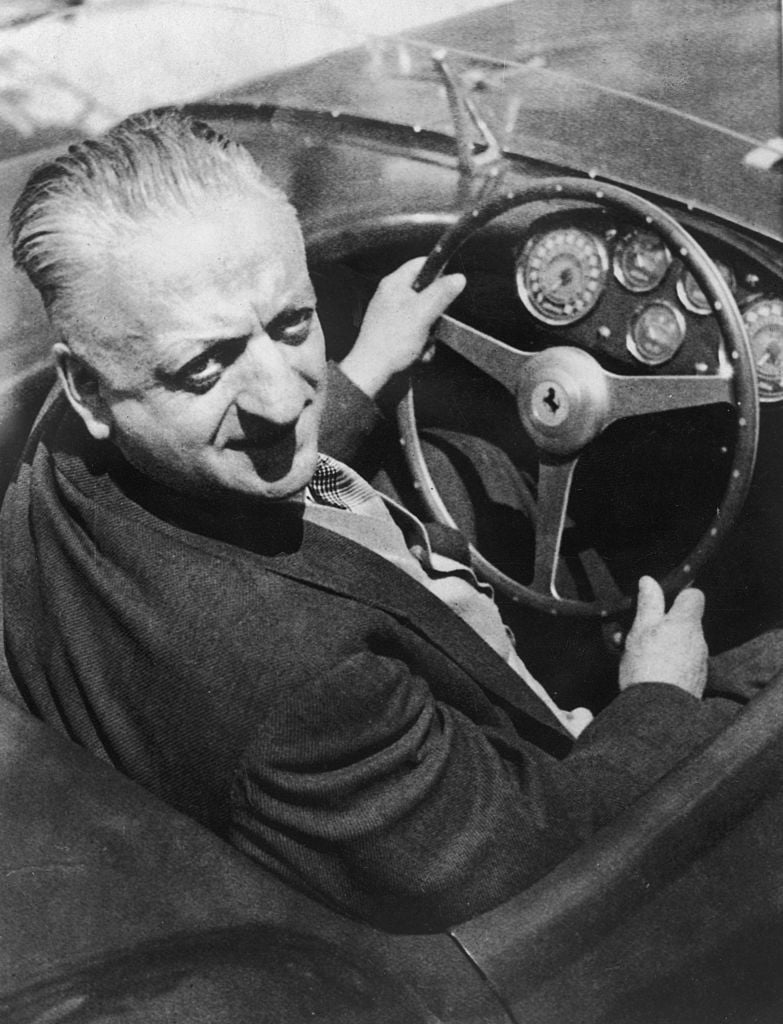
Evening Standard/Getty Images
Early Life
Enzo Ferrari was born on February 20, 1898, in Modena, Italy, as the younger of two children of Adalgisa and Alfredo. His older brother was Alfredo Jr. Ferrari had little formal education growing up. In 1908, he was inspired to become a racing driver when he witnessed Felice Nazzaro winning the Circuito di Bologna. Ferrari's father and brother both died in 1916 amid a flu outbreak in Italy. Later, during the 1918 flu pandemic, Ferrari got sick and was discharged from his post in the army.
Career Beginnings
After the collapse of his family's carpentry business, Ferrari began seeking work in the automobile industry. He ended up getting a job as a test driver for CMN, a car manufacturer in Milan. Ferrari was later promoted to race car driver, making his competitive debut in the 1919 Parma-Poggio di Berceto hillclimb competition. Toward the end of the year, he competed in the Targa Florio race, but had to retire when his car's fuel tank began leaking.
Success as a Racing Driver
In 1920, Ferrari became a driver in Alfa Romeo's racing department. He won his first Grand Prix three years later in Ravenna on the Savio Circuit. Ferrari had his best season in 1924, winning races in Ravenna, Polesine, and Pescara. His performances declined after that, in part due to his distress over the deaths of fellow racers Ugo Sivocci and Antonio Ascari. Following the birth of his son Alfredo in 1932, Ferrari chose to retire from competitive racing and focus instead on car management and development. He finished his racing career having claimed 11 wins in 41 Grand Prix appearances.
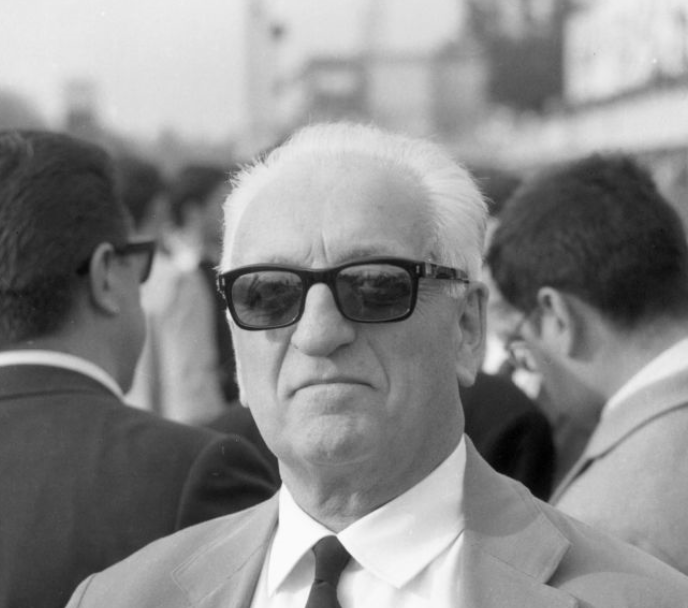
Getty
Ferrari
While at Alfa Romeo, Ferrari built up a team of superstar drivers that included Tazio Nuvolari and Giuseppe Campari. The team, founded in 1929 as a racing division of Alfa Romeo, was called Scuderia Ferrari. Eventually, the team adopted the prancing horse emblem that would become the Ferrari logo; it had originally been created and used by Italian fighter pilot Francesco Baracca, who was killed in action during World War I. In 1937, Scuderia Ferrari was dissolved, and Ferrari returned to Alfa Romeo's factory racing team. Due to a disagreement with the company's managing director, Ugo Gobbato, Ferrari left Alfa Romeo in 1939 and founded Auto-Avio Costruzioni, which supplied parts to other racing teams. During World War II, his factory was forced to undertake war production for Mussolini. After the war ended, Ferrari decided to start making cars bearing his name, and in 1947, he founded his eponymous automobile manufacturer. He soon returned to racing management with his own team, which made its open-wheel debut in Turin in 1948. Scuderia Ferrari scored its first major victory the following year at the 24 Hours of Le Mans.
In 1950, Scuderia Ferrari competed in Formula One's inaugural World Championship of Drivers; since then, it has been the only team to remain continuously present in the event. The next year, the team won its first world championship Grand Prix, with José Froilán González at Silverstone. That was followed in 1952 by Ferrari's first Drivers' Championship. The team went on to win further Drivers' Championships in 1953, 1956, and 1958. Several more have been won since then, in addition to numerous Constructors' Championships and Le Mans victories. In order to finance his various racing endeavors, including those in Formula One, Le Mans, and the Mille Miglia, Ferrari began making sports cars. However, following increasing financial struggles and issues with meeting new safety and emissions requirements, he decided to seek out a business partner. In 1969, Ferrari sold half of his company to Fiat while remaining 100% in control of racing activities. A couple of years later, he stepped down as managing director of the road car division.
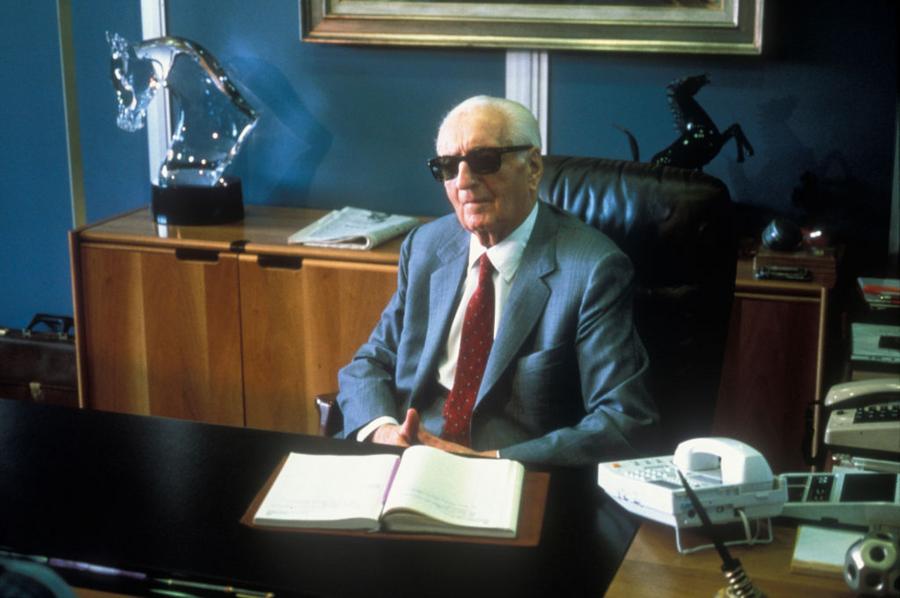
Enzo Ferrari in his office in 1985 in Maranello, Italy. (Photo by Grand Prix Photo/Getty Images)
Management and Racing Controversies
Nicknamed "Il Commendatore," Ferrari was notorious for his aggressive, autocratic style of management, often pitting his drivers against each other in games of psychological warfare with the aim of getting them to improve their performances through intense competition. This contributed to dangerous conditions on the track, with eight Ferrari drivers killed while racing between 1955 and 1971. During the 1957 Mille Miglia, Alfonso de Portago was traveling 250 km/h when his Ferrari 335 S blew a tire and crashed into the crowd, killing him, his co-driver, and nine spectators. Ferrari and the tire manufacturer Englebert were charged with manslaughter, but were cleared in 1961 following a long criminal prosecution.
In 1962, a number of disgruntled key figures at Ferrari's company staged a massive walkout to establish the rival car manufacturer and racing team Automobili Turismo e Sport. Ultimately, the company was short-lived, folding in late 1963. Ferrari continued generating controversy and backlash during the later years of his career. In 1981, he tried to revive his team's fortunes by switching to turbo engines; despite the promise shown by the second turbo-powered Ferrari in 1982, driver Gilles Villeneuve was killed in an accident during practice, and Didier Pironi suffered a career-ending injury.
Personal Life and Death
Ferrari was married to Laura Garello from 1923 until her passing in 1978. Together, they had a son named Alfredo, who died from muscular dystrophy in 1956. Ferrari had a second son, Piero, with his mistress Lina Lardi in 1945.
On August 14, 1988, Ferrari passed away in Maranello, Italy, at the age of 90. He was posthumously inducted into the International Motorsports Hall of Fame and the Automotive Hall of Fame.
/2020/02/Enzo-Ferrari-1.jpg)
/2020/08/GettyImages-493589996.jpg)
/2010/06/GettyImages-168551470.jpg)
/2014/10/GettyImages-486048505.jpg)
/2021/10/Mika-Hakkinen.jpg)
/2017/03/Jackie-Stewart.jpg)
/2014/10/enzo2.jpg)
/2009/09/Cristiano-Ronaldo.jpg)
/2020/01/lopez3.jpg)
:strip_exif()/2009/09/P-Diddy.jpg)