
/2024/06/adolf-hitler-net-worth.png)
/2014/08/GettyImages-104590424.jpg)
/2014/08/Gerhard-Schröder.jpg)
/2015/07/fdr.jpg)
/2022/03/Alexander-Lukashenko.jpg)
/2014/06/Charlie-Chaplin.jpg)
/2019/04/rr.jpg)
:strip_exif()/2015/09/GettyImages-476575299.jpg)
/2020/02/Angelina-Jolie.png)
/2020/01/lopez3.jpg)
/2009/09/Brad-Pitt.jpg)
/2009/09/Jennifer-Aniston.jpg)
/2019/10/denzel-washington-1.jpg)
/2019/11/GettyImages-1094653148.jpg)
/2020/04/Megan-Fox.jpg)
/2020/06/taylor.png)
/2017/02/GettyImages-528215436.jpg)
What was Adolf Hitler's net worth?
Adolf Hitler was a German politician who had a net worth equal to $150 million at the peak of his power (adjusting for inflation).
Adolf Hitler's rise to power reshaped Europe and resulted in one of the most catastrophic periods in modern history. After World War I, he emerged from obscurity as a radical nationalist agitator in Munich, joining the German Workers' Party and rapidly transforming it into the National Socialist German Workers' Party, or Nazi Party. Through mass rallies, propaganda, and a highly personalized leadership style, he positioned himself as the movement's central figure.
Hitler first attempted to seize power in 1923 during the failed Beer Hall Putsch. The coup collapsed, and he was imprisoned, a setback that proved pivotal. During his incarceration, he refined his ideological worldview and committed to pursuing power through legal and electoral means rather than open rebellion. Over the following decade, he rebuilt the Nazi Party into a national force by exploiting economic hardship, political instability, and widespread resentment stemming from Germany's defeat in World War I.
In 1933, Hitler was appointed Chancellor of Germany. He moved swiftly to dismantle democratic institutions, outlaw opposition parties, and consolidate authority, transforming the country into a totalitarian state. By 1934, following the death of President Paul von Hindenburg, he merged the offices of chancellor and president, assuming the title of Führer and establishing absolute control over the government, military, and society.
Once in power, Hitler pursued aggressive expansionist policies, rearming Germany and annexing neighboring territories in defiance of international agreements. These actions culminated in the invasion of Poland in 1939, triggering World War II. His regime was also responsible for systematic persecution and mass murder, including the Holocaust, in which six million Jews were killed alongside millions of other victims.
By 1945, Germany faced military collapse. As Allied forces closed in on Berlin, Hitler died by suicide, leaving behind a legacy defined by unprecedented destruction, human suffering, and moral catastrophe.
Mein Kampf Royalties & Hitler's Wealth
The primary source of Hitler's fortune was his book "Mein Kampf". At his peak, Hitler was earning over $1 million a year from "Mein Kampf" royalties. In terms of 2026 purchasing power, that is the equivalent of approximately $23.5 million a year. In total, "Mein Kampf" sold over 12.5 million copies by the time he committed suicide in 1945.
The book sales earned Hitler 7.8 million Reichsmarks, which is equal to roughly $220 million in inflation-adjusted 2026 US dollars. Hitler earned enough money from his royalties to accumulate a $10 million tax bill (roughly $150 million today), which he promptly "forgave" through a retroactive tax exemption the day he became Chancellor. Hitler used his newfound wealth to purchase several lavish homes, including his famous mountain retreat, the Berghof. Hitler invested millions of his own dollars into purchasing and renovating the Berghof property from what was once a small chalet into what we would today consider a massive, luxurious estate, complete with libraries, screening rooms, pools, tennis courts, multiple car garages, and much more.
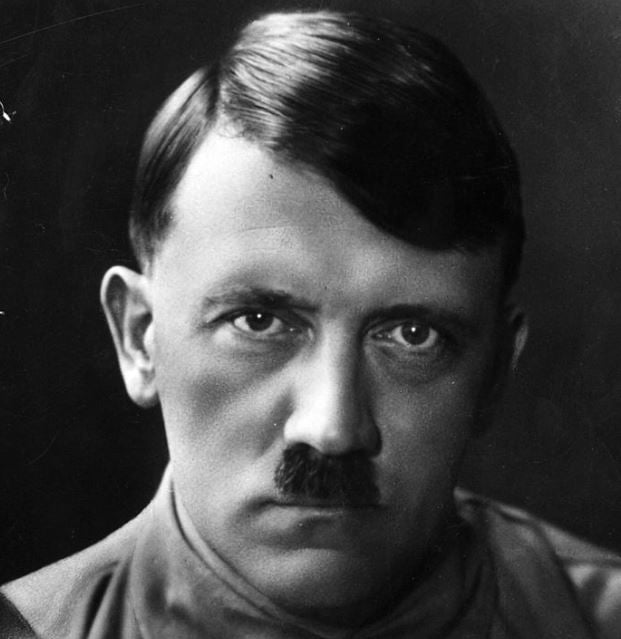
Getty
Early Life
Adolf Hitler was born on April 20, 1889, in Braunau am Inn, Austria-Hungary, as the fourth of sixth children of Klara and Alois. Three of his siblings died in infancy. When Hitler was three, he moved with his family to Passau, Germany. They later returned to Austria in 1894. Hitler's childhood was characterized by a mix of love from his mother and severe tension between him and his strict father. He harbored artistic passions that eventually brought him to Vienna, but rejections from art schools and a period of homelessness fostered his growing embitterment with the world.
World War I
Hitler found an outlet for his various resentments during World War I, when he enlisted in the Bavarian army. Rising to the rank of corporal, he embraced Germany's growing sense of nationalism and emerged as a decorated war hero. However, Hitler was deeply impacted by Germany's defeat in the war, further stoking his anger.
Rise in the Nazi Party
Disillusioned after World War I, Hitler joined the German Workers' Party, a fringe nationalist organization. He quickly became known for his charisma and oratory prowess, and in 1921 was appointed as the leader of the group, now called the Nazi Party. Hitler gained favor in the Nazi Party through his racist, nationalist ideology, which blamed Germany's woes on Jewish people and various others he deemed undesirable. His perverted version of history positioned the Aryan race as the superior people, and he promised to restore the alleged lost glory of Germany by ensuring Aryan dominance and establishing a vast empire in Eastern Europe.
In 1923, Hitler attempted to seize governmental power in the Beer Hall Putsch, an ultimately failed coup in Munich. He was consequently sentenced to prison, where he dictated the first volume of his political manifesto and autobiography, "Mein Kampf." Released from prison in 1924, Hitler focused on achieving power through legal means. He exploited the economic ferment and political instability of Germany's democratic Weimar Republic and held huge rallies that attracted Germans who were disillusioned with the state of the country. As unemployment and social unrest grew during the Great Depression in the 1930s, the Nazi Party's message increasingly resonated with a desperate populace.
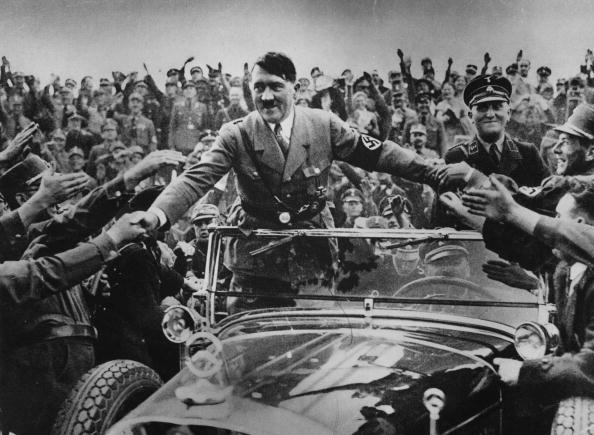
Hulton Archive/Getty Images
Chancellor of Germany
By late 1932, the Nazi Party held the most seats in Germany's parliament, the Reichstag, but did not have a majority. Because no political parties were able to form a majority coalition in support of a candidate to become chancellor, former Chancellor Franz von Papen and other conservative leaders persuaded President Paul von Hindenburg to appoint Hitler as chancellor. Shortly after that, Hitler began consolidating his authority and dismantling the democratic institutions of the Weimar Republic. The Enabling Act of 1933 granted him dictatorial powers, effectively placing him above the law. Hitler had political opponents arrested and imprisoned, and used propaganda to ensure his message dominated public discourse.
Upon the death of Hindenburg in August 1934, Hitler became the head of the German state and government with absolute power. Domestically, he implemented a plethora of racist policies aimed at deporting and killing German Jews. Hitler also engineered Germany's dramatic economic recovery from the Great Depression, as well as the annexation of territories inhabited by millions of ethnic Germans.
World War II and the Holocaust
In the latter half of the 1930s, Hitler spearheaded an aggressive expansionist foreign policy. He directed large-scale rearmament and, on September 1, 1939, invaded Poland, triggering World War II in Europe. Hitler would later order an invasion of the Soviet Union in 1941 and declare war on the United States later that year. World War II became a vehicle for him and his regime to enact their plans to exterminate Jewish people, Roma, homosexuals, disabled people, and various other groups. These plans were carried out during the Holocaust, the systematic genocide of around six million Jews and millions of others throughout Nazi-occupied Europe. By the end of 1941, German forces and the European Axis powers occupied most of Europe, as well as North Africa. However, these gains were gradually reversed as the war went on and the tide turned against Germany. Finally, in 1945, the Allied forces defeated the German army, and World War II came to an end not long after.
Marriage and Suicide
On April 29, 1945, Hitler married his longtime partner, Eva Braun. The next day, the two killed themselves to avoid capture by the Soviet army. Their corpses were subsequently burned in accordance with Hitler's wishes. On May 2, Berlin surrendered.
/2024/06/adolf-hitler-net-worth.png)
/2014/06/Charlie-Chaplin.jpg)
/2014/01/mein.jpg)
/2017/01/GettyImages-503970704.jpg)
/2014/04/GettyImages-56268095.jpg)
/2015/07/fdr.jpg)
/2014/08/GettyImages-104590424.jpg)
/2014/08/Gerhard-Schröder.jpg)
:strip_exif()/2009/09/P-Diddy.jpg)
/2009/11/George-Clooney.jpg)
/2018/03/GettyImages-821622848.jpg)