
/2020/03/amancio.jpg)
/2013/12/Anders-Holch-Povlsen.png)
/2016/03/joe-kennedy.png)
/2020/07/qin.png)
/2010/08/kaiser.jpg)
/2014/03/sandra.jpg)
/2020/01/lopez3.jpg)
/2009/11/George-Clooney.jpg)
/2019/04/rr.jpg)
/2020/02/Angelina-Jolie.png)
/2019/10/denzel-washington-1.jpg)
/2017/02/GettyImages-528215436.jpg)
/2009/09/Brad-Pitt.jpg)
:strip_exif()/2009/09/P-Diddy.jpg)
/2009/09/Cristiano-Ronaldo.jpg)
/2018/03/GettyImages-821622848.jpg)
/2009/09/Jennifer-Aniston.jpg)
What is Amancio Ortega's Net Worth?
Amancio Ortega Gaona is a Spanish fashion executive and entrepreneur who has a net worth of $142 billion.
Amancio Ortega Gaona earned his fortune as the co-founder of the global fashion giant Inditex, the parent company of "Zara." Widely regarded as one of the most successful retailers in modern history, Ortega built his fortune by pioneering the fast fashion model, a system that allows designs to move from concept to store shelves in a matter of weeks. This approach revolutionized the apparel industry, enabling Inditex to respond quickly to consumer trends while maintaining tight control over production and distribution. Over several decades, Ortega transformed Zara from a single storefront in Spain into the largest clothing retailer in the world, with thousands of locations spanning dozens of countries. Despite his immense wealth and influence, he has remained famously private, rarely granting interviews and avoiding the public spotlight. In later years, Ortega has increasingly shifted his focus toward investing, quietly assembling one of the largest and most valuable real estate portfolios on the planet through his holding company, Pontegadea, further solidifying his position among the richest individuals in the world.
Early Life
Amancio Ortega Gaona was born on March 28, 1936, in Busdongo de Arbás, León, Spain. He was the youngest of four children in a working-class family. His father was a railway worker, and his mother worked as a housemaid. The family moved frequently due to his father's job before eventually settling in A Coruña, Galicia, a coastal city in northwestern Spain that would become the center of Ortega's business empire.
Ortega's upbringing was modest, and financial hardship shaped his early outlook. One oft-repeated story describes a moment when a local grocer refused to extend further credit to his mother, an experience that reportedly left a lasting impression on him and fueled his determination to achieve financial independence.
At the age of 14, Ortega left school and began working as a delivery boy for a local shirtmaker. He quickly learned the basics of garment production, from sewing to distribution. Over the next several years, he worked his way up in the clothing industry, gaining hands-on experience that would later inform his unconventional business model.
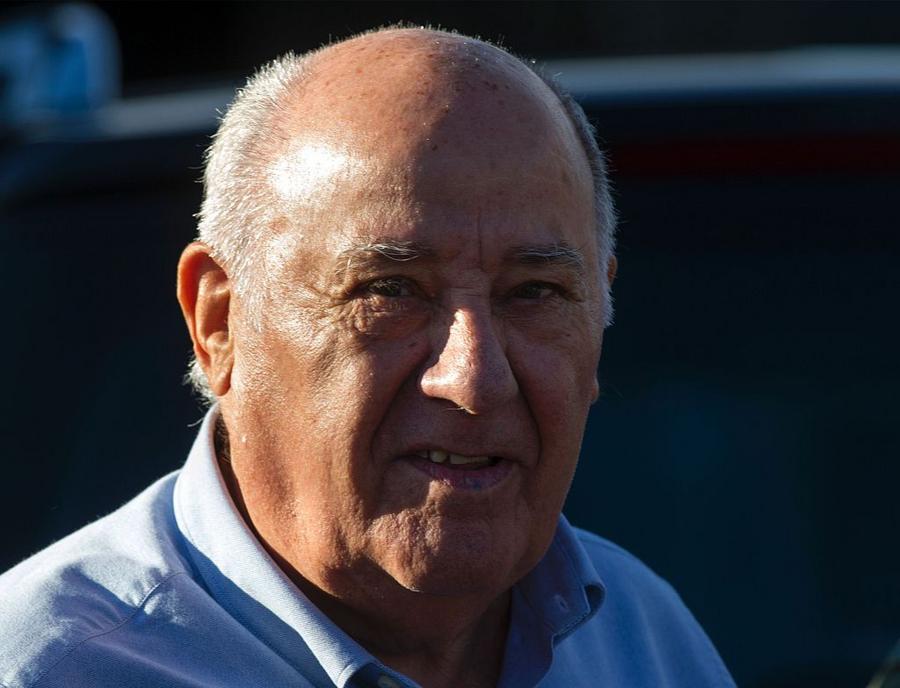
MIGUEL RIOPA/AFP/Getty Images
Early Career and the Birth of Zara
In the early 1960s, Ortega and his first wife, Rosalía Mera, began producing quilted bathrobes and lingerie out of their home. The couple built a small manufacturing operation that supplied garments to local retailers, gradually expanding their network and refining their production process.
By 1975, Ortega was ready to take the next step. He opened the first "Zara" store in A Coruña. The concept was simple but innovative: offer stylish, affordable clothing that closely resembled high-end fashion, and update inventory frequently to keep customers coming back. The store was an immediate success.
Over the next decade, Ortega expanded Zara across Spain, focusing on vertical integration. Unlike traditional retailers, which relied heavily on third-party suppliers, Ortega maintained control over design, manufacturing, and distribution. This allowed Zara to drastically shorten production cycles and minimize excess inventory.
In 1985, Ortega founded Inditex (Industria de Diseño Textil) as a holding company to oversee Zara and future brands. The company would eventually grow into a global retail powerhouse.
Inditex and the Fast Fashion Revolution
Under Ortega's leadership, Inditex redefined the global fashion industry. The company's ability to design, produce, and distribute clothing in a matter of weeks gave it a significant competitive advantage over traditional retailers, which often operated on six-month production cycles.
Zara became the flagship brand, but Inditex expanded to include other labels such as "Massimo Dutti," "Pull&Bear," "Bershka," "Stradivarius," and "Oysho." Each brand targeted a different demographic, allowing the company to capture a wide range of consumers.
By the late 1990s and early 2000s, Inditex had expanded internationally, opening stores across Europe, the Americas, and Asia. The company went public in 2001, a move that dramatically increased Ortega's wealth. At the time of the IPO, he sold a 13.5% stake for approximately $1.1 billion while retaining a controlling interest.
Inditex's growth continued for decades, making it the largest fashion retailer in the world by revenue. Ortega stepped down as chairman in 2011 but remained a major shareholder and influential figure within the company. Leadership eventually passed to his daughter, Marta Ortega, who became chair of Inditex, continuing the family's control over the business.
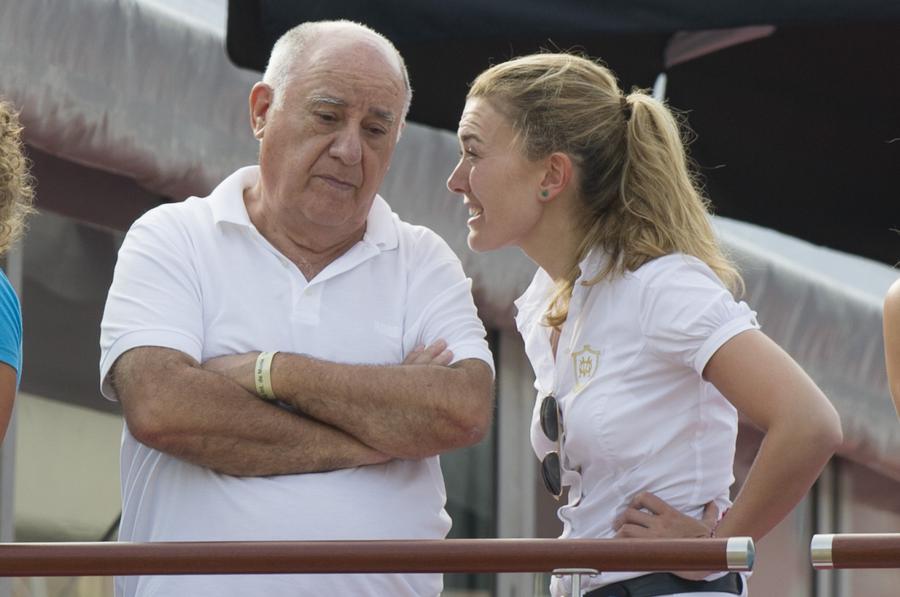
Pascal Le Segretain/Getty Images
Real Estate Empire and Pontegadea
While Ortega built his fortune through fashion, his second act as a real estate investor has been equally remarkable. Following the 2001 IPO, he began channeling his dividend income into property acquisitions through his holding company, Pontegadea.
Over the next two decades, Ortega quietly assembled a global portfolio of prime real estate assets. By 2026, that portfolio was estimated to be worth roughly $25 billion, making him the largest real estate owner among the world's billionaires.
Unlike many real estate investors, Ortega focuses on low-risk, high-quality assets in prime locations. His portfolio includes office towers, luxury retail properties, hotels, logistics facilities, and infrastructure investments across more than a dozen countries. He typically buys properties outright in all-cash deals and rarely sells, favoring long-term cash flow over short-term gains.
Some of his most notable acquisitions include London's Devonshire House, Seattle's Troy Block complex leased to Amazon, Toronto's Royal Bank Plaza, and a major office hub in Vancouver leased to Amazon that he purchased for approximately $850 million.
His tenants include some of the world's largest companies, such as Amazon, Apple, Meta, Nike, Spotify, and Walmart. This strategy provides stable, predictable income streams while preserving the long-term value of his assets.
Ortega has also diversified beyond traditional real estate, investing in infrastructure such as ports, as well as renewable energy projects including wind and solar farms.
Investment Strategy and Tax Efficiency
A key driver behind Ortega's real estate expansion has been tax efficiency. Spain imposes a wealth tax that includes cash holdings, incentivizing billionaires to keep assets invested rather than sitting idle.
By reinvesting billions of dollars in dividends from Inditex into real estate and other active business assets, Ortega has significantly reduced his tax burden. According to estimates, this strategy has saved him hundreds of millions of dollars in wealth taxes over the years.
Additionally, by holding his Inditex shares through Pontegadea, Ortega benefits from favorable tax treatment on dividends. Instead of paying Spain's top personal dividend tax rate, he pays a much lower effective rate through corporate exemptions, allowing him to reinvest more capital into his expanding portfolio.
This disciplined approach has enabled Ortega to steadily grow his wealth while maintaining a conservative risk profile, a rare combination among billionaires with portfolios of this scale.
Personal Life
Amancio Ortega has long been known for his intensely private lifestyle. Unlike many billionaires, he avoids public appearances and rarely gives interviews. For much of his career, relatively few photographs of him were publicly available.
He was married to Rosalía Mera, his early business partner, until their divorce in 1986. Mera remained a shareholder in Inditex until her death in 2013 and was one of Spain's wealthiest women. Ortega later married Flora Pérez Marcote, with whom he has children, including Marta Ortega, who has taken on a leading role within Inditex.
Despite his immense wealth, Ortega is known for his relatively understated personal habits. He has been described as preferring simple clothing, often wearing Zara products, and maintaining a low-profile daily routine.
Personal Wealth
During a brief period in 2015, Amancio Ortega climbed the ranks to become the wealthiest person on the planet, overtaking Bill Gates. This was because Inditex stocks peaked during this time. As the head of the Ortega family, Amancio leads the wealthiest family in all of Europe. The Ortegas have become a dynasty, and many of Amancio's children and relatives have become extremely wealthy in their own various endeavors thanks to the foundation laid by Amancio's original success.
In terms of retailers alone, Amancio is the second-wealthiest individual. His wealth is essentially a direct reflection of Inditex's stock value. In 2009, Ortega owned 52.9% of Inditex stocks. In 2016, he consolidated even more control and wealth by obtaining 60% of Inditex stock.
He has received more than $4.5 billion worth of dividends since the company's IPO in 2001. Ortega has invested in real estate in the United States and Europe and owns a property portfolio valued at $1.4 billion. In addition, he controls a 21.6 percent stake in real estate giant Grilse. The rest of the company is owned by his wife, Flora, as well as his daughter, Marta.
/2020/03/amancio.jpg)
/2014/03/sandra.jpg)
/2013/04/Rosalia-Mera.png)
/2017/08/GettyImages-584836336-1.jpg)
/2017/04/am.jpg)
/2013/12/Anders-Holch-Povlsen.png)
/2016/02/GettyImages-488162724.jpg)
:strip_exif()/2015/09/GettyImages-476575299.jpg)
/2019/11/GettyImages-1094653148.jpg)