
/2019/01/Jose-Carreras.jpg)
/2021/11/luciano.jpg)
/2009/11/Lang-Lang.jpg)
/2014/08/Plácido-Domingo-1.jpg)
/2014/12/GettyImages-145733131.jpg)
/2014/12/GettyImages-146938304.jpg)
/2019/10/denzel-washington-1.jpg)
/2017/02/GettyImages-528215436.jpg)
/2019/04/rr.jpg)
/2020/01/lopez3.jpg)
/2009/09/Jennifer-Aniston.jpg)
/2009/09/Brad-Pitt.jpg)
/2020/02/Angelina-Jolie.png)
/2009/09/Cristiano-Ronaldo.jpg)
/2009/11/George-Clooney.jpg)
/2018/03/GettyImages-821622848.jpg)
:strip_exif()/2015/09/GettyImages-476575299.jpg)
What is José Carreras' net worth?
José Carreras is a Spanish operatic tenor best known for his lyric warmth, expressive phrasing, and for being one-third of the historic Three Tenors alongside Luciano Pavarotti and Plácido Domingo. Over the course of a career spanning more than five decades, Carreras became one of the most widely recognized classical singers in the world, balancing traditional operatic excellence with unprecedented global visibility. While his voice was often described as more intimate and emotional than those of his counterparts, it proved ideally suited to both the operatic stage and large-scale international concerts.
Carreras built his reputation in the 1970s as one of the leading tenors of his generation, performing regularly at the world's most prestigious opera houses and recording extensively for major labels. In the 1990s, his career reached an entirely new level of fame through the Three Tenors phenomenon, which brought opera to stadiums, television broadcasts, and millions of listeners who had little prior exposure to classical music. Beyond performance, Carreras is also widely admired for his personal resilience. After being diagnosed with leukemia at the height of his career, he returned to the stage following a dramatic recovery and went on to found a major international charitable organization dedicated to fighting the disease.
Early Life
José Carreras was born on December 5, 1946, in Barcelona, Spain. He grew up in a Catalan household where music was a constant presence, and his vocal talent emerged at a very young age. As a child, he appeared in public performances and early stage productions, quickly gaining attention for the natural beauty of his voice. His formal musical training began in Barcelona, where he studied singing and piano while continuing his general education.
Carreras' early exposure to opera and disciplined instruction laid the foundation for a rapid professional ascent. By his late teens, he had already performed in operatic roles that far exceeded what would typically be expected of a singer his age, signaling the arrival of a major new talent.
Operatic Breakthrough
Carreras made his professional operatic debut in the early 1970s and rose quickly through the European opera circuit. His breakthrough came when he was invited to perform at major houses including the Gran Teatre del Liceu in Barcelona, the Vienna State Opera, and the Royal Opera House at Covent Garden. His voice, characterized by a rich lyric quality and emotional immediacy, proved especially well suited to the Italian repertory.
A pivotal moment in his career was his association with conductor Herbert von Karajan, who became an important mentor and champion. Under Karajan's guidance, Carreras performed in and recorded major works by Verdi and Puccini, gaining international acclaim. His interpretations of roles such as Don José in "Carmen," Cavaradossi in "Tosca," and Riccardo in "Un Ballo in Maschera" established him as one of the foremost tenors of his era.
International Fame and Recordings
By the late 1970s and early 1980s, Carreras was a fixture on the world's biggest stages, including the Metropolitan Opera in New York and La Scala in Milan. He recorded prolifically, releasing a wide catalog of complete operas, recitals, and crossover albums that reached audiences well beyond traditional opera circles. His recordings were praised for their lyrical sensitivity and emotional depth rather than sheer vocal power.
Unlike some contemporaries, Carreras favored roles that emphasized expressive storytelling, which helped distinguish him artistically even as the operatic marketplace grew increasingly competitive. This approach earned him both critical respect and a loyal international following.
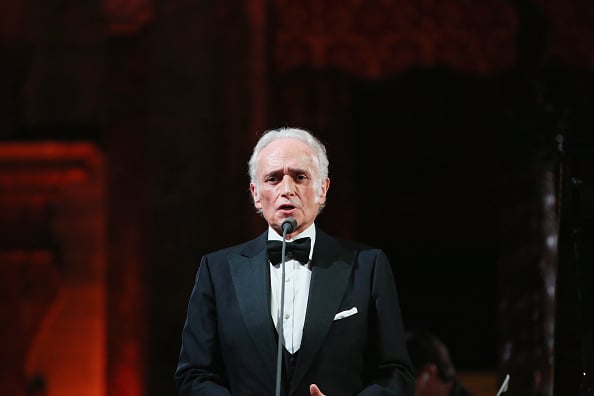
Getty
The Three Tenors Era
Carreras' career took an unprecedented turn in 1990 when he joined Luciano Pavarotti and Plácido Domingo for the first Three Tenors concert, staged in conjunction with the FIFA World Cup in Italy. The performance became a cultural landmark, broadcast worldwide and followed by a best-selling album that remains one of the most successful classical recordings of all time.
The Three Tenors concerts and tours transformed Carreras into a global celebrity. Performing arias and popular songs in massive stadiums, the trio reached audiences numbering in the tens of millions. While some critics viewed the project as overly commercial, its impact on popularizing opera was undeniable. For Carreras, the collaboration also carried personal significance, as it marked a triumphant return to the stage after a serious illness.
Illness and Return to the Stage
In 1987, Carreras was diagnosed with acute lymphoblastic leukemia, a life-threatening condition that forced him to step away from performing. After undergoing aggressive treatment, including a bone marrow transplant, he made a highly publicized recovery. His return to the stage was seen as both a medical miracle and a deeply emotional moment for fans around the world.
Following his recovery, Carreras shifted his repertoire somewhat, focusing more on concerts and select operatic appearances rather than the heaviest dramatic roles. His performances during this period were often marked by heightened emotional resonance, shaped by his personal experience and renewed perspective.
Philanthropy and the José Carreras Leukaemia Foundation
In the wake of his illness, Carreras founded the José Carreras Leukaemia Foundation, an international organization dedicated to supporting research, treatment, and patient care for leukemia. The foundation has funded major scientific initiatives and helped raise awareness worldwide, becoming one of the most prominent artist-led medical charities in Europe.
Carreras has remained closely involved with the foundation's work, frequently participating in benefit concerts and public campaigns. His philanthropic efforts have become an essential part of his legacy, often cited alongside his musical achievements.
Later Career and Legacy
In the later years of his career, Carreras gradually reduced his performance schedule while continuing to appear in concerts and special events. He officially announced his retirement from opera performances, though he has remained active in music through select appearances and recordings.
José Carreras' legacy rests on both artistic and human achievements. As a singer, he brought lyric beauty and emotional honesty to some of opera's most beloved roles. As a public figure, he helped usher classical music into a new era of mass accessibility through the Three Tenors. And as a survivor and philanthropist, he transformed personal adversity into a lasting global impact.
/2019/01/Jose-Carreras.jpg)
/2014/08/Plácido-Domingo-1.jpg)
/2021/11/luciano.jpg)
/2010/03/Andrea-Bocelli-1.jpg)
/2009/11/Lang-Lang.jpg)
/2014/12/GettyImages-145733131.jpg)
/2017/05/Adelmo-Fornaciari.jpg)
/2020/06/taylor.png)
/2020/04/Megan-Fox.jpg)
:strip_exif()/2009/09/P-Diddy.jpg)