
/2018/11/Luis-Aparicio.jpg)
/2017/11/Carlton-Fisk.jpg)
/2014/09/Albert-Bell.jpg)
/2021/06/ripken.jpg)
/2014/11/Eddie-Murray.png)
/2014/10/Omar-Vizquel.jpg)
/2009/09/Cristiano-Ronaldo.jpg)
/2020/02/Angelina-Jolie.png)
/2020/06/taylor.png)
/2019/11/GettyImages-1094653148.jpg)
/2020/01/lopez3.jpg)
/2018/03/GettyImages-821622848.jpg)
/2020/04/Megan-Fox.jpg)
/2009/09/Jennifer-Aniston.jpg)
/2009/09/Brad-Pitt.jpg)
/2009/11/George-Clooney.jpg)
/2019/04/rr.jpg)
What is Luis Aparicio's net worth?
Luis Aparicio is a Venezuelan former professional baseball player who has a net worth of $3 million. Renowned for his lightning speed, sharp fielding, and intelligent baserunning, Luis Aparicio revolutionized the role of the shortstop during the 1950s and 1960s. He was the first Venezuelan-born player inducted into the Baseball Hall of Fame and remains one of the most important Latin American figures in the sport's history. Over an 18-year career with the Chicago White Sox, Baltimore Orioles, and Boston Red Sox, Aparicio earned nine Gold Glove Awards, ten All-Star selections, and led the American League in stolen bases for nine consecutive seasons. Beyond his accolades, his professionalism and grace on and off the field helped open doors for generations of Latin American players who followed.
Early Life
Luis Ernesto Aparicio Montiel was born on April 29, 1934, in Maracaibo, Venezuela. Baseball ran deep in his family—his father, Luis Aparicio Sr., was a legendary player in the Venezuelan leagues, and his mother's family also had ties to the sport. From an early age, Aparicio was immersed in baseball culture and displayed remarkable athletic ability. He began his professional career as a teenager in the Venezuelan Winter League before being signed by the Chicago White Sox organization in 1953. By 1956, he had made his Major League debut at the age of 22, immediately showcasing the speed and defensive precision that would define his career.
Career
Aparicio's rookie season with the Chicago White Sox in 1956 was spectacular. He hit .266, led the American League with 21 stolen bases, and became the first Latin American player to win the Rookie of the Year Award. He quickly established himself as one of the premier defensive shortstops in baseball, combining sure hands, quick reflexes, and flawless footwork. From 1956 through 1964, he was the heart of Chicago's infield, winning six consecutive Gold Gloves and helping lead the team to the 1959 World Series—the franchise's first appearance since 1919.
In 1963, Aparicio was traded to the Baltimore Orioles, where his veteran leadership and defensive prowess helped solidify the team's rise to contention. In 1966, he played a pivotal role in guiding the Orioles to their first-ever World Series championship, anchoring the defense behind a young pitching staff that included Jim Palmer. After his stint in Baltimore, Aparicio returned to the White Sox for several seasons before finishing his career with the Boston Red Sox, retiring after the 1973 season.
Over his 18-year career, Aparicio compiled 2,677 hits, 506 stolen bases, and a .972 fielding percentage—remarkable numbers for a defense-first shortstop in an era when middle infielders were not expected to contribute heavily on offense. He was a ten-time All-Star and led the league in steals nine times between 1956 and 1964, redefining how speed could impact the game.
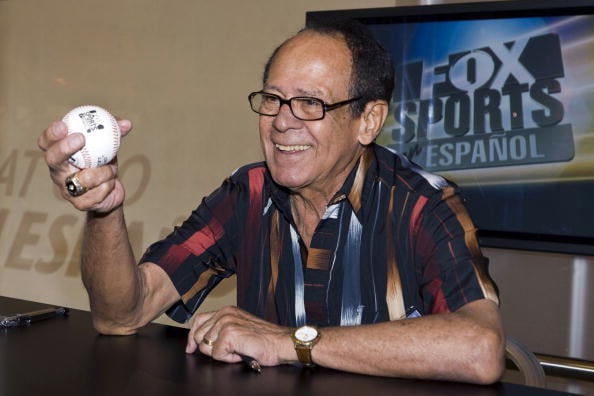
Getty
Contracts, Salaries & Career Earnings
Playing during an era long before the era of multimillion-dollar contracts, Aparicio's career earnings were modest by modern standards. In the late 1950s and early 1960s, top-tier players typically earned between $25,000 and $40,000 per season. Aparicio was consistently among the highest-paid players on the White Sox roster, and by the time of his tenure with the Orioles and Red Sox, his annual salary peaked at approximately $100,000. Over his entire career, he is estimated to have earned roughly $800,000 to $1 million in total salary. Despite the comparatively low figures, Aparicio's earnings represented great success for an international player of his time, particularly given that most Latin American athletes of that era faced limited opportunities and lower pay compared to their American counterparts.
Legacy and Honors
Luis Aparicio was inducted into the National Baseball Hall of Fame in 1984, becoming the first Venezuelan player ever to receive the honor. His induction was a source of immense national pride, and he remains a revered figure in Venezuelan sports history. In his home country, his number 11 jersey was retired by the Venezuelan Winter League team Tiburones de La Guaira, and the main baseball stadium in Maracaibo—Estadio Luis Aparicio "El Grande"—bears his name.
In the United States, Aparicio's influence extended far beyond statistics. His defensive brilliance and speed helped redefine the shortstop position, shifting it from a purely defensive role to one where agility, athleticism, and offensive pressure through base-stealing became key strategic elements. He inspired generations of Latin American infielders, paving the way for stars like Omar Vizquel and José Reyes.
Post-Playing Career and Personal Life
After retiring from professional baseball, Aparicio returned to Venezuela, where he remained active in promoting the sport. He has served as a mentor to young players, participated in ceremonial events with Major League Baseball, and continued to be honored by both American and Venezuelan organizations for his contributions. Aparicio has largely avoided public controversy, maintaining the same quiet dignity that defined his playing days.
/2018/11/Luis-Aparicio.jpg)
/2014/10/Omar-Vizquel.jpg)
/2010/06/Ozzie-Guillen.jpg)
/2017/11/Carlton-Fisk.jpg)
/2014/10/Freddy-Garcia-e1579979452929.jpg)
/2014/11/Eddie-Murray.png)
/2013/12/GettyImages-824524840.jpg)
:strip_exif()/2015/09/GettyImages-476575299.jpg)
:strip_exif()/2009/09/P-Diddy.jpg)
/2019/10/denzel-washington-1.jpg)