
/2009/12/King-Hassan-II.png)
/2009/11/Mohammed-VI-of-Morocco.jpg)
/2020/01/Qaboos-bin-Said-Al-Said-of-Oman.png)
/2015/01/GettyImages-79011061.jpg)
/2021/11/king.jpg)
/2020/06/taylor.png)
/2009/11/George-Clooney.jpg)
/2009/09/Cristiano-Ronaldo.jpg)
:strip_exif()/2009/09/P-Diddy.jpg)
/2020/02/Angelina-Jolie.png)
/2019/11/GettyImages-1094653148.jpg)
/2019/04/rr.jpg)
/2020/04/Megan-Fox.jpg)
/2020/01/lopez3.jpg)
/2017/02/GettyImages-528215436.jpg)
/2019/10/denzel-washington-1.jpg)
/2009/09/Jennifer-Aniston.jpg)
What was King Hassan II's net worth?
King Hassan II was a Moroccan King who had a net worth of $1 billion.
King Hassan II ruled Morocco for nearly four decades and stands as one of the most consequential, complex, and controversial monarchs in modern Arab history. Ascending the throne in 1961, Hassan II preserved a 300-year-old dynasty at a time when monarchies across North Africa and the Middle East were collapsing under the pressure of coups, revolutions, and militant ideologies. A shrewd political survivor, he combined deep religious legitimacy, personal authority, and calculated repression with gradual economic and political reform. To Western governments, he was one of the most reliable and strategically minded Arab leaders, a quiet ally of Washington and a discreet interlocutor in Arab-Israeli diplomacy. To critics, he was an autocrat whose long reign was marked by political imprisonment, enforced disappearances, and an iron grip on power.
Hassan II was a ruler of contradictions. He authored Morocco's first constitution yet repeatedly suspended democratic institutions when they threatened his authority. He tolerated opposition parties and a relatively free press while drawing a hard red line around criticism of the monarchy itself. He projected both religious piety and worldly sophistication, moving easily between traditional Islamic symbolism and Western diplomatic salons. By the time of his death in 1999, Morocco was more politically open and economically developed than when he took power, but still deeply shaped by his belief that stability required a strong, unquestioned throne.
Early Life and Education
Moulay Hassan ben Mohammed Alaoui was born on July 9, 1929, the eldest son of Sultan Mohammed V, later King Mohammed V of Morocco. Heir to the Alawite dynasty, which claimed direct descent from the Prophet Muhammad, Hassan grew up at the intersection of royal tradition and colonial politics. Much of Morocco was then under French and Spanish control, and nationalist resistance was steadily intensifying.
He received a dual education reflecting these competing worlds. Hassan studied at the Imperial College in Rabat, where instruction was conducted in Arabic and French, before earning a law degree from the University of Bordeaux. He also served in the French Navy aboard the battleship "Jeanne d'Arc." These experiences gave him fluency in Western legal systems and military structures while reinforcing his sense of Morocco's distinct religious and cultural identity.
Path to the Throne
During the final years of French rule, Hassan worked closely with his father to strengthen the monarchy's position amid growing nationalist unrest. When the French exiled Mohammed V in 1953, the move backfired, accelerating resistance and ultimately leading to independence in 1956. After independence, Hassan became commander in chief of the Royal Moroccan Army and played a key role in consolidating state authority, including leading military campaigns against rebellious tribes in the Rif Mountains.
In 1960, Hassan was named prime minister. The following year, Mohammed V died unexpectedly after surgery, and Hassan ascended the throne on February 26, 1961. Many observers doubted his ability to rule, viewing him as inexperienced and overly indulgent. Those doubts proved premature.
Authoritarian Rule and Political Survival
Hassan II quickly moved to centralize power. He introduced a constitution in 1962 that created an elected parliament and guaranteed civil liberties, but the document preserved sweeping powers for the king, including control of the military and the authority to dissolve the legislature. When political unrest intensified in the mid-1960s, Hassan suspended parliament and ruled under a state of emergency.
His reign was punctuated by dramatic challenges, including two violent coup attempts. In 1971, mutinous troops attacked his birthday celebration at the Skhirat palace, killing nearly 100 guests. In 1972, rogue air force pilots attempted to shoot down his plane. Hassan survived both attempts, emerging with his authority strengthened and his opponents crushed. These events cemented his reputation as both ruthless and remarkably resilient.
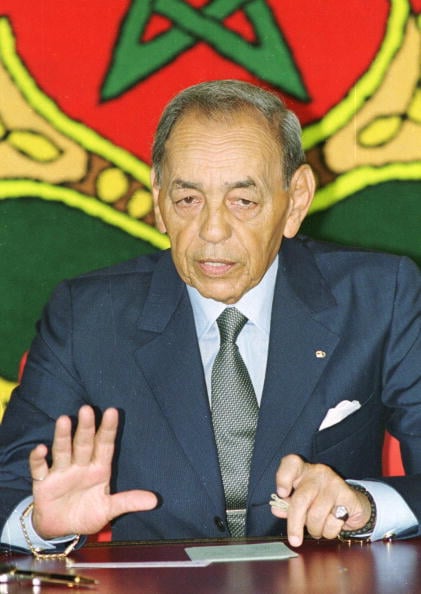
STR/AFP/Getty Images
Western Sahara and National Unity
One of the defining moments of Hassan II's reign came in 1975 with the "Green March," when he mobilized hundreds of thousands of civilians to assert Morocco's claim over Western Sahara as Spain withdrew. The move rallied national unity but sparked a prolonged conflict with the Polisario Front, backed by Algeria and Libya.
Though the conflict dragged on for years, Morocco ultimately secured control over most of the territory. The Western Sahara issue became a central pillar of Hassan's legitimacy, allowing him to frame dissent as a threat to national sovereignty.
Middle East Diplomacy and Relations with the West
Internationally, Hassan II was widely regarded as one of the most Western-oriented Arab leaders. He maintained close ties with the United States and Europe while carefully managing Morocco's position in the Arab world. He played a quiet but influential role in Arab-Israeli diplomacy, hosting secret meetings and acting as an intermediary long before such contacts were politically acceptable.
Hassan facilitated early contacts between Israeli and Arab leaders and later welcomed Israeli officials to Morocco, positioning his country as a bridge between worlds. At the same time, he sent symbolic military support to Arab states during regional wars, preserving his standing among Arab peers.
Gradual Reform and Final Years
From the late 1980s onward, Hassan cautiously expanded political freedoms. Human rights abuses declined, political prisoners were released, and opposition parties were allowed greater participation in government. Economic reforms continued, though poverty and unemployment remained widespread.
In 1998, he appointed longtime opposition leader Abderrahmane Youssoufi as prime minister, signaling a controlled transition toward broader political inclusion. By then, however, Hassan's health was failing, and his son Crown Prince Sidi Mohammed increasingly took on public responsibilities.
Death and Legacy
King Hassan II died on July 23, 1999, at the age of 70, after suffering a heart attack. He was succeeded by his son, Mohammed VI, who pledged continuity alongside reform.
Hassan II left behind a Morocco that was more stable and internationally connected than many of its neighbors, but also deeply marked by decades of centralized authority. His legacy is that of a masterful political survivor who believed that order and continuity were paramount, even at the expense of democratic ideals. Through intelligence, charm, and uncompromising control, he steered an ancient monarchy into the modern era, ensuring its survival while shaping Morocco's political landscape for generations.
/2009/12/King-Hassan-II.png)
/2009/11/Mohammed-VI-of-Morocco.jpg)
/2020/01/Qaboos-bin-Said-Al-Said-of-Oman.png)
/2025/02/missing_profile.jpg)
/2015/01/GettyImages-79011061.jpg)
/2014/10/GettyImages-488419937.jpg)
/2015/01/Abdullah-II.jpg)
/2014/07/King-Carl-XVI-Gustaf.png)
:strip_exif()/2015/09/GettyImages-476575299.jpg)
/2018/03/GettyImages-821622848.jpg)
/2009/09/Brad-Pitt.jpg)