
/2017/01/John-Lewis.jpg)
/2014/09/Bernie-Sanders.jpg)
/2014/07/GettyImages-451122000.jpg)
/2023/08/Lyndon-B.-Johnson.jpg)
/2010/03/GettyImages-911943150.jpg)
/2020/06/taylor.png)
/2018/03/GettyImages-821622848.jpg)
:strip_exif()/2009/09/P-Diddy.jpg)
/2009/09/Brad-Pitt.jpg)
/2009/09/Jennifer-Aniston.jpg)
/2020/02/Angelina-Jolie.png)
/2009/09/Cristiano-Ronaldo.jpg)
/2020/04/Megan-Fox.jpg)
/2009/11/George-Clooney.jpg)
/2019/10/denzel-washington-1.jpg)
/2017/02/GettyImages-528215436.jpg)
:strip_exif()/2015/09/GettyImages-476575299.jpg)
What was John Lewis's net worth and salary?
John Lewis was an American politician and civil rights leader who had a net worth of $300 thousand at the time of his death in 2020. John Lewis died on July 17, 2020, at the age of 80. According to this last Congressional wealth disclosure, Lewis estimated his net worth to be $150 – $300,000.
John Lewis was one of the most consequential figures of the American civil rights movement and a moral force in national politics for more than half a century. Rising from extreme poverty in the segregated South, Lewis became a frontline organizer in the fight against Jim Crow laws, enduring repeated beatings, arrests, and near-death violence in pursuit of racial equality and voting rights. As a young activist, he stood shoulder to shoulder with Martin Luther King Jr., helped organize the 1963 March on Washington, and led demonstrators across the Edmund Pettus Bridge in Selma, where his brutal assault on Bloody Sunday helped galvanize public support for the Voting Rights Act of 1965.
Unlike many activists of his generation, Lewis carried the moral authority of the movement directly into government. Elected to Congress in 1986, he represented Atlanta for more than three decades, earning the nickname "the conscience of the Congress." While not known for flashy legislation or partisan theatrics, Lewis became a living symbol of ethical leadership, nonviolence, and civic responsibility. His career bridged eras, from the struggle to dismantle segregation to modern debates over voting rights, police violence, and democratic norms. Few Americans embodied the idea of "moral courage" as completely or as consistently as John Lewis.
Early Life
John Robert Lewis was born on February 21, 1940, near Troy, Alabama, the third of ten children born to Eddie and Willie Mae Lewis, who worked as sharecroppers. He grew up in rural poverty without electricity or indoor plumbing, surrounded by the daily humiliations of segregation. As a child, Lewis was deeply religious and often preached to the family's chickens, earning the nickname "Preacher."
Lewis was profoundly influenced by hearing Martin Luther King Jr. speak on the radio during the Montgomery bus boycott. As a teenager, he wrote to King seeking guidance and was invited to meet him in Montgomery. That encounter solidified his commitment to nonviolent activism. Lewis later enrolled at American Baptist Theological Seminary in Nashville, where he studied theology and philosophy while working menial jobs to support himself.
Student Activism and the Civil Rights Movement
While in Nashville, Lewis became immersed in the emerging civil rights movement. He participated in nonviolence workshops led by James Lawson and joined sit-ins challenging segregated lunch counters. In 1960, he was arrested for the first time during a sit-in protest, marking the beginning of a long history of civil disobedience.
Lewis was a founding member of the Student Nonviolent Coordinating Committee (SNCC) and soon emerged as one of its most disciplined and fearless leaders. He was one of the original Freedom Riders in 1961, challenging segregated interstate travel. During those rides, Lewis was beaten unconscious by white mobs in Montgomery, Alabama, and repeatedly jailed across the South.
Despite escalating violence, Lewis remained committed to nonviolence, believing it was both a moral philosophy and a practical strategy for social change.
March on Washington and Bloody Sunday
At just 23 years old, Lewis was the youngest speaker at the 1963 March on Washington for Jobs and Freedom. While Martin Luther King Jr.'s "I Have a Dream" speech became the event's defining moment, Lewis's address was among its most forceful. He demanded immediate federal action on civil rights and warned that patience had become a tool of oppression.
Lewis's most iconic moment came two years later. On March 7, 1965, he helped lead more than 600 peaceful demonstrators across the Edmund Pettus Bridge in Selma, Alabama, demanding voting rights for Black Americans. State troopers attacked the marchers with tear gas and clubs in what became known as Bloody Sunday. Lewis's skull was fractured by a blow from a billy club, an assault broadcast on national television.
The images shocked the nation and directly accelerated passage of the Voting Rights Act of 1965, one of the most important pieces of civil rights legislation in U.S. history.
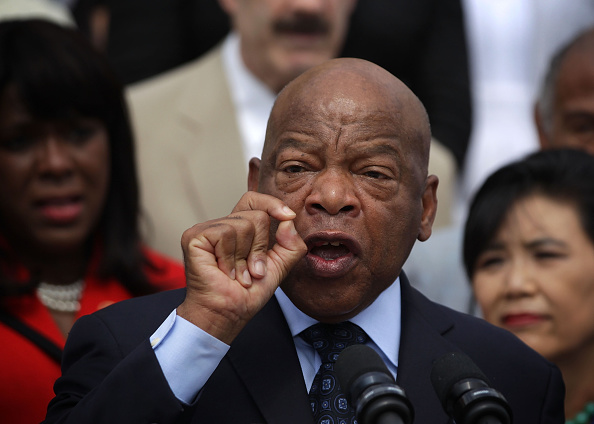
Alex Wong/Getty Images
Transition to Public Service
As the civil rights movement evolved, SNCC fractured over ideology, with some leaders embracing militancy and "Black Power." Lewis, committed to nonviolence, was replaced as SNCC chairman in 1966. He spent the next several years working on voter registration efforts and completing his education at Fisk University.
Lewis entered electoral politics in the late 1970s. After an unsuccessful congressional bid in 1977, he was elected to the Atlanta City Council in 1981. In 1986, he won election to the U.S. House of Representatives, defeating fellow civil rights leader Julian Bond in a hard-fought race.
Congressional Career
John Lewis served in Congress for more than 33 years, representing Georgia's 5th District. He was not a legislative showman, but he wielded extraordinary moral influence. Lewis consistently supported civil rights, voting protections, social justice, and anti-poverty programs. He opposed wars he viewed as unjust, including the Persian Gulf War and the Iraq War, and voted against trade agreements he believed harmed working-class communities.
Lewis was arrested several times while in office, including during protests against apartheid, genocide in Darfur, and gun violence. In 2016, he led a sit-in on the House floor demanding votes on gun control legislation after the Orlando nightclub massacre.
He was also outspoken about threats to democratic legitimacy. Lewis boycotted the inaugurations of George W. Bush and Donald Trump, citing concerns about election legitimacy and foreign interference.
Later Years and Final Legacy
In 2011, Lewis was awarded the Presidential Medal of Freedom by President Barack Obama, who praised him as a man whose life demonstrated "the fierce urgency of now." Even in his later years, Lewis remained deeply engaged in national conversations about justice and equality.
After the killing of George Floyd in 2020, Lewis publicly supported the global protests against police brutality and systemic racism, calling them a continuation of the civil rights struggle. Diagnosed with Stage 4 pancreatic cancer that same year, he vowed to fight the disease with the same determination he had shown throughout his life.
John Lewis died on July 17, 2020, at the age of 80.
Legacy
John Lewis's life traced the moral arc of modern American history. From the brutality of Jim Crow to the halls of Congress, he embodied the belief that democracy demands participation, sacrifice, and courage. His philosophy of getting into "good trouble" became both a rallying cry and a guiding principle for generations of activists.
More than a legislator, Lewis was a living bridge between the civil rights movement and contemporary struggles for justice. His legacy endures not only in the laws he helped shape, but in the moral standard he set for public life.
/2017/01/John-Lewis.jpg)
/2014/09/Bernie-Sanders.jpg)
/2021/12/mlk.jpg)
/2023/08/Lyndon-B.-Johnson.jpg)
/2022/11/Malcolm-X.jpg)
/2014/07/GettyImages-451122000.jpg)
/2010/12/harry-2.jpg)
/2020/01/lopez3.jpg)
/2019/11/GettyImages-1094653148.jpg)