
/2009/11/Brock-Lesnar.jpg)
/2010/09/frank-mir-1.jpg)
/2011/12/cain.jpg)
/2018/12/sable.jpg)
/2021/07/Randy-Couture.jpg)
/2015/07/Seth-Rollins-1.jpg)
/2017/02/GettyImages-528215436.jpg)
/2019/04/rr.jpg)
/2020/04/Megan-Fox.jpg)
/2018/03/GettyImages-821622848.jpg)
/2019/11/GettyImages-1094653148.jpg)
/2020/01/lopez3.jpg)
/2009/09/Jennifer-Aniston.jpg)
/2020/06/taylor.png)
/2009/09/Cristiano-Ronaldo.jpg)
:strip_exif()/2009/09/P-Diddy.jpg)
/2020/02/Angelina-Jolie.png)
What Is Brock Lesnar's Net Worth?
Brock Lesnar is an American professional wrestler and former Mixed Martial Artist who has a net worth of $10 million. Some media sources have claimed that during his wrestling and MMA careers, Brock has earned over $150 million. We have not found any credible evidence to back up that claim. He was certainly paid tens of millions of dollars, but nowhere near $100 million. In fact, in a podcast interview around the time he returned to the WWE in March 2026, Brock implied he decided to come back because he needed the money "so I could feed my kids.. you guys should see my grocery bill." It's unclear if he was joking or exagerating or both.
Although he has experienced some success in both professional football and the UFC, Brock Lesnar is probably best known for his time in the WWE, where he has been the overall world champion eight times. Lesnar began as an amateur wrestler before joining the WWE (formerly the WWF) in 2000. Shortly thereafter, he became the youngest champion in the title's history.
After leaving the WWE in 2004, Brock successfully joined the Minnesota Vikings as a defensive tackle, but he was cut before the start of the season. He then spent time in Japan as a professional wrestler before beginning a career in Mixed Martial Arts. His journey with the UFC began in 2007, and he performed well throughout the next few years despite injuries. Eventually, Brock became the undisputed Heavyweight Champion, and he succeeded in bringing the UFC some of its most commercially successful pay-per-view events in history. Brock earned $3 million fighting Alistair Overeem in 2011. He then earned $8 million fighting Mark Hunt in 2016.
After another return to the WWE, Lesnar returned to the UFC once again, only to be suspended for using a banned substance. This prompted him to retire for a second and final time in 2017. Brock is the only person to simultaneously hold a UFC championship and a WWE world championship. He has been called one of the most accomplished wrestlers in history, and many fans have praised him for his ability to entertain while in the ring.
Wrestling Earnings
Brock Lesnar has been one of the highest-paid performers in professional wrestling history, particularly during his second run with WWE beginning in 2012. His return fundamentally changed the economics of top-tier wrestling contracts by establishing the modern "part-time megastar" model.
Over the course of that run, Lesnar's base salary reportedly fluctuated between $5 million and $12 million per year, despite working a drastically reduced schedule compared to full-time wrestlers. Rather than appearing weekly, he was positioned as a special attraction, competing primarily at major pay-per-view events and select television appearances.
In addition to his base salary, Lesnar commanded enormous per-appearance fees. Contract leaks from the late 2010s suggested he earned roughly $167,000 simply for showing up on television, and as much as $650,000 per match. Those figures did not include merchandise revenue, where Lesnar earned a significant cut from his highly successful "Suplex City" brand, further boosting his annual income.
Earlier in his career, Lesnar also earned substantial money during his initial WWE run from 2002 to 2004, when he quickly became one of the company's top stars. While exact figures from that period are less public, he was already among the highest-paid performers on the roster before leaving to pursue other opportunities.
Outside of WWE, Lesnar had a brief but lucrative stint with New Japan Pro-Wrestling between 2005 and 2007. He was brought in as a premium attraction and even held the IWGP Heavyweight Championship, commanding top-tier pay for limited appearances. His run in Japan ended amid contract and payment disputes, but it further demonstrated his ability to draw major money internationally.
Taken together, Lesnar's wrestling earnings over the course of his career likely total well into the tens of millions, driven largely by his ability to generate revenue as a rare, must-see attraction rather than a full-time performer.
UFC Earnings
Brock Lesnar's UFC career was relatively short, spanning just nine fights, but financially it was extraordinarily lucrative. Combining disclosed purses and estimated pay-per-view shares, his total earnings from mixed martial arts are believed to be around $24 million.
Lesnar's earning power was driven heavily by his ability to draw massive pay-per-view audiences. While athletic commissions only disclosed base salaries, court documents from a later UFC antitrust lawsuit revealed the true scale of his paydays once back-end points were included.
His biggest single payday came at UFC 200 in 2016, when he returned to face Mark Hunt. Lesnar's disclosed base salary for the fight was $2.5 million, which was already a record at the time. However, when his share of pay-per-view revenue was factored in, his total earnings for that bout were estimated to fall between $5.5 million and $8 million.
Several of his earlier fights also generated enormous payouts. At UFC 141 in 2011 against Alistair Overeem, court records later revealed Lesnar earned approximately $3 million. His fight against Frank Mir at UFC 100 in 2009, one of the highest-selling events in UFC history, brought in an estimated $3 million or more. His 2010 bout against Shane Carwin at UFC 116 is believed to have earned him over $2 million.
Despite having far fewer fights than most top MMA earners, Lesnar consistently commanded elite-level pay due to his crossover fame and drawing ability. His UFC run remains one of the most financially efficient careers in combat sports history, with massive earnings concentrated into a relatively small number of appearances.
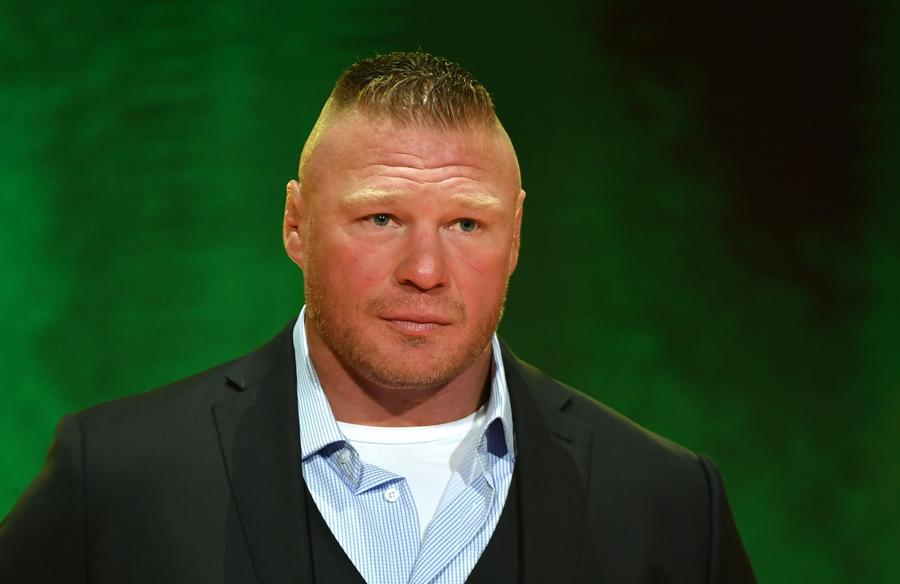
(Photo by Ethan Miller/Getty Images)
Early Life
Brock Edward Lesnar was born on July 12, 1977, in Webster, South Dakota. Brock was raised alongside three siblings on a dairy farm in a family with German and Polish heritage. During his high school years, he joined the football and wrestling teams. He eventually placed third in the state championships during his senior year of high school. At age 17, Lesnar joined the Army National Guard and was subsequently reassigned to a desk job after his colorblindness was discovered. He then failed a computer typing test and was discharged.
After graduating from high school, Brock attended Bismarck State College and once again joined the wrestling team. He won the NJCAA heavyweight wrestling championship in his sophomore year before transferring to the University of Minnesota on a wrestling scholarship. While studying at the University of Minnesota, he became the roommate of Shelton Benjamin, who would later join the WWE as well.
During his amateur wrestling career, Brock won the NCAA Division I heavyweight wrestling championship in 2000. He also became a two-time NJCAA All-American, a two-time NCAA All-American, and a two-time Big Ten Conference Champion. In the end, he finished his amateur career with a record of 106-5.
Early Wrestling Career and NCAA Dominance
Brock Lesnar first gained national attention as an amateur wrestler, establishing himself as one of the most dominant collegiate heavyweights of his era. After beginning his college career at Bismarck State College, where he won a junior college national championship, Lesnar transferred to the University of Minnesota. There, he developed into a powerhouse competitor, combining rare size, strength, and athleticism.
In 2000, Lesnar captured the NCAA Division I Heavyweight Championship, finishing his senior season with an extraordinary 106–5 overall collegiate record. His success at the amateur level made him one of the most sought-after prospects in professional wrestling and combat sports.
WWE Breakthrough and Rapid Rise (2002–2004)
Lesnar signed with WWE in 2000 and spent time developing in its training system before making his main roster debut in 2002. From the moment he appeared on television, he was positioned as a once-in-a-generation talent. Within months, he won the King of the Ring tournament, earning a shot at the WWE Championship.
At just 25 years old, Lesnar defeated The Rock at "SummerSlam" to become the youngest WWE Champion in history at the time. His early run featured high-profile feuds with stars such as Kurt Angle, The Undertaker, and Big Show, and he quickly became the centerpiece of the company.
Lesnar's combination of legitimate wrestling credentials and explosive athleticism helped redefine the image of a WWE main event star. However, the demanding travel schedule and his desire to pursue other opportunities led him to leave WWE in 2004.
NFL Attempt and Transition to MMA
After departing WWE, Lesnar made an unconventional move by attempting to transition into professional football despite not having played since high school. He signed with the Minnesota Vikings in 2004 but was ultimately cut during preseason, ending his brief NFL pursuit.
Shortly afterward, Lesnar shifted his focus to mixed martial arts. He began training seriously and made his professional MMA debut in 2007. His rapid progression in the sport was notable, given his limited experience, but his elite athleticism and wrestling background provided a strong foundation.
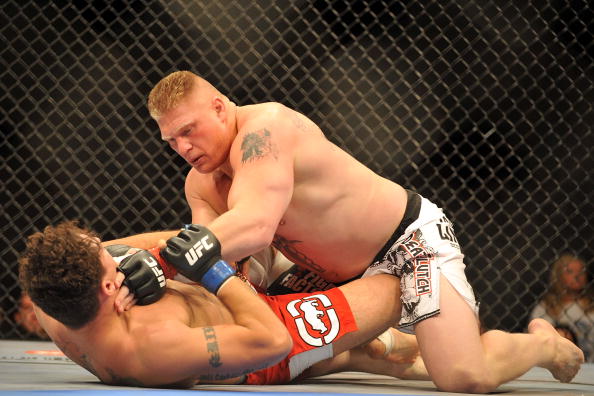
Jon Kopaloff/Getty Images
UFC Career and Heavyweight Championship
Lesnar joined the UFC in 2008 and quickly became one of the organization's biggest draws. After just a few fights, he earned a shot at the UFC Heavyweight Championship. In November 2008, he defeated Randy Couture to win the title, completing one of the fastest rises to a championship in UFC history.
He successfully defended the belt against Frank Mir in a highly anticipated rematch and later against Shane Carwin in a dramatic comeback victory. During this period, Lesnar was one of the biggest pay-per-view attractions in combat sports, bringing mainstream attention to the UFC.
His reign was ultimately impacted by serious health issues, including a bout with diverticulitis that required surgery and extended time away from competition. He returned to fight Cain Velasquez and later Alistair Overeem but was defeated in both bouts. Following his loss to Overeem in 2011, Lesnar retired from MMA.
WWE Return and Part-Time Superstar Era
Lesnar returned to WWE in 2012, this time under a very different arrangement. Rather than working a full-time schedule, he appeared as a special attraction, competing in major events while maintaining a limited number of matches.
This second run proved highly successful. Lesnar ended The Undertaker's legendary undefeated streak at "WrestleMania 30," one of the most shocking moments in wrestling history. He went on to have major feuds with John Cena, Roman Reigns, and Seth Rollins, capturing multiple WWE and Universal Championships.
His portrayal during this era emphasized dominance and realism, often presented as an unstoppable force with legitimate combat credentials. The part-time model also helped extend his longevity, allowing him to remain a top attraction for over a decade.
Later Career and Ongoing Legacy
Throughout the late 2010s and early 2020s, Lesnar continued to make periodic appearances in WWE, typically centered around marquee matches and championship storylines. His bouts with Roman Reigns became defining rivalries of the era, headlining multiple "WrestleMania" events.
By this stage of his career, Lesnar had established himself as one of the most unique figures in combat sports history, having achieved elite success in amateur wrestling, professional wrestling, and mixed martial arts. His ability to draw audiences across different disciplines set him apart from nearly all of his contemporaries.
His career remains defined by dominance, crossover appeal, and an ability to reinvent himself across multiple phases of the sports and entertainment landscape.
Relationships
Brock was initially engaged to a woman named Nicole McClain, and they had twins together before ending their relationship. In 2006, Lesnar married another WWE performer, Sable, whose real name is Rena Greek. Over the course of their relationship, they have had two children together. Lesnar is also the stepfather of Greek's child from a former marriage.
Legal Issues
In 2001, Brock was arrested in Louisville after authorities became convinced he possessed large quantities of steroids. When police discovered that he actually possessed large quantities of legal growth hormone, the charges were dropped. According to his lawyers, this substance was a type of vitamin.
Another legal issue came when he challenged WWE's non-compete clause in court. This part of his contract specifically stated that Brock could not work for any other professional wrestling company for a set period of time after leaving the WWE. Lesnar appeared to breach his contract when he appeared at a New Japan Pro-Wrestling show in 2004.
Eventually, both sides decided against legal action and took steps to renew Brock's contract – although Lesnar then walked away. In 2006, a judge stated that he was going to take Brock's side in the matter, and this caused both parties to reach a settlement. Brock's case was dropped as a result.
In 2011, Lesnar was fined $1,725 after "improperly tagging an animal" while on a hunting trip to Alberta. He was actually charged with three separate infractions, but Brock only pleaded guilty to the improper tagging charge. The other two were dropped. As a result, Lesnar was suspended from hunting for six months.
Real Estate
Brock Lesnar's real estate decisions have consistently reflected his intensely private personality and desire to live far from the spotlight. Rather than investing in flashy urban mansions, he has focused on large, secluded properties with significant acreage, often in rural or remote areas.
Early in his WWE career, Lesnar purchased a sprawling estate in Maple Plain, Minnesota, in 2003 for $783,500. The property sat on 43 acres of wooded land and included a private pond and a large main residence, offering the kind of isolation he preferred even at the height of his rising fame. He later listed the property for $849,000 but ultimately sold it in 2014 for $750,000, taking a slight loss as he prepared to relocate to Canada.
He also owned a second Minnesota property in Alexandria, which featured a 2,800-square-foot log-style home set on more than 40 acres. Like his Maple Plain estate, the property emphasized privacy and space over luxury flash. In 2020, Lesnar listed this retreat for $850,000 as part of his continued move away from the United States.
Lesnar's primary residence today is a large farm in Maryfield, Saskatchewan, where he lives with his wife, former WWE star Sable. Valued at roughly $2.1 million, the property is not just a home but a fully functioning farm. Lesnar has fully embraced rural life, spending much of his time farming, hunting, and raising animals.
The property also includes a custom-built private gym in a separate outbuilding, allowing him to train at an elite level without ever needing to leave his land. This setup enabled him to prepare for both WWE appearances and UFC fights in total seclusion.
/2009/11/Brock-Lesnar.jpg)
/2015/07/Seth-Rollins-1.jpg)
/2010/09/frank-mir-1.jpg)
/2021/07/Randy-Couture.jpg)
/2017/12/Mark-Kerr.jpg)
/2011/12/cain.jpg)
/2015/06/cena.jpg)
/2016/06/Daniel-Cormier.jpg)
/2009/11/George-Clooney.jpg)
/2009/09/Brad-Pitt.jpg)
:strip_exif()/2015/09/GettyImages-476575299.jpg)
/2019/10/denzel-washington-1.jpg)