
/2009/09/ck2.jpg)
/2019/08/dc.jpg)
/2023/01/GettyImages-1240514628.jpg)
/2012/08/Jim-davis.png)
/2009/09/otto2.jpg)
/2009/09/Larry-Ellison-1.jpg)
/2020/04/Megan-Fox.jpg)
/2020/06/taylor.png)
/2019/04/rr.jpg)
/2009/09/Cristiano-Ronaldo.jpg)
/2019/10/denzel-washington-1.jpg)
/2017/02/GettyImages-528215436.jpg)
/2009/11/George-Clooney.jpg)
/2020/02/Angelina-Jolie.png)
/2018/03/GettyImages-821622848.jpg)
:strip_exif()/2009/09/P-Diddy.jpg)
:strip_exif()/2015/09/GettyImages-476575299.jpg)
What is Charles Koch's Net Worth?
Charles Koch is an American businessman who has a net worth of $73 billion. Charles Koch has been ranked as high as the fourth-richest person in the world.
Charles serves as chairman and chief executive officer of Koch Inc., one of the largest privately held companies in the United States. He first became CEO at the age of 32, upon his father's death in 1967. For much of his adult life, Charles and his late brother David Koch owned the majority of the family business. David's stake in the family business was inherited by his widow, Julia Flesher Koch. She is now one of the richest women in the world.
Under their leadership, they transformed a regional oil refining business founded by their father into a sprawling conglomerate with operations spanning oil refining, pipelines, commodities trading, chemicals, paper and pulp, consumer products, software, ranching, and advanced materials. Charles owns approximately 38% of the company, which has generated annual revenues exceeding $125 billion in recent years. Koch Industries is the second-largest privately held company by revenue in the United States, behind Cargill. Koch Inc. has major holdings in Georgia-Pacific, Invista, Flint Hills Resources, Koch Fertilizer, Koch Pipelines, Molex, and more. He holds a stake in his family's private equity fund, Koch Equity Development, and has around $2 billion worth of cash investments. Koch has written three books about his business philosophy: "Good Profit," "The Science of Success," and "Market-Based Management."
His fortune, derived primarily from that ownership stake, has consistently ranked among the largest in the world. Beyond business, Koch is widely known for his support of libertarian and free-market causes, his role in founding influential policy organizations, and his extensive philanthropic giving, including multibillion-dollar stock donations to charitable foundations.
Early Life
Charles Koch (pronounced "coke") was born Charles de Ganahl Koch on November 1, 1935, in Wichita, Kansas. His parents, Mary and Fred, co-founded Koch Industries, an engineering company that specialized in oil refining and other oil processes.
Charles grew up with his older brother Frederick and his younger twin brothers David and Bill. He went to private school during his youth, then attended the Massachusetts Institute of Technology, earning a Bachelor of Science in General Engineering (1957), and Master of Science degrees in Nuclear Engineering (1958) and Chemical Engineering (1960). Koch was hired by Arthur D. Little, Inc., a Boston management consulting firm, after graduating from college.
Taking Over the Family Business
Koch joined the family company in 1961. At the time, the business was primarily focused on oil refining and engineering services. In 1967, following the death of his father, he assumed control of the company.
Over the next several decades, Koch expanded the enterprise aggressively. Rather than concentrating solely on refining, he diversified into chemicals, pipelines, trading operations, fertilizers, forest products, and consumer goods. Under his leadership, Koch Industries grew from a modest Midwestern energy company into one of the largest privately held corporations in America.
A pivotal moment came in 2005, when Koch Industries acquired paper and pulp giant Georgia-Pacific for $21 billion. The acquisition significantly expanded the company's footprint in consumer products, adding brands in paper towels, tissue, and building materials. Other major holdings over time have included Flint Hills Resources in refining and chemicals, Invista in polymers and fibers, Molex in electronic components, Guardian Industries in glass manufacturing, and Infor Global Solutions in enterprise software.
By the mid-2020s, Koch Inc. had evolved into a diversified industrial powerhouse with annual revenues exceeding $125 billion and tens of thousands of employees worldwide.
The Koch Family Feud
Despite the company's growth, Koch's leadership was not without internal conflict. In 1980, a dramatic boardroom struggle erupted when his brothers Bill and Frederick attempted to oust him as CEO. Their effort failed, and another brother, David Koch, sided with Charles.
In 1983, Bill and Frederick agreed to sell their shares back to the company for approximately $1.1 billion. Two years later, they sued, claiming they had been underpaid for their stakes. The dispute turned into a prolonged legal battle that lasted nearly 15 years. Ultimately, in 2000, the courts ruled in favor of Charles and David Koch, cementing their control over the business.
The feud became one of the most prominent family business disputes in American corporate history and underscored the immense value and complexity of the privately held empire.
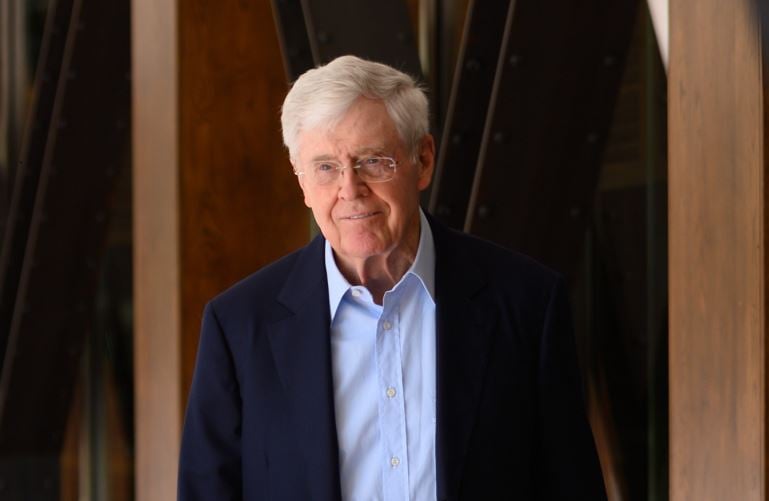
Getty Images
Structure and Financial Strength
Koch's wealth is primarily derived from his 38% ownership stake in Koch Inc. Unlike publicly traded corporations, the company does not release detailed quarterly earnings. However, based on industry comparisons and credit reports, various subsidiaries have posted multibillion-dollar revenues and earnings.
Flint Hills Resources has generated tens of billions in estimated annual revenue. Georgia-Pacific has reported billions in earnings from paper and pulp operations. Invista and Molex have contributed substantial industrial and manufacturing income streams. Guardian Industries operates in global glass markets, while Infor adds enterprise software earnings.
At the parent level, Koch Inc. has maintained a conservative financial profile, often operating with minimal or zero net debt. Reports have indicated that tens of billions of dollars in cash, investments, and land are held at the parent company level, providing significant flexibility for acquisitions and reinvestment.
This diversified structure and disciplined capital allocation strategy have allowed Koch to weather commodity cycles and economic downturns more effectively than many pure-play energy firms.
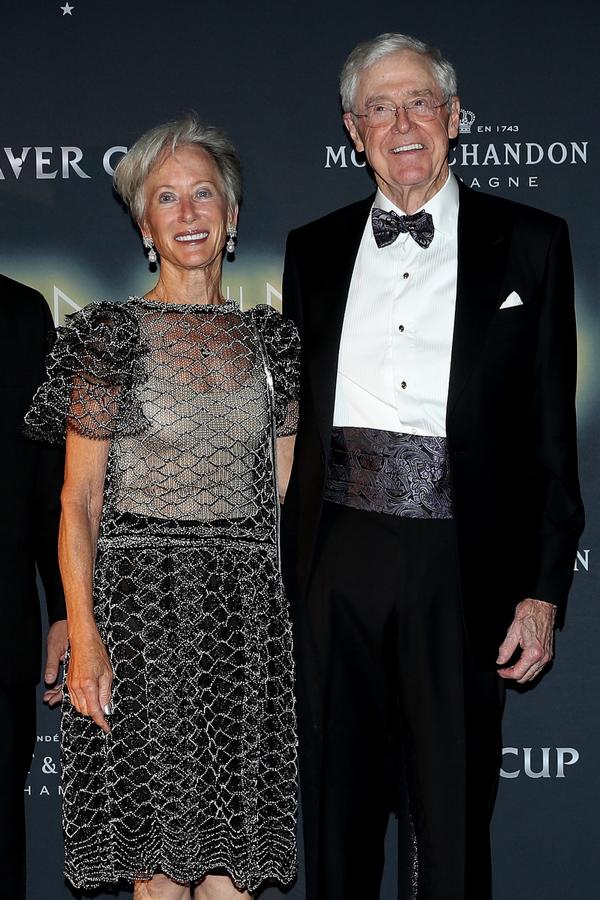
Liz Koch and Charles Koch via Getty Images
Philosophy and Market-Based Management
A defining element of Koch's career has been his emphasis on management philosophy. He developed and codified "Market-Based Management," a framework rooted in classical liberal economic theory. The model emphasizes decentralized decision-making, incentives aligned with value creation, knowledge sharing, and long-term investment horizons.
Koch has written books explaining this philosophy, arguing that internal corporate structures should mimic the information flows and incentive systems of free markets. This approach has shaped hiring, compensation, and capital deployment across the conglomerate.
His intellectual influences include Austrian economics and thinkers who advocate limited government and free enterprise, themes that also inform his political and philanthropic activities.
Political and Philanthropic Influence
Charles Koch has long been associated with libertarian and free-market causes. He was one of the original founders of the Cato Institute in 1976, a Washington-based think tank promoting limited government and individual liberty. Over time, disputes over governance led to legal conflicts involving the institute, which were eventually settled in 2012.
Koch has been a significant financial backer of Republican candidates and libertarian policy initiatives. Through a network of organizations and donor groups, he has supported efforts related to tax policy, regulatory reform, and economic freedom.
In addition to political giving, Koch has engaged in large-scale philanthropy. In 2020 and 2022, he donated non-voting stock valued at approximately $5.3 billion to private foundations. These contributions represented a meaningful portion of his stake in the company. His philanthropic efforts have supported education, criminal justice reform, and civil society initiatives, reflecting an effort to blend ideological goals with broader social impact programs.
Longevity and Leadership
By the time he reached his 90th year, Koch had served as CEO for more than half a century, making him one of the longest-serving chief executives of a major American enterprise. His tenure has spanned oil shocks, deregulation, globalization, the rise of China, digital transformation, and multiple recessions.
Despite stepping back from some day-to-day responsibilities in recent years, he has remained chairman and an influential voice in corporate strategy and long-term planning.
His leadership style has been described as analytical, disciplined, and intensely focused on long-term value creation. Unlike many public-company executives, Koch has not faced quarterly earnings pressure, allowing for multiyear or even multidecade investment horizons.
Personal Life
Charles married his wife, Liz, in 1972, and they welcomed daughter Elizabeth in 1976 and son Chase in 1977. Chase is widely believed to be the heir-apparent from the third generation of Kochs, and he has served as president of Koch Fertilizer, Koch Agronomic Services, and Koch Disruptive Technologies. All four of the Koch brothers have been diagnosed with prostate cancer at some point during their lives, and David died after battling the disease for nearly three decades.
Koch supports several conservative educational organizations, including the Institute for Humane Studies and the Mercatus Center at George Mason University. He has donated money to the Republican Party and libertarian groups as well as charitable organizations and cultural institutions. Charles co-founded the Cato Institute, a libertarian think tank in Washington, D.C. He has also backed artistic projects through the Koch Cultural Trust, which was founded by Liz. Between 2004 and 2008, Charles donated $246 million to libertarian causes, such as academic research and social welfare, leading Businessweek to include him on their 50 Top American Givers list in 2008.
Awards and Honors
Koch has received Honorary Doctor degrees from George Mason University (science), Washburn University (commerce), and Babson College (law). He has won numerous awards, including The Tax Foundation's National Distinguished Service Award, The Heritage Foundation's Spirit of Justice Award, the Boy Scouts of America's Distinguished Citizen Award, the Wichita District Minority Small Business Advocate of the Year award, and the National Association of Criminal Defense Lawyers' Defender of Justice award. Charles' charity work earned him the Philanthropy Roundtable's William E. Simon Prize for Philanthropic Leadership and the National Society of Fundraising Executives' Outstanding Humanitarian Award (Greater Wichita Chapter). He was inducted into the Kansas Oil and Gas Hall of Fame in 1996, the Kansas Business Hall of Fame in 1997, and the Wichita Sports Hall of Fame and Museum (for investing in Wichita State University's athletic facilities) in 2015.
Real Estate
Charles owns several houses, but his main home is located in Wichita, next to the Wichita Country Club. He also owns homes in Aspen and Vail, Colorado, and he paid $10 million for a 7,500 square foot home in Indian Wells, California, in 1999. In 2018, Koch purchased the property next door for $3.25 million.
/2009/09/ck2.jpg)
/2019/08/dc.jpg)
/2019/11/julia-koch.jpg)
/2018/08/GettyImages-131426374.jpg)
/2021/06/GettyImages-965568310.jpg)
/2011/11/GettyImages-648880876-e1539220019822.jpg)
/2019/11/GettyImages-1094653148.jpg)
/2009/09/Brad-Pitt.jpg)
/2020/01/lopez3.jpg)