
/2009/11/Quentin-Tarantino-1.jpg)
/2014/01/GettyImages-479995843.jpg)
/2021/01/Ryan-Coogler.jpg)
/2011/05/Matthew-Vaughn.jpg)
/2019/11/hw.jpg)
/2021/09/Christoph-Waltz.jpg)
/2019/10/denzel-washington-1.jpg)
/2020/01/lopez3.jpg)
/2018/03/GettyImages-821622848.jpg)
:strip_exif()/2009/09/P-Diddy.jpg)
/2020/06/taylor.png)
/2019/11/GettyImages-1094653148.jpg)
/2009/09/Brad-Pitt.jpg)
/2020/02/Angelina-Jolie.png)
/2017/02/GettyImages-528215436.jpg)
/2020/04/Megan-Fox.jpg)
:strip_exif()/2015/09/GettyImages-476575299.jpg)
What is Quentin Tarantino's net worth and salary?
Quentin Tarantino is an American writer, producer, director, and actor who has a net worth of $150 million. Quentin Tarantino is known for writing/directing, and producing some of the most unique dramatic/action movies of the last three decades. As of this writing, Quentin Tarantino's net worth is $120 million. Quentin Tarantino is unique as a film director for many reasons. He has a characteristic style and seems to make his own rules as far as filmmaking is concerned. This one-of-a-kind approach to storytelling has no doubt contributed to Tarantino's popularity and success as a filmmaker, and his films have generated more than $1.5 billion globally.
Emerging in the early 1990s with "Reservoir Dogs," a heist film that was as much about its colorful criminals as the actual crime, Tarantino immediately made waves in the industry. This was soon followed by "Pulp Fiction" in 1994, a film that is often regarded as his magnum opus. With its nonlinear narrative, sharp dialogue, and an ensemble cast, "Pulp Fiction" not only won the Palme d'Or at the Cannes Film Festival but also redefined modern cinema in many ways.
As his career progressed, Tarantino continued to surprise and challenge audiences. "Jackie Brown," his homage to blaxploitation films, showcased a more mature, character-driven narrative. The two-part martial arts extravaganza "Kill Bill" paid tribute to samurai films and spaghetti westerns, while "Death Proof" nodded to the grindhouse era.
"Inglourious Basterds," a revisionist take on World War II, demonstrated Tarantino's ability to blend historical events with his signature style. Similarly, "Django Unchained" and "The Hateful Eight" explored America's tumultuous history, tackling themes of racism, vengeance, and justice with a distinct Tarantino flair.
"Once Upon a Time in Hollywood," set against the backdrop of 1969 Los Angeles, weaves together both fictional and real-life characters, exploring the golden age of Hollywood and the end of an era.
Early Life
Quentin Jerome Tarantino was born on March 27, 1963, in Knoxville, Tennessee. His mother, Connie McHugh, moved him to Los Angeles when he was a toddler, and he grew up in the South Bay, where he developed an early obsession with movies. He consumed everything from mainstream Hollywood releases to obscure genre films and developed a knack for remembering dialogue and story structure. Tarantino struggled in traditional schooling and eventually dropped out of high school, gravitating instead toward acting classes and part-time jobs that allowed him to immerse himself further in film culture.
One of the pivotal experiences of his youth was his job at Video Archives, a Manhattan Beach video rental store. The position gave him access to thousands of films across every genre imaginable, and he and his coworkers built a tight-knit film-loving community that helped refine his tastes. While working there he began writing screenplays, studying movies obsessively, and experimenting with the narrative ideas that would later define his creative voice.
Early Career
Tarantino started in Hollywood as a writer and aspiring actor. He held small roles in television and low-budget films while drafting screenplays that he hoped to direct. During this period he wrote scripts that would later be sold to studios, including "True Romance" and "Natural Born Killers." He envisioned directing both films himself, but financing and studio politics led to other directors taking over, with Tony Scott helming "True Romance" and Oliver Stone directing "Natural Born Killers." Despite his lack of creative control over those projects, Tarantino's voice was unmistakable in the finished films, and the industry began to take notice of his talent as a writer.
His break came when producer Lawrence Bender encouraged him to direct his own script. Tarantino wrote "Reservoir Dogs," envisioned it as a microbudget indie film, and circulated the script through industry networks. Actor Harvey Keitel got involved early, helping raise financing and bringing additional credibility to the project. The momentum transformed what began as a small independent film into a major Sundance sensation.
Breakthrough With Reservoir Dogs
Released in 1992, "Reservoir Dogs" became one of the most influential debut films of its era. The tightly constructed crime thriller showcased Tarantino's signature narrative structure, nonlinear editing, stylized violence, extended dialogue scenes, and deep pop-culture references. The film launched him into the forefront of the independent cinema movement and marked the beginning of his collaboration with a stable of actors who would appear in multiple future projects.
Critics recognized Tarantino's command of genre and storytelling, and the film generated intense debate due to its violence, helping cement his reputation as both a visionary and a provocateur. Most importantly, the success of "Reservoir Dogs" positioned him to pursue his next project at a much larger scale.
Pulp Fiction And Global Stardom
In 1994 Tarantino released "Pulp Fiction," a nonlinear, multi-story crime epic that became one of the most acclaimed films of the decade. The movie reinvigorated John Travolta's career, elevated Samuel L. Jackson into a top-tier star, and reshaped audience expectations for narrative structure. Its blend of humor, violence, rich dialogue, and genre subversion made it a landmark achievement.
"Pulp Fiction" won the Palme d'Or at Cannes, earned Tarantino his first Academy Award for Best Original Screenplay, and became a global box office success. The film influenced an entire generation of filmmakers and established Tarantino as one of the most important directors of his generation.
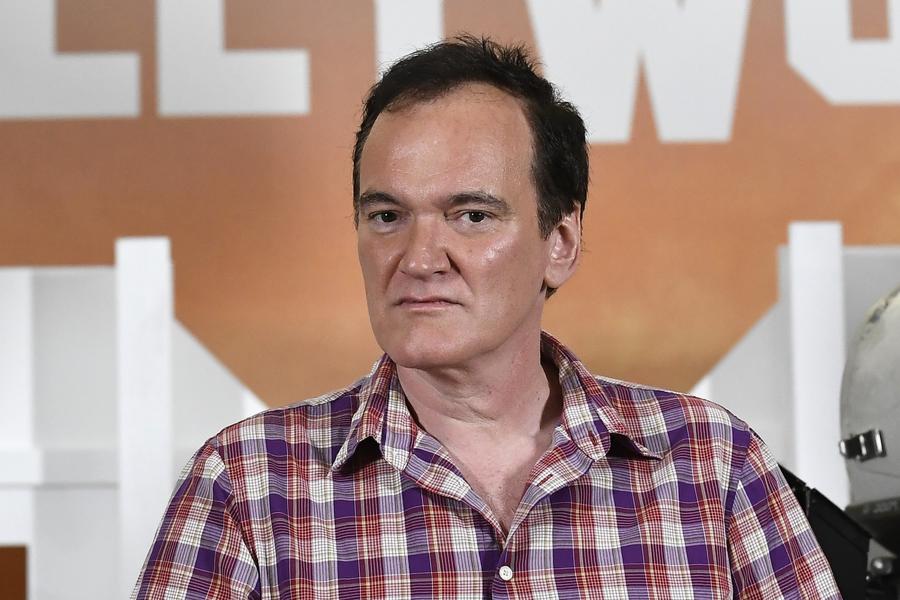
Kevork Djansezian/Getty Images
From "Jackie Brown" To The "Kill Bill" Era
Tarantino followed "Pulp Fiction" with "Jackie Brown," an adaptation of Elmore Leonard's novel "Rum Punch." Released in 1997, the film served as a tribute to 1970s blaxploitation cinema and revived the career of Pam Grier. "Jackie Brown" showcased a more mature, restrained tone, prioritizing character over spectacle and demonstrating Tarantino's respect for genre traditions.
After a six-year gap he returned with the two-part martial-arts-infused revenge epic "Kill Bill: Vol. 1" (2003) and "Kill Bill: Vol. 2" (2004). The films paid homage to samurai cinema, kung fu movies, spaghetti westerns, and grindhouse aesthetics. Starring Uma Thurman, the story became one of his most recognizable and ambitious works. The two volumes highlighted his skill at blending genre styles while crafting a revenge narrative that combined stylized action with emotional depth.
"Death Proof," "Inglourious Basterds," And Expanded Ambition
In 2007 Tarantino collaborated with Robert Rodriguez on the double-feature project "Grindhouse." His segment, "Death Proof," functioned as a tribute to exploitation road-rage thrillers and featured elaborate practical stunt work. Though less commercially successful than his other films, it deepened his cult following and further cemented his place as a curator of film history.
His next feature, "Inglourious Basterds" (2009), marked a dramatic expansion of ambition. A revisionist World War II film built around interconnected narratives, it became one of his most successful and critically acclaimed works. Christoph Waltz's performance as Colonel Hans Landa earned widespread recognition, including an Academy Award. Tarantino's blending of historical fantasy, suspense, humor, and violence showcased his control over large ensemble stories and complex tonal shifts.
"Django Unchained" And "The Hateful Eight"
Tarantino continued exploring historical revisionism with "Django Unchained" in 2012. The film reimagined the American slave era through the lens of a spaghetti western revenge story. Jamie Foxx, Christoph Waltz, and Leonardo DiCaprio delivered memorable performances, and Waltz earned his second Oscar for a Tarantino film. "Django Unchained" became Tarantino's highest-grossing film to date and won the Academy Award for Best Original Screenplay.
He followed with "The Hateful Eight" in 2015, a tense, dialogue-driven chamber western shot in 70mm Ultra Panavision. The film displayed his interest in theatrical, almost stage-like storytelling and highlighted his skill for slow-burn suspense. The project also became notable for its musical score by Ennio Morricone, who won an Oscar for the composition.
"Once Upon a Time in Hollywood"
Released in 2019, "Once Upon a Time in Hollywood" became a major cultural event. Starring Leonardo DiCaprio, Brad Pitt, and Margot Robbie, the film offered a wistful, revisionist portrait of late-1960s Los Angeles and the end of the studio era. It blended real history and fiction, shifting between satire, nostalgia, and suspense. Pitt's performance earned him an Academy Award, and the film became one of Tarantino's most commercially successful and critically acclaimed works.
The film also served as a reflection on Tarantino's own lifelong relationship with Hollywood and cinema history, often interpreted as his most personal project.
Writing, Novels, And Other Creative Work
Beyond directing, Tarantino built a parallel career as an author and screenwriter. He published the novelization of "Once Upon a Time in Hollywood," expanding the world of the film with new characters, backstories, and alternate perspectives. He also wrote "Cinema Speculation," a collection of essays combining film criticism, memoir, and cultural analysis.
Tarantino has also directed episodes of television, including work on "ER" and "CSI," and has occasionally acted in films, including small roles in his own projects.
Quentin Tarantino's Salary Per Movie
Quentin typically receives a $20 million advance for his standard directing/producing/writing work on his own movies. He also owns a generous backend percentage of his films' profits that can translate into a total per movie haul of $30-40 million in some cases.
Awards
Tarantino's filmmaking career has earned extensive recognition across major international awards bodies. He has won two Academy Awards for Best Original Screenplay, for "Pulp Fiction" and "Django Unchained." His work has also earned three BAFTA Awards, including wins for "Pulp Fiction," "Inglourious Basterds," and "Django Unchained," along with two Golden Globe Awards for Best Screenplay. In 1994 he received the Palme d'Or at the Cannes Film Festival for "Pulp Fiction," one of the festival's highest honors. Tarantino's films have collectively earned dozens of nominations across the Oscars, BAFTAs, Golden Globes, and major critics associations, reflecting his wide influence on contemporary cinema. In 2015 he received a star on the Hollywood Walk of Fame, and his ongoing contributions to film history have earned him numerous retrospective tributes, festival honors, and lifetime-achievement recognitions from international film organizations.
Personal Life
Tarantino dated comedians Margaret Cho and Kathy Griffin in the early 90s. From 1995 to 1998, he dated actress Mira Sorvino. And from 2003 to 2005, Tarantino was in a relationship with filmmaker Sofia Coppola. In June 2017, Tarantino and Israeli singer Daniella Pick got engaged. He married Israeli singer and model Daniella Pick in 2018, and the couple has two children. He has divided his time between Los Angeles and Tel Aviv and has spoken in interviews about how fatherhood and marriage shifted his lifestyle. Known for his outspoken nature in interviews and press appearances, Tarantino has long maintained a deep commitment to physical film, theatrical exhibition, and film preservation.
/2009/11/Quentin-Tarantino-1.jpg)
/2021/09/Christoph-Waltz.jpg)
/2018/05/GettyImages-160125230-e1525489457724.jpg)
/2010/02/Paul-Thomas-Anderson.jpg)
/2014/08/Greta-Gerwig-1.jpg)
/2014/08/GettyImages-76522655.jpg)
/2019/11/hw.jpg)
/2009/09/Jennifer-Aniston.jpg)
/2009/11/George-Clooney.jpg)