
/2010/11/Sparky-Anderson.png)
/2014/07/Johnny-Bench-1.jpg)
/2014/10/GettyImages-97687387.jpg)
/2020/11/GettyImages-586855342.jpg)
/2011/07/Lou-Piniella.jpg)
/2015/07/joe-morgan-1.jpg)
/2019/10/denzel-washington-1.jpg)
/2009/11/George-Clooney.jpg)
/2020/01/lopez3.jpg)
/2009/09/Brad-Pitt.jpg)
/2018/03/GettyImages-821622848.jpg)
/2009/09/Jennifer-Aniston.jpg)
/2019/04/rr.jpg)
:strip_exif()/2015/09/GettyImages-476575299.jpg)
/2020/06/taylor.png)
/2020/02/Angelina-Jolie.png)
/2017/02/GettyImages-528215436.jpg)
What was Sparky Anderson's net worth and salary?
Sparky Anderson was a Major League Baseball manager who had a net worth of $10 million at the time of his death.
Sparky Anderson was one of the most accomplished and influential managers in Major League Baseball history, best known for leading two iconic franchises to championship glory and redefining modern bullpen strategy. Rising from obscurity as a career minor leaguer, Anderson became the guiding force behind the Cincinnati Reds' legendary "Big Red Machine" of the 1970s and later delivered a World Series title to the Detroit Tigers in the 1980s. In doing so, he became the first manager to win World Series championships in both the National League and the American League, a feat that underscored his adaptability, tactical intelligence, and deep understanding of players.
Anderson's success was rooted less in charisma than in preparation, discipline, and an obsessive commitment to winning. Nicknamed "Captain Hook" for his quick trigger in pulling starting pitchers, he anticipated the modern game's emphasis on bullpen depth and matchup-based decision-making decades before it became standard practice. Over a 26-year managerial career, he compiled more than 2,100 victories and earned a reputation as a leader who trusted great players, stayed out of their way, and created an environment where excellence became routine. By the time he was inducted into the Baseball Hall of Fame, Sparky Anderson had secured his place as one of the most respected managers the sport has ever known.
Early Life
Sparky Anderson was born George Lee Anderson on February 22, 1934, in Bridgewater, South Dakota. His father worked painting farmhouses and silos, and when Sparky was eight years old, the family relocated to Los Angeles. There, Anderson was immersed in baseball culture at a young age, serving as a batboy for the University of Southern California teams coached by Rod Dedeaux, one of the most influential figures in college baseball.
Anderson played in the infield during high school and signed with the Brooklyn Dodgers' organization in 1953. Though his playing career never flourished, his fiery temperament and intense competitiveness earned him the nickname "Sparky," a moniker that would follow him for the rest of his life.
Playing Career and Transition to Managing
Anderson spent most of his playing career in the minor leagues, bouncing between organizations and positions. He briefly reached the major leagues with the Philadelphia Phillies in 1959, appearing in 94 games as a second baseman. He hit .218 with no home runs on a last-place team, and his major league playing career ended almost as quickly as it began.
Rather than drift away from the game, Anderson pivoted to managing in the minors, where his instincts began to shine. He demonstrated an unusual ability to understand personnel, motivate players, and manage games with precision. By the late 1960s, his reputation as a sharp baseball mind had begun to circulate quietly within front offices.
Cincinnati Reds and the Big Red Machine
In one of the most surprising managerial hires of the era, the Cincinnati Reds named Anderson their manager in 1970, when he was just 35 years old. The move prompted skepticism, famously summed up by a newspaper headline that read, "Sparky Who?" The doubts vanished quickly.
Under Anderson's leadership, the Reds became a dominant force. His teams won four National League pennants and back-to-back World Series titles in 1975 and 1976. The Big Red Machine lineup featured a core of future Hall of Famers, including Johnny Bench, Joe Morgan, and Tony Perez, alongside stars such as Pete Rose, George Foster, Dave Concepcion, and Ken Griffey Sr.
Anderson's management style emphasized preparation, accountability, and trust. He preferred to deflect credit to his players, often joking that his genius was simply recognizing talent and staying out of the way. His tactical approach, especially his aggressive use of relievers, helped shape the evolution of bullpen management across the league.
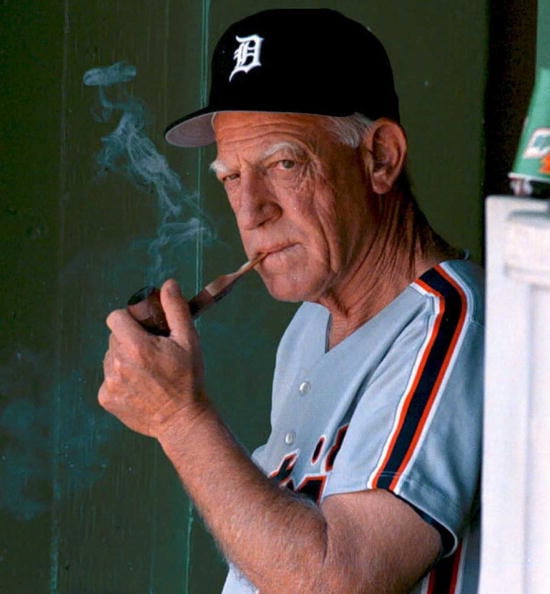
PETER MUHLY/AFP/Getty Images
Detroit Tigers Championship Run
After being fired by the Reds following the 1978 season, Anderson accepted the Detroit Tigers' managerial job in 1979. There, he built another powerhouse, centered around Alan Trammell, Lou Whitaker, Jack Morris, and Kirk Gibson.
The pinnacle came in 1984, when the Tigers stormed out to a historic 35–5 start and cruised to a World Series championship, defeating the San Diego Padres in five games. The victory cemented Anderson's legacy and silenced any lingering bitterness from his departure in Cincinnati. He later wrote that the 1984 title gave him a sense of vindication he had carried for years.
Later Career and Principles
Anderson continued managing the Tigers through the 1995 season, becoming the winningest manager in franchise history. During the 1994–95 labor dispute, he was the only major league manager to refuse to work with replacement players, citing the integrity of the game and his loyalty to unionized players. He took an unpaid leave rather than compromise his principles.
After the 1995 season, Anderson resigned amid speculation he would be dismissed. He finished his managerial career with 2,194 wins, ranking among the most successful managers in baseball history.
Hall of Fame and Legacy
Sparky Anderson was inducted into the Baseball Hall of Fame in 2000. He chose to be represented on his plaque with a Cincinnati Reds cap, honoring the organization that first gave him a chance at the major league level. Known for his wit and humility, Anderson often downplayed his own brilliance, insisting that great players were the true key to success.
Anderson died on November 4, 2010, at the age of 76, following complications related to dementia.
Legacy
Sparky Anderson's influence on baseball extends far beyond championships and win totals. He helped usher in a more analytical, bullpen-driven approach to managing while maintaining an old-school respect for players and clubhouse culture. His career remains a testament to preparation, adaptability, and the power of leadership rooted in trust.
/2010/11/Sparky-Anderson.png)
/2014/07/Johnny-Bench-1.jpg)
/2020/10/pete-rose.png)
/2015/01/krik.jpg)
/2014/10/GettyImages-97687387.jpg)
/2020/11/GettyImages-586855342.jpg)
/2025/01/Hank-Greenberg.jpg)
/2009/09/Cristiano-Ronaldo.jpg)
:strip_exif()/2009/09/P-Diddy.jpg)