
/2014/08/GettyImages-458654038.jpg)
/2010/08/GettyImages-473873842.jpg)
/2015/01/Dean-DeBlois-picture-e1596497267174.jpg)
/2022/05/Hidetaka-Miyazaki-scaled.jpg)
/2014/09/George-Miller-1.jpg)
/2021/10/roald-dahl.png)
/2020/06/taylor.png)
/2020/02/Angelina-Jolie.png)
/2018/03/GettyImages-821622848.jpg)
/2017/02/GettyImages-528215436.jpg)
/2019/04/rr.jpg)
/2009/09/Cristiano-Ronaldo.jpg)
/2009/09/Brad-Pitt.jpg)
/2019/11/GettyImages-1094653148.jpg)
/2009/11/George-Clooney.jpg)
/2020/01/lopez3.jpg)
/2009/09/Jennifer-Aniston.jpg)
What Is Hayao Miyazaki's Net Worth?
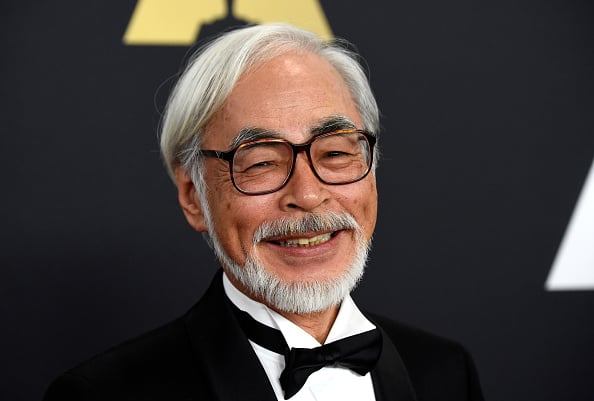
Hayao Miyazaki is a Japanese film director, animator, artist, illustrator, producer, and screenwriter who has a net worth of $50 million. Hayao Miyazaki is an acclaimed maker of anime feature films. Hayao co-founded Studio Ghibli with Isao Takahata, and he has been compared to Walt Disney, Nick Park, and Steven Spielberg. He started his career by joining Toei Animation in 1963. Miyazaki was an in-between artist for 1965's "Gulliver's Travels Beyond the Moon," and his first feature film was 1979's "The Castle of Cagliostro." He had success with his 1984 film " Nausicaä of the Valley of the Wind." Hayao was very popular in Japan but found worldwide success with 1997's "Princess Mononoke," which became the first animated movie to win the Picture of the Year award at the Japanese Academy Awards. His 2001 film "Spirited Away" earned him his second Picture of the Year award and was also the first anime film to win an American Academy Award. "Princess Mononoke" became the highest-grossing film in Japan but was passed by "Titanic," which was then passed by "Spirited Away" in 2001. Hayao's 2023 film "The Boy and the Heron" won an Academy Award for Best Animated Feature Film.
Early Life
Hayao Miyazaki was born on January 5, 1941, in Hongō, Tokyo City, Empire of Japan. He grew up with three brothers. His father, Katsuji, was the director of his brother's company, Miyazaki Airplane, which made rudders for fighter planes during the Second World War. Hayao's family was affluent during his youth, and his father enjoyed buying paintings and showing them to guests. Around 1940, Katsuji was in the Imperial Japanese Army, but he was discharged after he told his commanding officer that he didn't want to fight because of his wife and young son. When Hayao was three years old, he evacuated to Utsunomiya with his family, then they evacuated to Kanuma after Utsunomiya was bombed in July 1945. During his childhood, Miyazaki had digestive problems and was told that he probably wouldn't live past the age of 20. His mother, Yoshiko, was diagnosed with spinal tuberculosis in the late 1940s and subsequently spent a few years in the hospital.
The family moved to Suginami-ku in 1950, and Hayao attended Ōmiya Elementary School, Eifuku Elementary School, and Ōmiya Junior High School. He wanted to become a manga artist but couldn't draw people well, so he drew battleships, planes, and tanks. While attending Toyotama High School, Miyazaki was inspired by Japan's first color feature-length anime film, 1958's "The White Snake Enchantress." After graduation, he majored in Japanese Industrial Theory at Gakushuin University. There, he was a member of the Children's Literature Research Club, which was the "closest thing back then to a comics club." In 1963, he graduated with degrees in economics and political science.
Career
In 1963, Miyazaki was hired by the animation studio Toei Doga, and he was an inbetween artist on the anime TV series "Wolf Boy Ken" (1963) and the films "Doggie March" (1963) and "Gulliver's Travels Beyond the Moon" (1965). In 1964, he became the chief secretary of Toei's labor union, and he befriended his vice-chairman, Isao Takahata, who would become his lifelong collaborator. In the mid-1960s, Hayao moved to the key animation department and worked on the shows "Hustle Punch" (1965–1966), "Sally the Witch" (1966–1968), and "Rainbow Sentai Robin" (1966–1967). He was the chief animator, scene designer, and concept artist on the 1968 film "The Great Adventure of Horus, Prince of the Sun," which was directed by Takahata, and he was the key animator on 1969's "The Wonderful World of Puss 'n Boots." In 1971, Miyazaki left Toei Animation and followed Takahata to A-Pro, where he directed several episodes of the TV series "Lupin the Third Part I." In mid-1973, the duo moved to Zuiyō Eizō, which later split into two companies; the branch Hayao and Isao worked for became Nippon Animation. Miyazaki directed 24 episodes of the 1978 animated series "Future Boy Conan," then he moved to the studio Tokyo Movie Shinsha for his directorial film debut, 1979's "The Castle of Cagliostro" which he co-wrote with Haruya Yamazaki.
Next, Hayao wrote and directed the 1984 film "Nausicaä of the Valley of the Wind," which was based on his 1982 manga of the same name. He followed it with 1986's "Castle in the Sky," 1988's "My Neighbor Totoro," and 1989's "Kiki's Delivery Service." All three films won several awards, but "Kiki's Delivery Service" was especially successful, earning three Anime Grand Prix awards as well as Japan Cinema Association Awards for Best Film and Best Director. Miyazaki's 1992 film "Porco Rosso" was based on his 1989 manga "Hikōtei Jidai," and he wrote 1995's "Whisper of the Heart" but didn't direct it. He wrote and directed 1997's "Princess Mononoke," which won more than 20 awards, including a Japan Academy Film Prize for Picture of the Year. Hayao won his first Academy Award for 2001's "Spirited Away," which grossed ¥31.68 billion at the box office. "Spirited Away" was Japan's highest-grossing film of all time until "Demon Slayer: Kimetsu no Yaiba – The Movie: Mugen Train" was released in 2020.
Miyazaki wrote, directed, and executive produced 2004's "Howl's Moving Castle" and 2008's "Ponyo." "Howl's Moving Castle" won numerous awards and appeared on several critics' top ten lists of the year's best films. "Ponyo" won five Tokyo Anime Awards and a Japan Academy Prize for Animation of the Year. Hayao co-wrote 2010's "Arrietty" and 2011's "From Up on Poppy Hill" with Keiko Niwa, and he executive produced "Arrietty." He wrote and directed 2013's "The Wind Rises," which was based on a manga he published in 2009. He originally intended for the Oscar-nominated "The Wind Rises" to be his final feature film, but he later changed his mind and wrote and directed 2023's "The Boy and the Heron." The film won an Academy Award, Golden Globe, BAFTA Award, Japanese Academy Film Prize, and many other awards.
Getty Images
Personal Life
Hayao married Akemi Ôta in October 1965, and they have welcomed sons Goro (born 1967) and Keisuke (born 1969) together. Ôta was an in-between artist for Toei Animation, where she met Miyazaki in 1964. The couple has worked together on projects such as "The Wonderful World of Puss 'n Boots" and "The Great Adventure of Horus." In 1972, Akemi quit working so she could stay home and raise their sons. Hayao's relationship with his children was harmed by his dedication to work, and he has said that he "tried to be a good father, but in the end [he] wasn't a very good parent." Goro said in 2006 that Hayao "gets zero marks as a father, but full marks as a director of animated films." Goro used to work at a landscape design firm, and after he started working at the Ghibli Museum, he designed its rooftop garden and became its curator. Keisuke is a wood artist, and a woodcut print he designed can be seen in "Whisper of the Heart."
Awards and Nominations
Miyazaki has won more than 140 awards for his work. In 2003, he won an Academy Award for Best Animated Feature for "Spirited Away." He earned nominations in that category for "Howl's Moving Castle" in 2006 and "The Wind Rises" in 2014, then he won for "The Boy and the Heron" in 2024. In 2015, the Academy Awards presented him with an Honorary Award. Hayao has received two BAFTA Award nominations, winning for Best Animated Feature Film for "The Boy and the Heron" in 2024. His other nomination was for Best Film not in the English Language for "Spirited Away" (2004). Miyazaki has won 18 Mainichi Film Awards, 14 Kinema Junpo Awards, and 12 Tokyo Anime Awards, and he has received Lifetime Achievement Awards from the Awards of the Japanese Academy (2002), Los Angeles Film Critics Association Awards (2018), Las Vegas Film Critics Society Awards (2023), and San Sebastián International Film Festival (2023).
/2014/08/GettyImages-458654038.jpg)
/2021/10/roald-dahl.png)
/2014/05/Cole-Hauser.jpg)
/2013/12/GettyImages-465285338.jpg)
/2013/12/Sam-Mendes.jpg)
/2016/01/GettyImages-482154148.jpg)
/2014/06/Stanley-Kubrick-1.jpg)
/2016/08/Nicolas-Winding-Refn.jpg)
/2020/04/Megan-Fox.jpg)
:strip_exif()/2009/09/P-Diddy.jpg)
:strip_exif()/2015/09/GettyImages-476575299.jpg)