
/2009/09/Jay-Rockefeller.png)
/2019/01/Nelson-Rockefeller.jpg)
/2019/01/Chuck-Grassley.jpg)
/2020/03/john-d-rockefeller-1.jpg)
/2023/09/David-Rockefeller.jpg)
/2020/06/taylor.png)
/2017/02/GettyImages-528215436.jpg)
:strip_exif()/2015/09/GettyImages-476575299.jpg)
/2018/03/GettyImages-821622848.jpg)
/2019/10/denzel-washington-1.jpg)
/2009/09/Cristiano-Ronaldo.jpg)
/2020/01/lopez3.jpg)
/2009/09/Jennifer-Aniston.jpg)
/2009/09/Brad-Pitt.jpg)
/2020/02/Angelina-Jolie.png)
/2019/04/rr.jpg)
/2009/11/George-Clooney.jpg)
What is Jay Rockefeller's net worth?
Jay Rockefeller is an American public servant who has a net worth of $160 million.
Jay Rockefeller spent decades building an independent political identity rooted in social policy, health care reform, and Appalachian economic development. Though born into one of the most famous fortunes in American history, Rockefeller deliberately chose a career in public service that placed him far from the centers of inherited wealth and power. After early work in antipoverty programs, he established deep political ties to West Virginia, where he served as governor and later as a long-tenured U.S. senator. Over the course of his career, Rockefeller became best known as a policy-focused Democrat who prioritized health care access, education, and support for vulnerable populations, even when those positions put him at odds with powerful corporate interests. His Senate tenure included leadership roles on major committees, where he helped shape national debates on Medicare, public health, telecommunications regulation, and intelligence oversight. By the time he retired from public office, Rockefeller had become one of the most influential political figures in West Virginia history and a rare example of a dynastic heir who consciously stepped away from private wealth to pursue a life in government.
Reported Net Worth
According to financial disclosure data analyzed during his final years in the Senate, Rockefeller's estimated net worth fluctuated but remained significantly high:
- 2012: Approximately $101,290,514.
- 2011: Approximately $102,706,012.
- 2004: Approximately $123,595,484.
Between 2004 and 2012, his reported average net worth saw a decline of approximately 18%. Despite this, he remained one of the top 10 wealthiest Senators during his final years in office.
Key Assets and Holdings
Rockefeller's wealth was primarily managed through structures designed to prevent conflicts of interest while in office.
As of 2007, official disclosures showed that Rockefeller held three blind trusts valued at more than $80 million. Blind trusts are commonly used by wealthy public officials to give a third-party manager full control over assets, so the official does not know how their specific holdings are being traded.
As a great-grandson of John D. Rockefeller, his wealth originated from the family's historical oil fortune (Standard Oil). While his individual wealth was public through Senate filings, the total combined wealth of the Rockefeller family has never been known with precision due to private archives and distributed management.
Early Life and Education
John Davison Rockefeller IV was born on June 18, 1937, in New York City. He is the great-grandson of John D. Rockefeller, the founder of Standard Oil, and the grandson of John D. Rockefeller Jr. Despite that lineage, his parents emphasized public service rather than business. His father, John D. Rockefeller III, was a major philanthropist, and his mother, Blanchette Ferry Rockefeller, was a civic leader.
Rockefeller attended Phillips Exeter Academy before enrolling at Brown University, where he earned a bachelor's degree in 1961. He later completed graduate studies in Far Eastern languages and history at Harvard University. Early exposure to international issues and social policy helped steer him away from corporate life and toward public service.
Early Public Service and Move to West Virginia
Rather than entering family foundations or private finance, Rockefeller joined the Peace Corps in the early 1960s, serving in Malaysia. That experience deeply shaped his worldview and reinforced his interest in poverty alleviation and development.
In the late 1960s, he moved to West Virginia to work on antipoverty initiatives during the War on Poverty. He became involved in community development programs and worked closely with local leaders, forging relationships that would anchor his political future. At a time when West Virginia faced economic decline tied to coal industry contraction, Rockefeller positioned himself as an advocate for federal investment, job training, and social services.
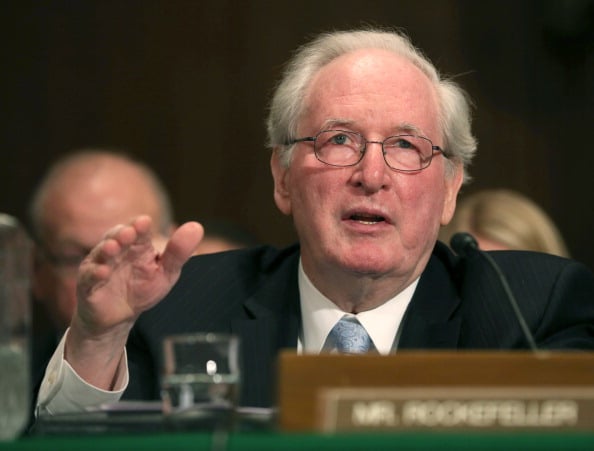
Mark Wilson/Getty Images
Governor of West Virginia
Rockefeller was elected governor of West Virginia in 1976 after serving as president of West Virginia Wesleyan College and as a state official focused on economic development. He served two terms as governor from 1977 to 1985.
As governor, Rockefeller emphasized education funding, public health initiatives, and efforts to diversify the state's economy beyond coal. His administration expanded programs aimed at reducing poverty and improving access to health care, particularly in rural areas. He also gained national attention for supporting teachers during a historic statewide strike, siding with education workers in a dispute that reshaped labor relations in the state.
U.S. Senate Career
In 1984, Rockefeller was elected to the United States Senate, representing West Virginia. He would hold the seat for 30 years, winning reelection four times and becoming one of the chamber's most senior Democrats.
During his Senate career, Rockefeller developed a reputation as a policy specialist rather than a media-driven politician. He served as chairman of the Senate Commerce Committee and later the Senate Intelligence Committee, overseeing critical issues ranging from telecommunications regulation to national security oversight. As Intelligence Committee chairman, he played a key role in scrutinizing post-9/11 surveillance programs and intelligence practices.
Health Care and Social Policy Focus
Rockefeller's signature issue was health care. He was a long-time advocate for strengthening Medicare and Medicaid and expanding access to affordable care. His work on health policy culminated in a significant role shaping provisions of the Affordable Care Act, particularly those affecting rural states and low-income populations.
He consistently challenged pharmaceutical companies, insurance providers, and hospital systems when he believed patient interests were being sidelined. That stance often placed him at odds with corporate lobbyists but reinforced his image as a senator focused on consumer protection and public health.
Relationship to the Rockefeller Legacy
Jay Rockefeller was the son of John D. Rockefeller III, making him a first cousin of Nelson Rockefeller, who served as governor of New York and vice president of the United States, and David Rockefeller, the longtime head of Chase Manhattan Bank and one of the most influential financiers of the 20th century.
Despite carrying one of the most recognizable surnames in American history, Jay Rockefeller intentionally distanced himself from the business empire that defined earlier generations. He did not play a role in running Rockefeller financial institutions and frequently emphasized that his wealth was secondary to his public responsibilities.
That separation was both symbolic and practical. Rockefeller lived modestly by the standards of his family's history and spent most of his adult life immersed in the economic realities of West Virginia. His career came to represent a modern evolution of the Rockefeller legacy, shifting from industrial dominance to public policy and governance.
Later Years and Retirement
Rockefeller announced in 2013 that he would not seek reelection, stepping down from the Senate at the end of his term in 2015. In retirement, he has remained active in policy discussions related to health care, education, and civic engagement, while largely avoiding partisan commentary.
Jay Rockefeller's career stands out for its longevity, policy depth, and unusual trajectory. As a Rockefeller by birth and a West Virginian by choice, he carved out a political identity defined not by inherited wealth but by decades of sustained public service.
/2009/09/Jay-Rockefeller.png)
/2023/09/David-Rockefeller.jpg)
/2019/01/Chuck-Grassley.jpg)
/2019/01/Nelson-Rockefeller.jpg)
/2018/11/Dick-Durbin.jpg)
/2013/11/Rosa-L.-DeLauro.jpg)
/2014/03/Ali-Yıldırım.jpg)
/2012/11/Robert-Reich.jpg)
/2020/04/Megan-Fox.jpg)