
/2010/01/Barry-Bonds.jpg)
/2025/05/GettyImages-2208048759.jpg)
/2010/08/Sammy-Sosa.jpg)
/2010/02/Albert-Pujols.jpg)
/2014/07/Johnny-Bench-1.jpg)
/2010/11/hank.jpg)
:strip_exif()/2015/09/GettyImages-476575299.jpg)
/2020/02/Angelina-Jolie.png)
:strip_exif()/2009/09/P-Diddy.jpg)
/2019/11/GettyImages-1094653148.jpg)
/2019/10/denzel-washington-1.jpg)
/2019/04/rr.jpg)
/2009/11/George-Clooney.jpg)
/2020/06/taylor.png)
/2009/09/Cristiano-Ronaldo.jpg)
/2009/09/Brad-Pitt.jpg)
/2017/02/GettyImages-528215436.jpg)
What is Barry Bonds' Net Worth, Salary, and Career Earnings?
Barry Bonds is a retired American professional baseball player who has a net worth of $80 million. During his major league baseball career, Barry Bonds earned $190 million in salary alone. At the peak of his career, his SF Giants salary was $22 million. After adjusting for inflation, that's the same as making around $33 million today. He also earned tens of millions more from endorsements.
Barry Bonds stands as one of baseball's most dominant yet controversial figures across his 22-season MLB career (1986-2007).
Beginning with the Pittsburgh Pirates before his legendary tenure with the San Francisco Giants, Bonds compiled unprecedented statistical achievements, including MLB records for career home runs (762), single-season home runs (73 in 2001), walks (2,558), and intentional walks (688). His combination of power, speed, and batting eye established him as the only player in the exclusive 500 home run/500 stolen base club. The seven-time National League MVP (including four consecutive awards from 2001-2004) earned 14 All-Star selections, 12 Silver Slugger Awards, and 8 Gold Gloves for his defensive excellence in left field.
Despite these accomplishments, Bonds' legacy remains complicated by his connection to performance-enhancing drugs during baseball's "Steroid Era," particularly following investigations into the BALCO scandal. This association has prevented his election to the Baseball Hall of Fame despite having statistical credentials that would otherwise make him a first-ballot inductee. Nevertheless, his impact on baseball remains profound, forcing fundamental changes to how the game was played as teams routinely chose to walk him rather than pitch to baseball's most feared hitter.
Contracts, Salary History, and Career Earnings
Over the course of his 22-season career, Barry Bonds earned approximately $190 million in salary alone, placing him among the highest-paid players of his era. His earnings reflect a career that spanned two very different financial periods in baseball, beginning in the relatively modest salary structure of the 1980s and extending into the early wave of nine-figure contracts in the 2000s. At his peak, Bonds earned $22 million in 2005 with the San Francisco Giants, which is roughly equivalent to $33 million in today's dollars.
Bonds' financial trajectory began modestly after being drafted by the Pittsburgh Pirates in 1985. He signed for a $150,000 bonus and worked his way through baseball's pre-arbitration and arbitration system, with his salary climbing steadily from $60,000 as a rookie in 1986 to $4.7 million by 1992. By the time he reached free agency, he had already established himself as one of the best all-around players in the game.
His first major financial breakthrough came in 1993 when he entered free agency and turned down a $40 million offer from the New York Yankees to sign with his hometown Giants. After an extended negotiation, he agreed to a six-year, $43.75 million contract that included a $2.5 million signing bonus and an average annual salary of $6.9 million. At the time, this was the largest contract in baseball history and made Bonds the highest-paid player in the sport. The deal was considered groundbreaking, arriving at a moment when MLB salaries were just beginning to cross into eight-figure territory.
As his career progressed, Bonds continued to secure increasingly lucrative deals. From 1999 to 2001, he signed a two-year, $22.9 million extension that carried him into his late 30s. Following his historic 73-home run season in 2001, he capitalized on his dominance by signing a five-year, $90 million extension in 2002. That deal included a $10 million signing bonus and kept him among the league's top earners well into his 40s.
During this period, his annual salary climbed into elite territory. He earned $15 million in 2002, $18 million in 2004, and a career-high $22 million in 2005. Even in his final season in 2007, he commanded $15.8 million on a one-year deal.
A year-by-year breakdown of Bonds' salary illustrates his steady rise from a low-paid rookie to one of baseball's financial pioneers:
| Year | Salary | Team |
|---|---|---|
| 1986 | $60,000 | Pittsburgh Pirates |
| 1987 | $100,000 | Pittsburgh Pirates |
| 1988 | $220,000 | Pittsburgh Pirates |
| 1989 | $360,000 | Pittsburgh Pirates |
| 1990 | $850,000 | Pittsburgh Pirates |
| 1991 | $2,300,000 | Pittsburgh Pirates |
| 1992 | $4,700,000 | Pittsburgh Pirates |
| 1993 | $4,600,000 | San Francisco Giants |
| 1994 | $4,750,000 | San Francisco Giants |
| 1995 | $8,166,666 | San Francisco Giants |
| 1996 | $8,416,667 | San Francisco Giants |
| 1997 | $8,666,667 | San Francisco Giants |
| 1998 | $8,916,667 | San Francisco Giants |
| 1999 | $9,700,000 | San Francisco Giants |
| 2000 | $10,600,000 | San Francisco Giants |
| 2001 | $10,300,000 | San Francisco Giants |
| 2002 | $15,000,000 | San Francisco Giants |
| 2003 | $13,000,000 | San Francisco Giants |
| 2004 | $18,000,000 | San Francisco Giants |
| 2005 | $22,000,000 | San Francisco Giants |
| 2006 | $18,000,000 | San Francisco Giants |
| 2007 | $15,800,000 | San Francisco Giants |
In total, Bonds' career earnings reached just under $190 million.
While those numbers were massive for his era, they have since been surpassed by the modern wave of mega-contracts. For example, Shohei Ohtani signed a 10-year, $700 million deal in 2024, while players like Aaron Judge now earn around $40 million annually. Even so, Bonds' contracts were groundbreaking in their time and helped push the market forward, setting new benchmarks for elite player compensation.
Ultimately, Bonds' earnings tell the story of a player who not only dominated on the field but also played a key role in reshaping baseball's financial landscape, bridging the gap between the sport's earlier salary structure and the modern era of blockbuster deals.
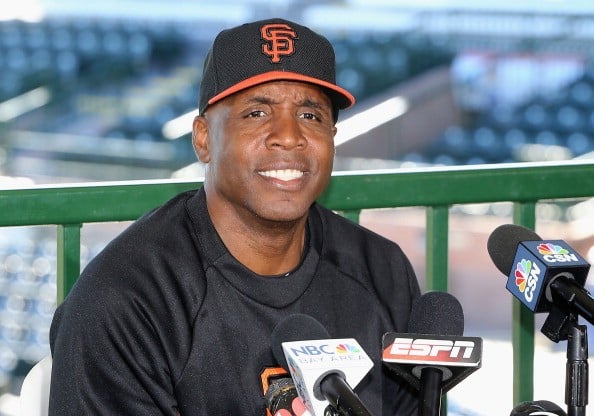
(via Getty)
Early Life
Barry Lamar Bonds was born on July 24, 1964, in Riverside, California. He was raised in San Carlos by his parents, Bobby Bonds and Patricia Bonds. His father is a former Major League Baseball player and played for teams like the San Francisco Giants, New York Yankees, and the Chicago White Sox. Bonds attended Junipero Serra High School in San Mateo, California, where he played baseball, basketball, and football. He was originally drafted by the San Francisco Giants in the 1982 MLB draft when he was just a high school senior, but they were unable to agree on contract terms because Bonds' minimum he required to go pro was $75,000, and Giants coach Tom Haller gave a maximum offer of $70,000 ($185,452 today after inflation). Therefore, instead of going pro straight out of high school, Bonds decided to go to college.
College Career
Bonds attended Arizona State University, where he studied criminology. Despite his stellar performance as a player, he was not well-liked by his baseball teammates because his behavior was often considered by them to be rude and inconsiderate. In fact, one time when he was suspended for breaking curfew, initially, the other Sun Devil players voted against his return, even though he was widely considered to be the best on the team. Accolades and recognitions he received while at college include being a Sporting News All-American selection in 1984, being named to the All-Time College World Series Team in 1996, and being named ASU On Deck Circle Most Valuable Player.
Professional Career
Barry Bonds' career can be divided into two distinct phases: his early years as a complete five-tool superstar with the Pittsburgh Pirates, and his later transformation into the most feared power hitter in baseball history with the San Francisco Giants.
Bonds made his MLB debut in 1986 with Pittsburgh and quickly developed into one of the most well-rounded players in the game. By the early 1990s, he was already among baseball's elite, combining power, speed, and defense at a level rarely seen. He won National League MVP awards in 1990 and 1992 and finished second in 1991, while leading the Pirates to three consecutive division titles from 1990 to 1992. During this stretch, Bonds regularly posted 30+ home runs, 30+ stolen bases, and Gold Glove-caliber defense, establishing himself as arguably the best all-around player in baseball.
In 1993, Bonds signed with the San Francisco Giants, returning to the Bay Area where his father had played. He immediately made an impact, winning another MVP award in his first season with the team. Throughout the 1990s, Bonds continued to produce at an elite level, combining power and on-base ability while remaining a consistent All-Star.
However, his career reached an entirely different level beginning in the late 1990s and early 2000s. From 2001 to 2004, Bonds produced one of the most dominant stretches in sports history. He won four consecutive MVP awards during that span and shattered the single-season home run record with 73 in 2001. During these years, pitchers increasingly refused to challenge him, leading to unprecedented walk totals. In 2004, he posted a .609 on-base percentage, the highest in MLB history, as teams routinely pitched around him.
Bonds' dominance forced opposing teams to fundamentally change their strategies. Intentional walks became a regular occurrence, including situations where he was walked with the bases empty or even with the bases loaded. His combination of power and plate discipline made him a unique offensive force that the game had never seen before.
He continued playing with the Giants through 2007, when he surpassed Hank Aaron to become baseball's all-time home run leader, finishing his career with 762 home runs. By the time he retired, he also held records for career walks and intentional walks, further illustrating how dominant he was at the plate.
Despite his historic production, Bonds never won a World Series. His only appearance came in 2002, when the Giants lost to the Anaheim Angels in seven games.
Bonds' career totals and accolades place him among the most accomplished players in baseball history: 7 MVP awards, 14 All-Star selections, 8 Gold Gloves, and membership in both the 500 home run and 500 stolen base clubs. Whether viewed through the lens of peak dominance or total career value, his on-field performance remains one of the most extraordinary in the history of the sport.
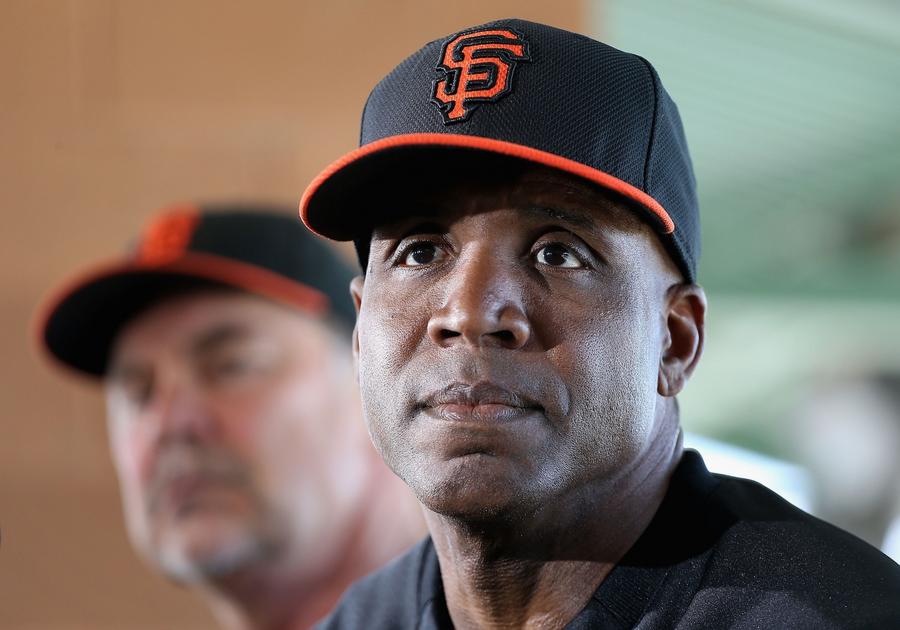
(Photo by Christian Petersen/Getty Images)
BALCO Scandal and Controversy
Bonds' career became deeply intertwined with the performance-enhancing drug era in baseball. He was linked to the BALCO scandal, a major investigation into the distribution of banned substances to professional athletes.
Although Bonds was never suspended by MLB, he admitted during testimony that he had used substances given to him by his trainer, whom he claimed had told him they were legal supplements. The controversy fueled widespread debate about the legitimacy of his records and achievements.
The scandal significantly impacted public perception of Bonds and has been a major factor in his failure to be elected to the Baseball Hall of Fame, despite his statistical accomplishments.
Post-Baseball
After retiring from professional baseball, Bonds has been involved in other projects. This includes the reality TV show "Bonds on Bonds" (2006), which aired briefly in April and May before getting canceled in June 2006. He is not a member of the MLB Players Association's licensing agreement because he felt like making his own independent marketing deals would prove to be more lucrative. As a result, he does not appear in some baseball video games and is replaced by generic characters such as "Jon Dowd" in "MVP Baseball 2005".
Personal Life
In August 1987, Bonds met Susann "Sun" Margreth Branco. They eloped to Las Vegas in February 1988, ultimately separated in June 1994, and finalized their divorce in December 1994 before getting their marriage annulled by the Catholic Church in 1997. Together, they share two children, Nikolai and Shikari. He was in a relationship with Kimberly Bell from 1994 to May 2003. However, in January 1998, he married his second wife, Liz Watson. His marriage to Watson lasted until February 2010, and they have one child together, Aisha.
Real Estate
In 2000, Barry paid $5.3 million for an incredible newly-built mansion on nearly 2 acres located in a gated community called Beverly Park high up in the hills of Beverly Hills. Barry sold the home in 2014 for a mouth-watering $22 million to a Russian billionaire. The billionaire tried to flip the house a year later for $36 million, ultimately accepting $26 million in 2016. In 2019, the home was sold again, this time for $23 million. In June 2020, actress Sofia Vergara paid $26 million for the property.
/2010/01/Barry-Bonds.jpg)
/2010/11/hank.jpg)
/2010/08/Sammy-Sosa.jpg)
/2022/09/aaron-judge.jpg)
/2025/05/GettyImages-2208048759.jpg)
/2010/02/Albert-Pujols.jpg)
/2010/05/Ichiro-Suzuki.jpg)
/2012/10/GettyImages-154686392.jpg)
/2020/01/lopez3.jpg)
/2018/03/GettyImages-821622848.jpg)